







Question: QUESTION 1 Modulating binary data onto a sinusoidal carrier wave is similar to analog modulation in that: QUESTION 4 IfM-8, then the number of bits
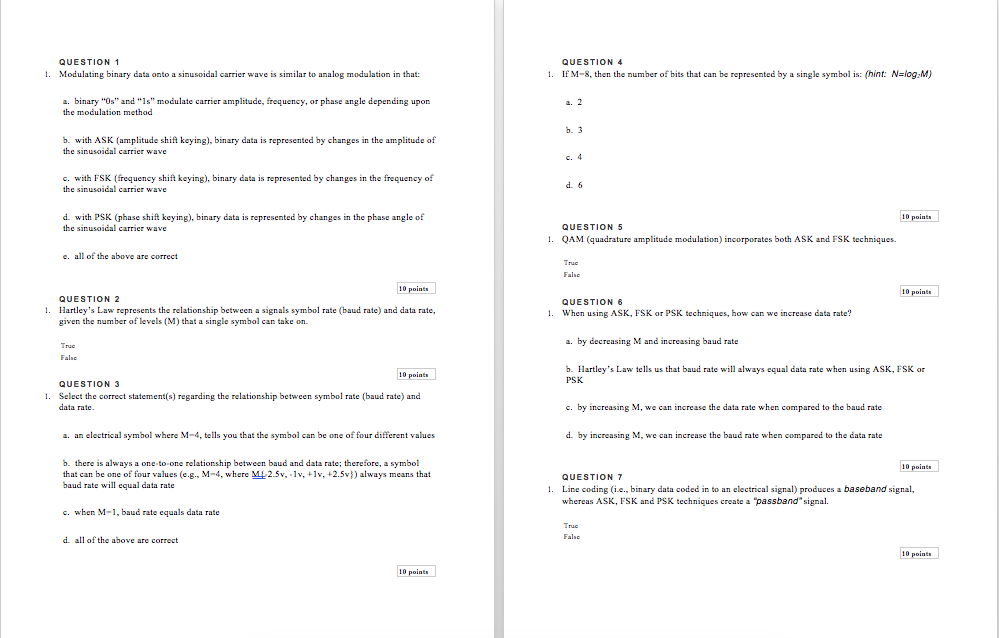
QUESTION 1 Modulating binary data onto a sinusoidal carrier wave is similar to analog modulation in that: QUESTION 4 IfM-8, then the number of bits that can be represented by a single symbol is: (hint: N log:M) 1. 1. a. binary "Os"and "s" modulate carrier amplitude, frequency, or phase angle depending upon he modulation method b. with ASK (amplitude shift keying), binary data is represented by changes in the amplitude of the siusoidal carrier wave c. with FSK (frequency shift keying), binary data is represented by changes in the frequency of the siusoidal carrier wave d. with PSK (phase shift keying), binary data is represented by changes in the phase angle of the siusoidal carrier wave 10 points QUESTION 5 QAM (quadrature amplitude modulation) incorporates both ASK and FSK techniques. 1. e. all of the above are correct Truc 10 points 10 points QUESTION 2 Hartley's Law represents the relationship between a signals symbol rate (baud rate) and data rate, given the number of levels (M) that a single symbol can take on. QUESTION 6 When using ASK, FSK or PSK techniques, how can we increase data rate? 1. 1. Truc a by decreasing M and increasing baud rate b. Hartley's Law tells us that baud rate will always equal data rate when using ASK, FSK or PSK 10 points QUESTION 3 1. Select the correct statement(s) regarding the relationship between symbol rate (baud rate) and data rate. c. by increasing M, we can increase the data rate when compared to the baud rate a. an electrical symbol where M-4, tells you that the symbol can be one of four different values d by increasing M, we can increase the baud rate when compared to the data rate b. there is always a one-to one relationship between baud and data rate; therefore, a symbol that can be one of four values (eg., M-4, where2.5v, .lv, +1 v, +2.5v) always means that baud rate wl equal data rate 10 points QUESTION 7 Line coding (i.e., binary data coded in to an electrical signal) produces a baseband signal, whereas ASK, FSK and PSK techniques create a "passband"signal. I. c. when M, baud rate equals data rate Truc d. all of the above are correct 10 points 10 points
Step by Step Solution
There are 3 Steps involved in it

Get step-by-step solutions from verified subject matter experts
 Study Help