







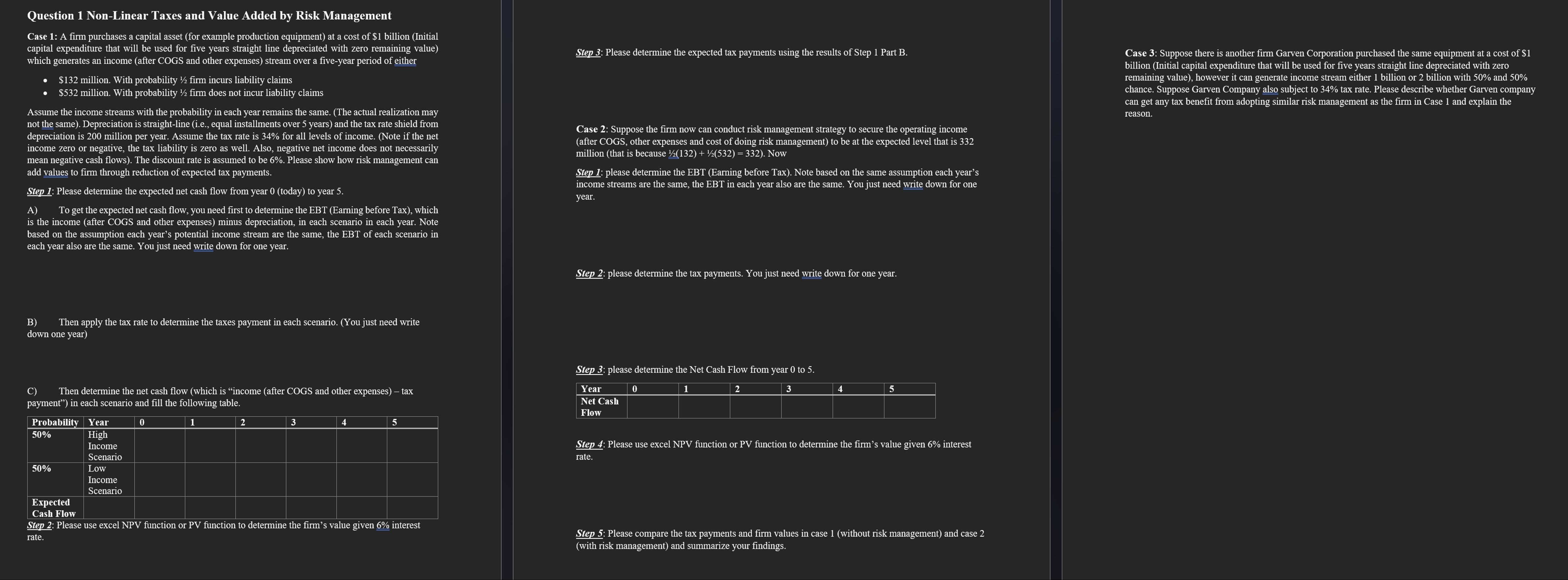
Question: Question 1 Non - Linear Taxes and Value Added by Risk Management Case 1 : A firm purchases a capital asset ( for example production
Question NonLinear Taxes and Value Added by Risk Management
Case : A firm purchases a capital asset for example production equipment at a cost of $ billion Initial
capital expenditure that will be used for five years straight line depreciated with zero remaining value
which generates an income after COGS and other expenses stream over a fiveyear period of either
$ million. With probability firm incurs liability claims
$ million. With probability firm does not incur liability claims
Assume the income streams with the probability in each year remains the same. The actual realization may
not the same Depreciation is straightline ie equal installments over years and the tax rate shield from
depreciation is million per year. Assume the tax rate is for all levels of income. Note if the net
income zero or negative, the tax liability is zero as well. Also, negative net income does not necessarily
mean negative cash flows The discount rate is assumed to be Please show how risk management can
add values to firm through reduction of expected tax payments.
Step : Please determine the expected net cash flow from year today to year
A To get the expected net cash flow, you need first to determine the EBT Earning before Tax which
is the income after COGS and other expenses minus depreciation, in each scenario in each year. Note
based on the assumption each year's potential income stream are the same, the EBT of each scenario in
each year also are the same. You just need write down for one year.
B Then apply the tax rate to determine the taxes payment in each scenario. You just need write
down one year
C Then determine the net cash flow which is "income after COGS and other expenses tax
payment" in each scenario and fill the following table.
Cash Flow
Step : Please use excel NPV function or PV function to determine the firm's value given interest
rate.
Step : Please determine the expected tax payments using the results of Step Part B
Case : Suppose the firm now can conduct risk management strategy to secure the operating income
after COGS, other expenses and cost of doing risk management to be at the expected level that is
Step : please determine the EBT Earning before Tax Note based on the same assumption each year's
income streams are the same, the EBT in each year also are the same. You just need write down for one
year.
Step : please determine the tax payments. You just need write down for one year.
Step : please determine the Net Cash Flow from year to
Step : Please use excel NPV function or PV function to determine the firm's value given interest
rate.
Step : Please compare the tax payments and firm values in case without risk management and case
with risk management and summarize your findings.
Case : Suppose there is another firm Garven Corporation purchased the same equipment at a cost of $
billion Initial capital expenditure that will be used for five years straight line depreciated with zero
remaining value however it can generate income stream either billion or billion with and
chance. Suppose Garven Company also subject to tax rate. Please describe whether Garven company
can get any tax benefit from adopting similar risk management as the firm in Case and explain the
reason.
Step by Step Solution
There are 3 Steps involved in it
1 Expert Approved Answer
Step: 1 Unlock

Question Has Been Solved by an Expert!
Get step-by-step solutions from verified subject matter experts
Step: 2 Unlock
Step: 3 Unlock
 Study Help