





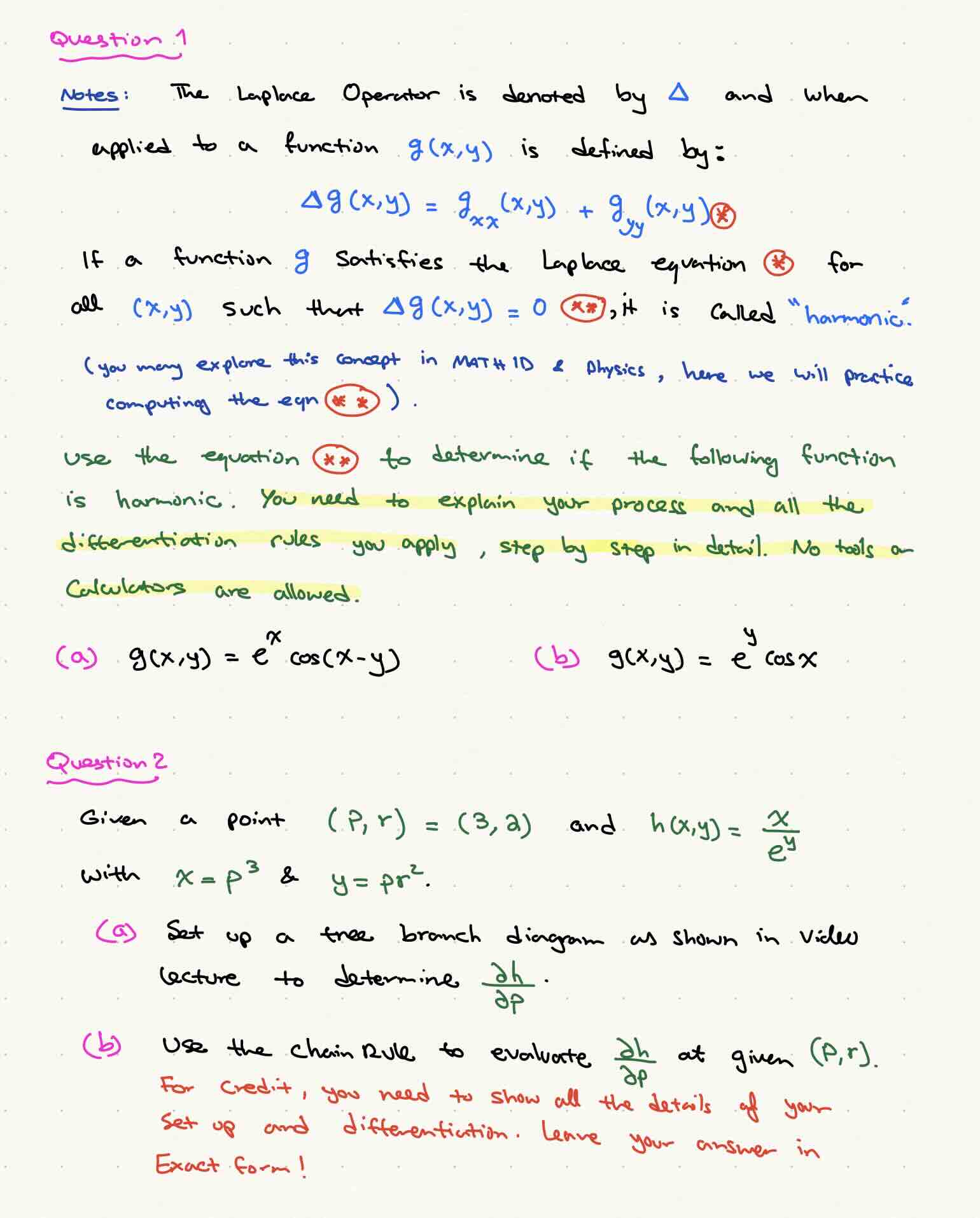
Question: Question 1 Notes : The Laplace Operator is denoted by A and When applied to a function g ( x ,y ) is defined by:
Question 1 Notes : The Laplace Operator is
Question 1 Notes : The Laplace Operator is denoted by A and When applied to a function g ( x ,y ) is defined by: 49 ( x, y) = 9 (x,y) + 9 (x,y )@) If a function Satisfies the Laplace equation @ for all (x,y ) such that 49 ( x ,y) = 0 ( # ) , it is called "harmonic . ( you may explore this concept in MATH ID & physics, here we will practice computing the eyn * * ) . use the equation xx ) to determine if the following function is harmonic : You need to explain your process and all the differentiation rules you apply , step by step in detail . No tools an Calculators are allowed. ( a) g( x ,y ) = e cos ( x - y ) ( b) g ( x,y ) = e cosx Question 2 Given a point ( P, r ) = (3, 2 ) and h( xx,y ) = with x= p3 & y= prz. ( G) Set up a tree branch diagram as shown in video lecture to determine oh. ap (b) Use the chain Rule to evaluate oh at given ( P,r ). For credit , you need to show all the details of your Set up and differentiation . leave your answer in Exact form

Step by Step Solution

There are 3 Steps involved in it

1 Expert Approved Answer
Step: 1 Unlock blur-text-image

Question Has Been Solved by an Expert!

Get step-by-step solutions from verified subject matter experts

Step: 2 Unlock
Step: 3 Unlock

Students Have Also Explored These Related Accounting Questions!