







Question: Question 1 : PARTICLE SIZE DISTRIBUTFONS You take a sample from one of the streams in the crushing circuit and use a series of lab
Question: PARTICLE SIZE DISTRIBUTFONS
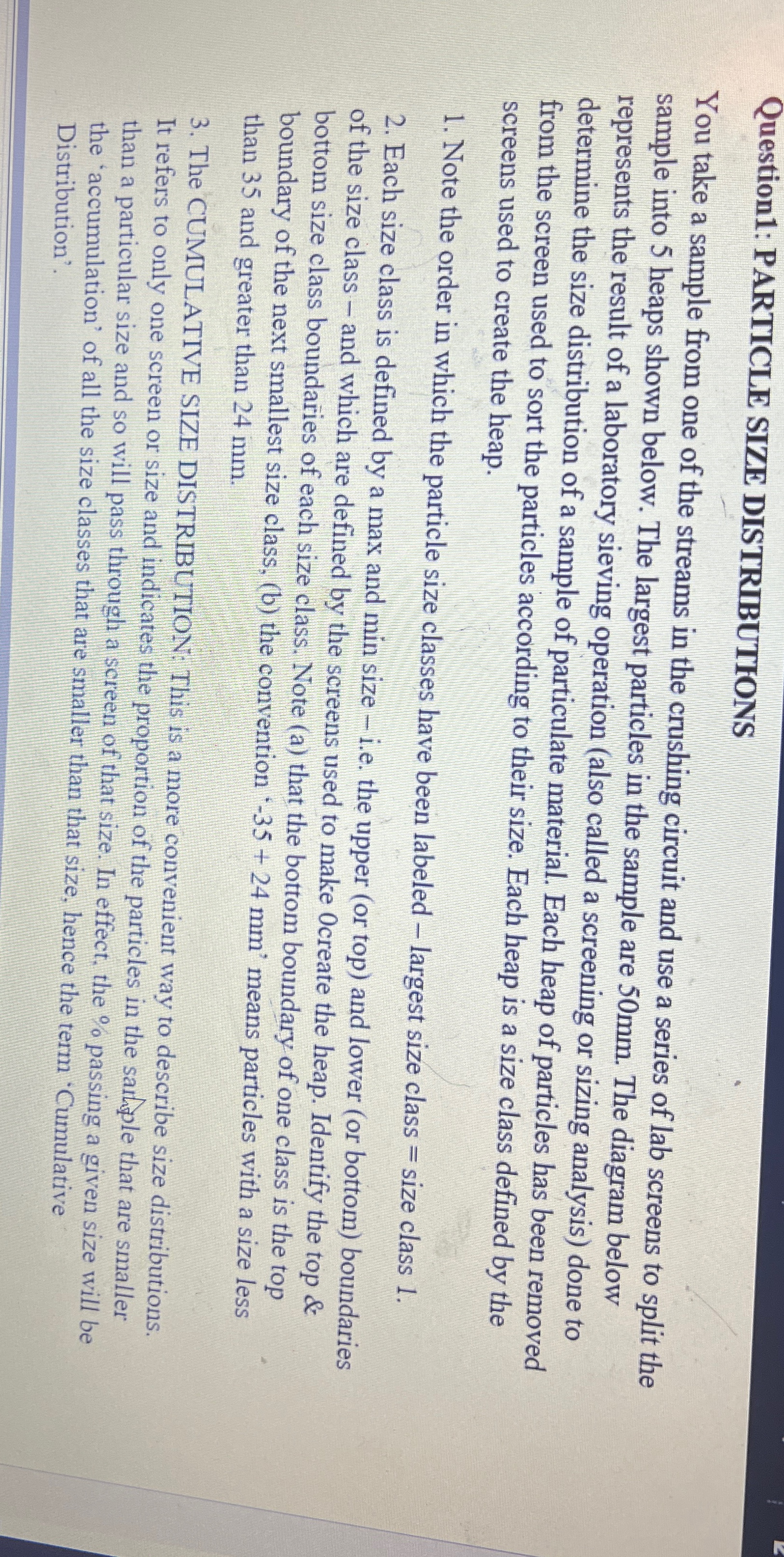
You take a sample from one of the streams in the crushing circuit and use a series of lab screens to split the sample into heaps shown below. The largest particles in the sample are The diagram below represents the result of a laboratory sieving operation also called a screening or sizing analysis done to determine the size distribution of a sample of particulate material. Each heap of particles has been removed from the screen used to sort the particles according to their size. Each heap is a size class defined by the screens used to create the heap.
Note the order in which the particle size classes have been labeled largest size class size class
Each size class is defined by a max and min size ie the upper or top and lower or bottom boundaries of the size class and which are defined by the screens used to make create the heap. Identify the top & bottom size class boundaries of each size class. Note a that the bottom boundary of one class is the top boundary of the next smallest size class, b the convention means particles with a size less than and greater than
The CUMULATIVE SIZE DISTRIBUIION: This is a more convenient way to describe size distributions. It refers to only one screen or size and indicates the proportion of the particles in the sartaple that are smaller than a particular size and so will pass through a screen of that size. In effect, the passing a given size will be the 'accumulation' of all the size classes that are smaller than that size, hence the term 'Cumulative Distribution'.
Step by Step Solution
There are 3 Steps involved in it
1 Expert Approved Answer
Step: 1 Unlock

Question Has Been Solved by an Expert!
Get step-by-step solutions from verified subject matter experts
Step: 2 Unlock
Step: 3 Unlock
 Study Help