







Question: QUESTION 1 Payoffs for the row player 1 are indicated first in each cell, and payoffs for the column player 2. B 10,16 15, 20
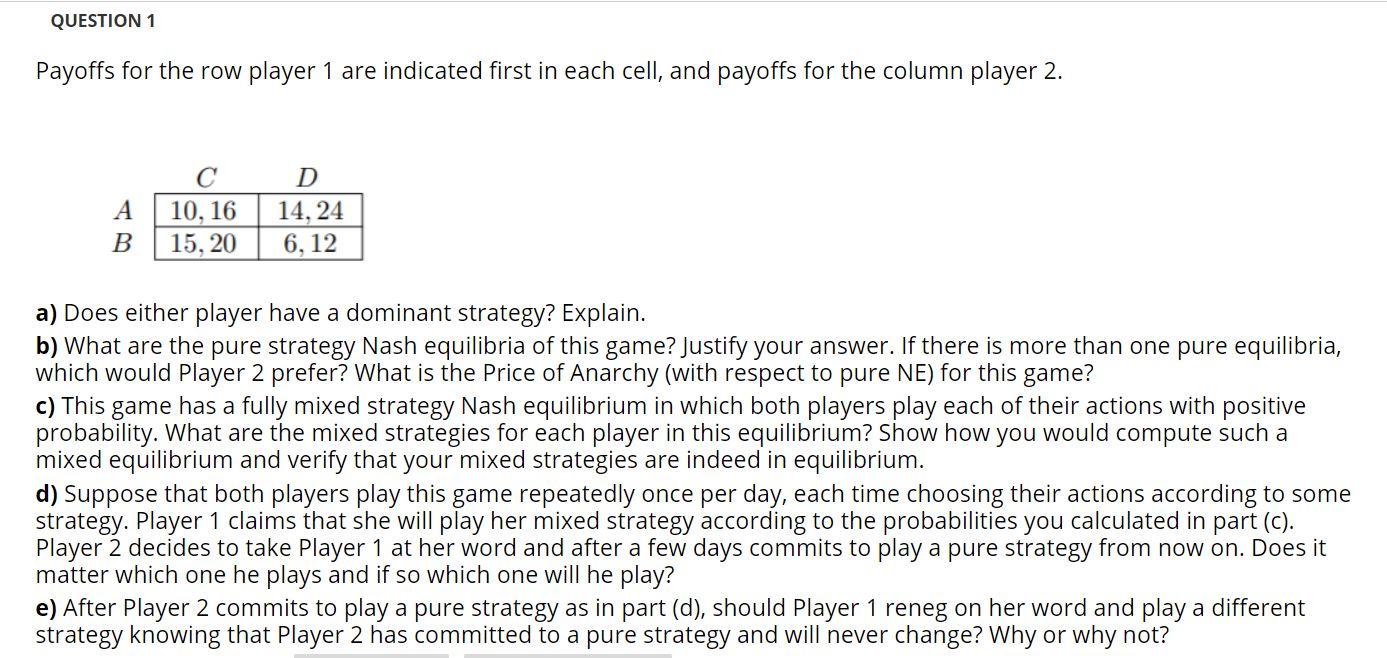
QUESTION 1 Payoffs for the row player 1 are indicated first in each cell, and payoffs for the column player 2. B 10,16 15, 20 D 14, 24 6, 12 a) Does either player have a dominant strategy? Explain. b) What are the pure strategy Nash equilibria of this game? Justify your answer. If there is more than one pure equilibria, which would Player 2 prefer? What is the price of Anarchy (with respect to pure NE) for this game? c) This game has a fully mixed strategy Nash equilibrium in which both players play each of their actions with positive probability. What are the mixed strategies for each player in this equilibrium? Show how you would compute such a mixed equilibrium and verify that your mixed strategies are indeed in equilibrium. d) Suppose that both players play this game repeatedly once per day, each time choosing their actions according to some strategy. Player 1 claims that she will play her mixed strategy according to the probabilities you calculated in part (C). Player 2 decides to take Player 1 at her word and after a few days commits to play a pure strategy from now on. Does it matter which one he plays and if so which one will he play? e) After Player 2 commits to play a pure strategy as in part (d), should Player 1 reneg on her word and play a different strategy knowing that Player 2 has committed to a pure strategy and will never change? Why or why not
Step by Step Solution
There are 3 Steps involved in it

Get step-by-step solutions from verified subject matter experts
 Study Help