







Question: Question 1 prepare a network diagram with precedence relationships Sage Sage Business Cases (C) 2018 This case was prepared for inclusion in SAGE Business Cases
Question 1
prepare a network diagram with precedence relationships
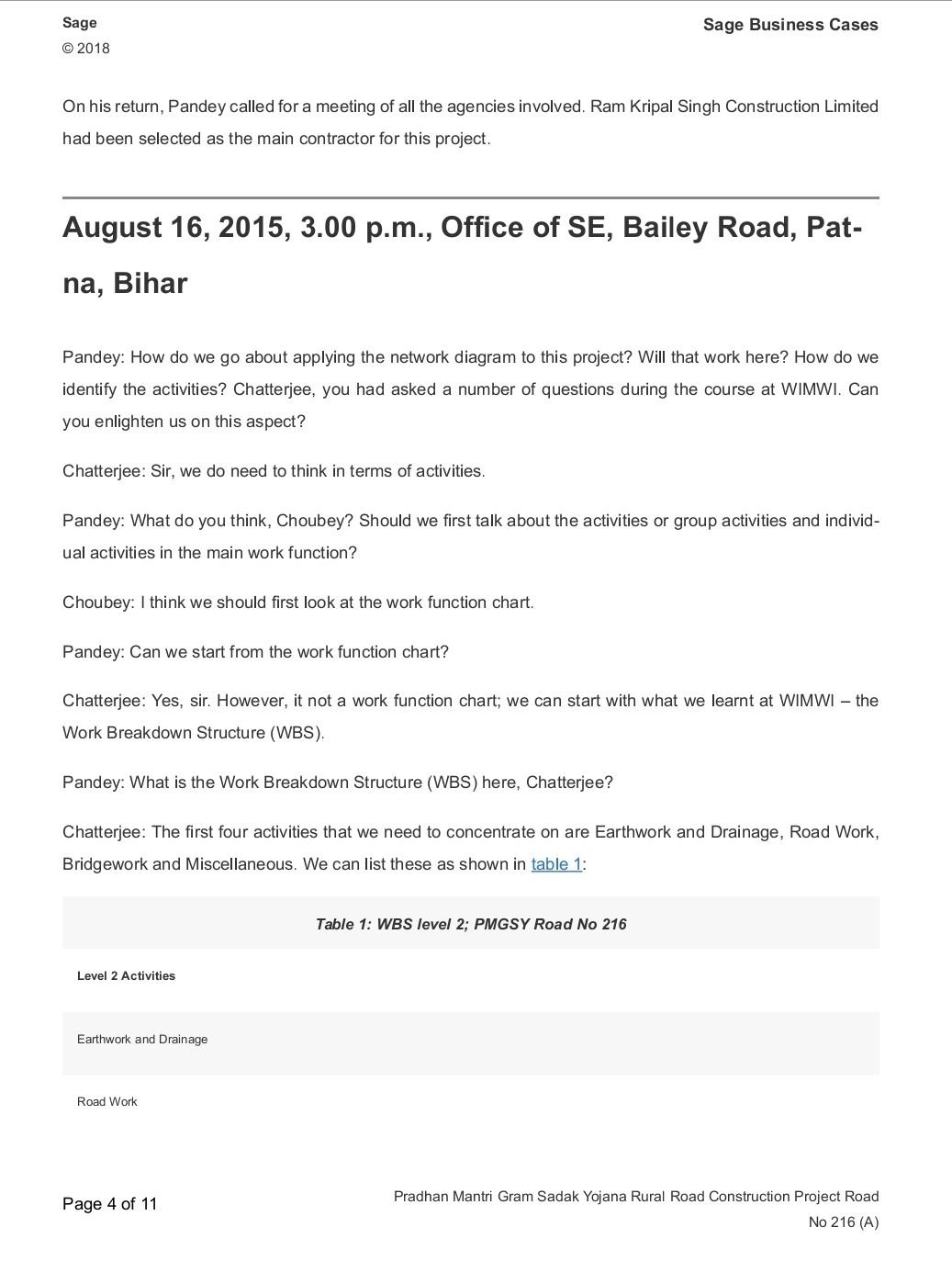
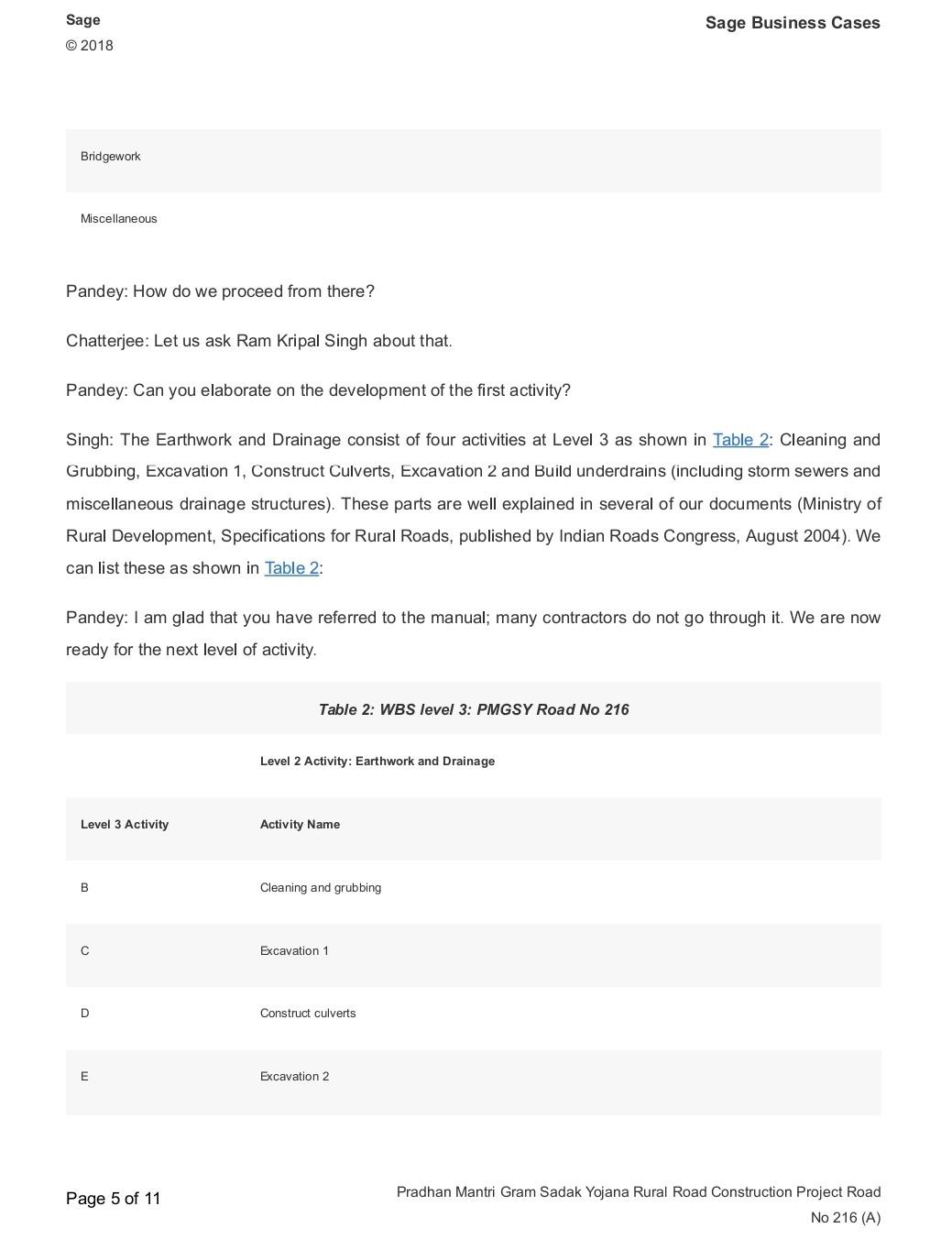
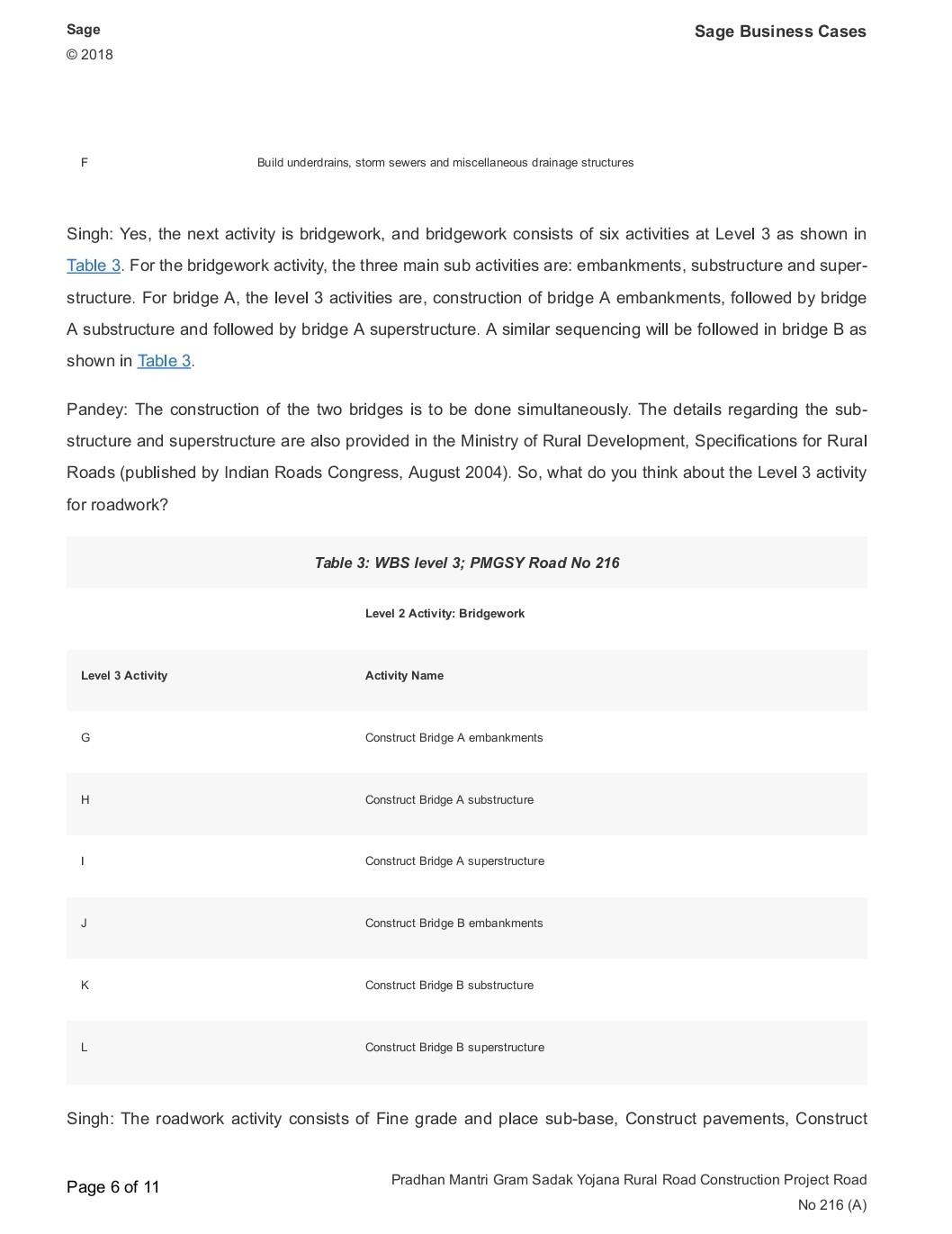
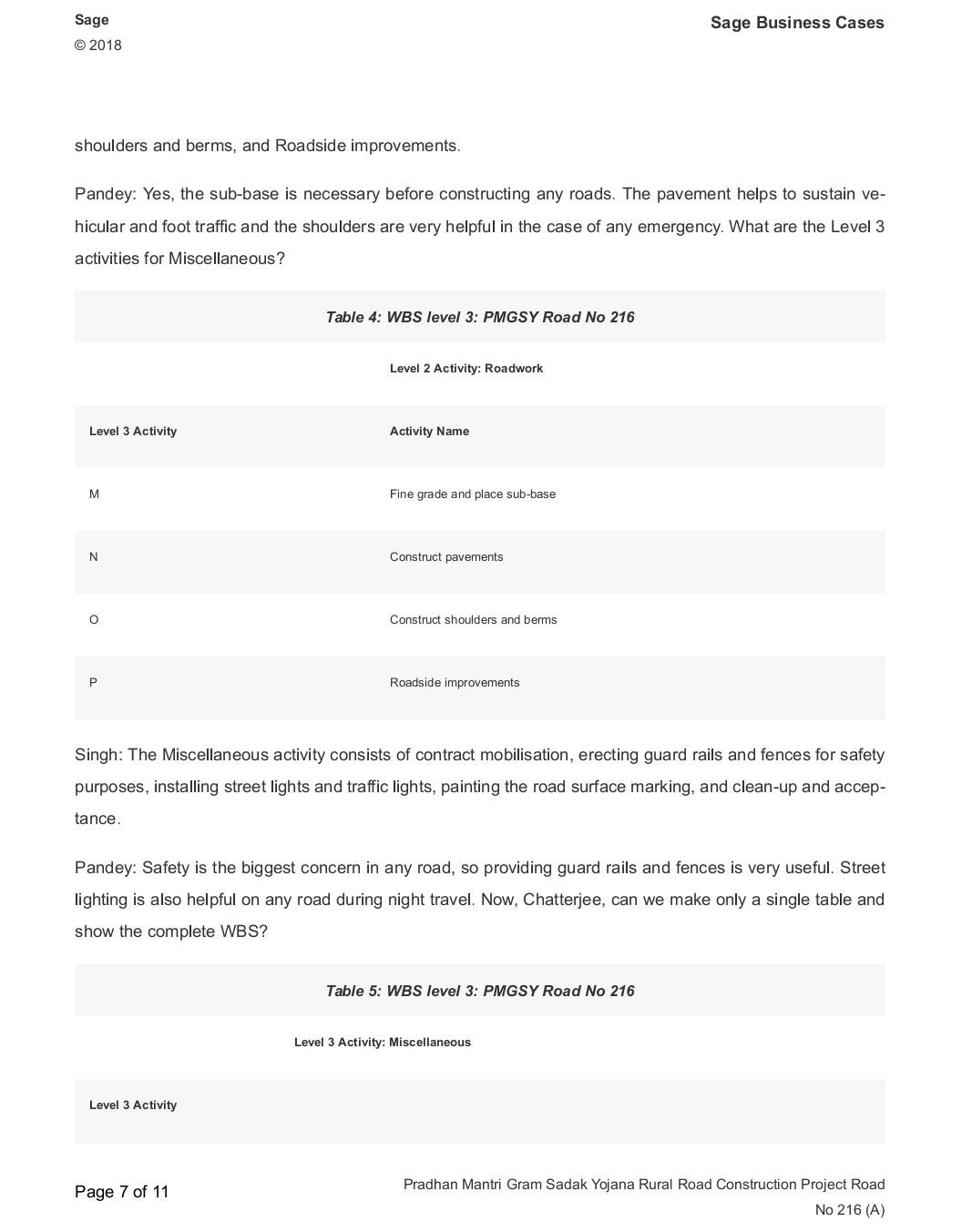
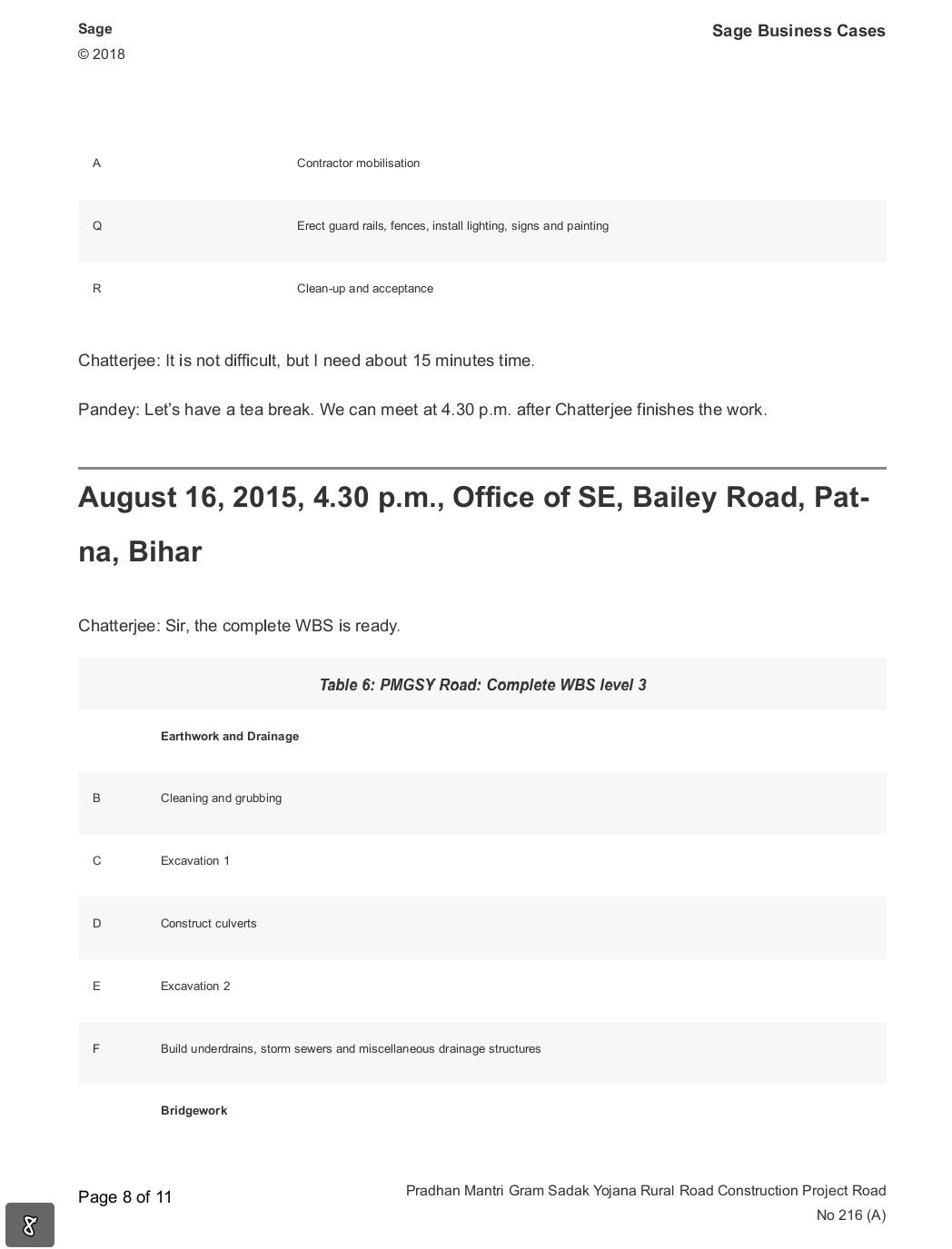
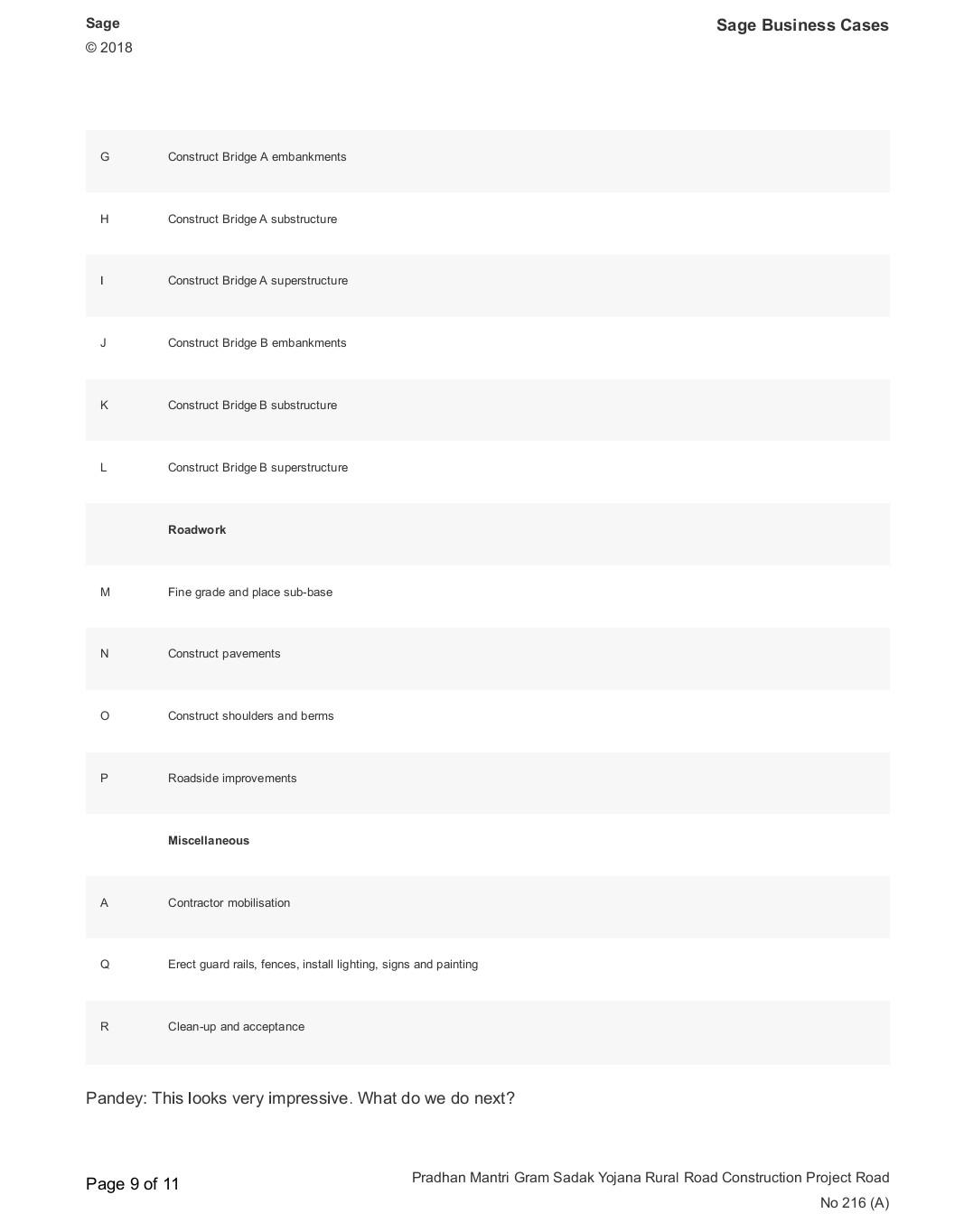
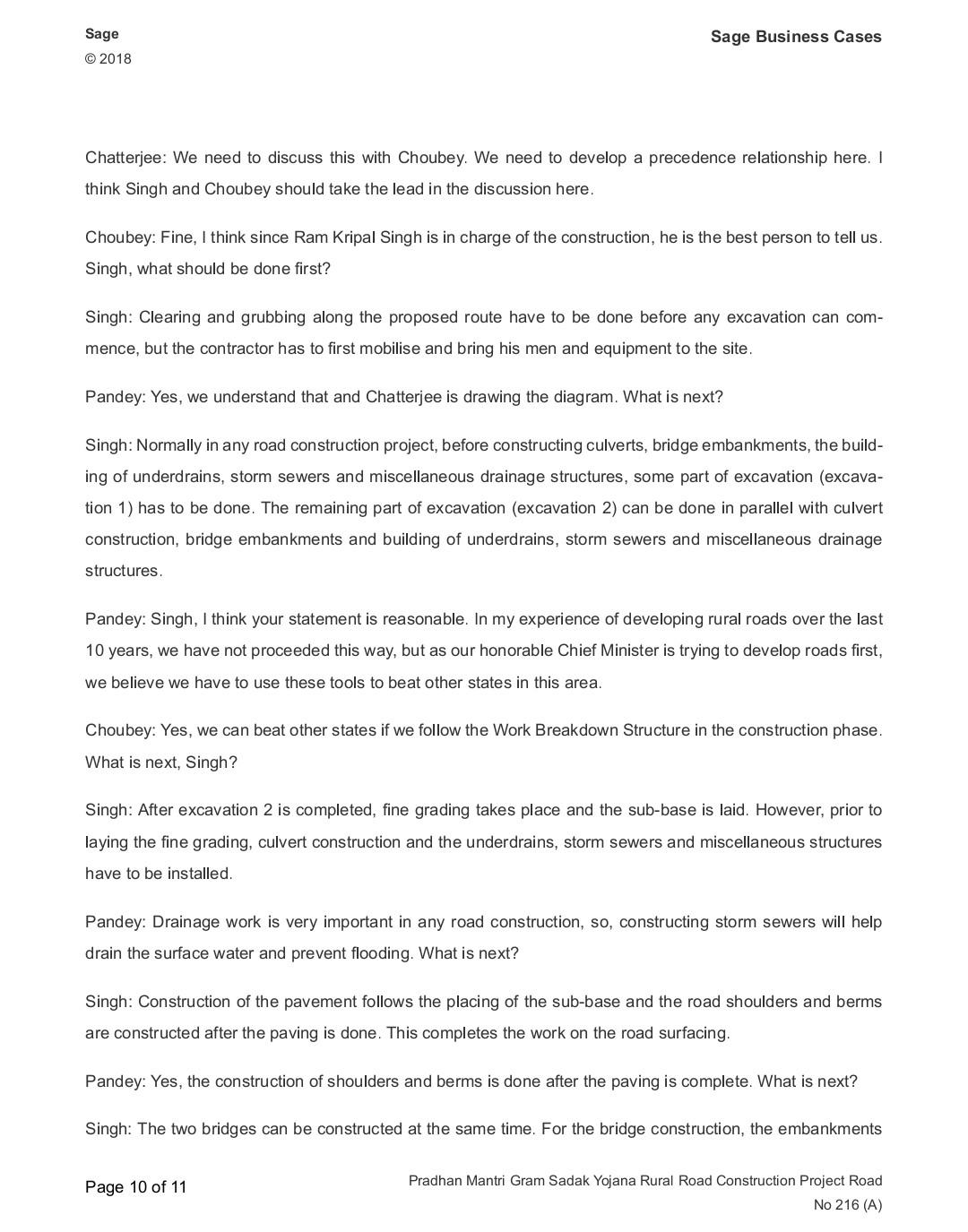
Sage Sage Business Cases (C) 2018 This case was prepared for inclusion in SAGE Business Cases primarily as a basis for classroom discussion or self-study, and is not meant to illustrate either effective or ineffective management styles. Nothing herein shall be deemed to be an endorsement of any kind. This case is for scholarly, educational, or personal use only within your university, and cannot be forwarded outside the university or used for other commercial purposes. The case studies on SAGE Business Cases are designed and optimized for online learning. Please refer to the online version of this case to fully experience any video, data embeds, spreadsheets, slides, or other resources that may be included. This content may only be distributed for use within Uni of the West of England. 2023 Sage Publications, Inc. All Rights Reserved Abstract S.R. Pandey, Superintending Engineer (SE), Rural Roads Department, Patna, Bihar wanted to have a meeting of all the agencies involved, including his other engineers and the contractors, to discuss his village road making project as part of the Pradhan Mantri Gram Sadak Yojana (PMGSY) or Prime Minister's Rural Roads Scheme. This case discusses how the concept of work breakdown is used to subdivide all the activities of road making into different sub activities (earthwork, bridgework, roadwork and other miscellaneous activities) at different levels. The case demonstrates how, with a series of statements in the meetings, the precedence diagram can be created. Case For part B of this case, click here. S.R. Pandey, Superintending Engineer (SE), Rural Roads Department, Patna, Bihar was discussing his next project in the Pradhan Mantri Gram Sadak Yojana with his team. He had just finished work on rural road development, an earlier assignment in PMGSY Bihar, and was not very happy with the way things had progressed. He and two of his Executive Engineers, R.K. Choubey and S.K. Chatterjee, had just attended a course at a Well-known Institute of Management of Western India (WIMWI). Page 3 of 11 Pradhan Mantri Gram Sadak Yojana Rural Road Construction Project Road No 216 (A) Sage Sage Business Cases (c) 2018 On his return, Pandey called for a meeting of all the agencies involved. Ram Kripal Singh Construction Limited had been selected as the main contractor for this project. August 16, 2015, 3.00 p.m., Office of SE, Bailey Road, Patna, Bihar Pandey: How do we go about applying the network diagram to this project? Will that work here? How do we identify the activities? Chatterjee, you had asked a number of questions during the course at WIMWI. Can you enlighten us on this aspect? Chatterjee: Sir, we do need to think in terms of activities. Pandey: What do you think, Choubey? Should we first talk about the activities or group activities and individual activities in the main work function? Choubey: I think we should first look at the work function chart. Pandey: Can we start from the work function chart? Chatterjee: Yes, sir. However, it not a work function chart; we can start with what we learnt at WIMWI - the Work Breakdown Structure (WBS). Pandey: What is the Work Breakdown Structure (WBS) here, Chatterjee? Chatterjee: The first four activities that we need to concentrate on are Earthwork and Drainage, Road Work, Bridgework and Miscellaneous. We can list these as shown in table 1: Sage Sage Business Cases (C) 2018 Bridgework Miscellaneous Pandey: How do we proceed from there? Chatterjee: Let us ask Ram Kripal Singh about that. Pandey: Can you elaborate on the development of the first activity? Singh: The Earthwork and Drainage consist of four activities at Level 3 as shown in Table 2: Cleaning and Grubbing, Excavation 1, Construct Culverts, Excavation 2 and Build underdrains (including storm sewers and miscellaneous drainage structures). These parts are well explained in several of our documents (Ministry of Rural Development, Specifications for Rural Roads, published by Indian Roads Congress, August 2004). We can list these as shown in Table 2: Pandey: I am glad that you have referred to the manual; many contractors do not go through it. We are now ready for the next level of activity. Table 2: WBS level 3: PMGSY Road No 216 Level 2 Activity: Earthwork and Drainage Level 3 Activity B C D Activity Name Cleaning and grubbing Excavation 1 Construct culverts Page 5 of 11 Pradhan Mantri Gram Sadak Yojana Rural Road Construction Project Road No 216 (A) Sage Sage Business Cases (C) 2018 Build underdrains, storm sewers and miscellaneous drainage structures Singh: Yes, the next activity is bridgework, and bridgework consists of six activities at Level 3 as shown in Table 3 . For the bridgework activity, the three main sub activities are: embankments, substructure and superstructure. For bridge A, the level 3 activities are, construction of bridge A embankments, followed by bridge A substructure and followed by bridge A superstructure. A similar sequencing will be followed in bridge B as shown in Table 3. Pandey: The construction of the two bridges is to be done simultaneously. The details regarding the substructure and superstructure are also provided in the Ministry of Rural Development, Specifications for Rural Roads (published by Indian Roads Congress, August 2004). So, what do you think about the Level 3 activity for roadwork? Table 3: WBS level 3; PMGSY Road No 216 Level 2 Activity: Bridgework Level 3 Activity Activity Name G Construct Bridge A embankments H Construct Bridge A substructure Construct Bridge A superstructure J Construct Bridge B embankments K Construct Bridge B substructure L Construct Bridge B superstructure Singh: The roadwork activity consists of Fine grade and place sub-base, Construct pavements, Construct Page 6 of 11 Pradhan Mantri Gram Sadak Yojana Rural Road Construction Project Road No 216(A) (C) 2018 shoulders and berms, and Roadside improvements. Pandey: Yes, the sub-base is necessary before constructing any roads. The pavement helps to sustain vehicular and foot traffic and the shoulders are very helpful in the case of any emergency. What are the Level 3 activities for Miscellaneous? Table 4: WBS level 3: PMGSY Road No 216 Level 2 Activity: Roadwork Level 3 Activity Activity Name M Fine grade and place sub-base N Construct pavements O Construct shoulders and berms P Roadside improvements Singh: The Miscellaneous activity consists of contract mobilisation, erecting guard rails and fences for safety purposes, installing street lights and traffic lights, painting the road surface marking, and clean-up and acceptance. Pandey: Safety is the biggest concern in any road, so providing guard rails and fences is very useful. Street lighting is also helpful on any road during night travel. Now, Chatterjee, can we make only a single table and show the complete WBS? Table 5: WBS level 3: PMGSY Road No 216 Level 3 Activity: Miscellaneous Page 7 of 11 Pradhan Mantri Gram Sadak Yojana Rural Road Construction Project Road No 216 (A) Chatterjee: It is not difficult, but I need about 15 minutes time. Pandey: Let's have a tea break. We can meet at 4.30 p.m. after Chatterjee finishes the work. August 16, 2015, 4.30 p.m., Office of SE, Bailey Road, Patna, Bihar Chatterjee: Sir, the complete WBS is ready. Table 6: PMGSY Road: Complete WBS level 3 Earthwork and Drainage B Cleaning and grubbing C Excavation 1 D Construct culverts E Excavation 2 F Build underdrains, storm sewers and miscellaneous drainage structures Bridgework Page 8 of 11 Pradhan Mantri Gram Sadak Yojana Rural Road Construction Project Road No 216(A) Pandey: This looks very impressive. What do we do next? Sage Sage Business Cases (C) 2018 Chatterjee: We need to discuss this with Choubey. We need to develop a precedence relationship here. I think Singh and Choubey should take the lead in the discussion here. Choubey: Fine, I think since Ram Kripal Singh is in charge of the construction, he is the best person to tell us. Singh, what should be done first? Singh: Clearing and grubbing along the proposed route have to be done before any excavation can commence, but the contractor has to first mobilise and bring his men and equipment to the site. Pandey: Yes, we understand that and Chatterjee is drawing the diagram. What is next? Singh: Normally in any road construction project, before constructing culverts, bridge embankments, the building of underdrains, storm sewers and miscellaneous drainage structures, some part of excavation (excavation 1) has to be done. The remaining part of excavation (excavation 2) can be done in parallel with culvert construction, bridge embankments and building of underdrains, storm sewers and miscellaneous drainage structures. Pandey: Singh, I think your statement is reasonable. In my experience of developing rural roads over the last 10 years, we have not proceeded this way, but as our honorable Chief Minister is trying to develop roads first, we believe we have to use these tools to beat other states in this area. Choubey: Yes, we can beat other states if we follow the Work Breakdown Structure in the construction phase. What is next, Singh? Singh: After excavation 2 is completed, fine grading takes place and the sub-base is laid. However, prior to laying the fine grading, culvert construction and the underdrains, storm sewers and miscellaneous structures have to be installed. Pandey: Drainage work is very important in any road construction, so, constructing storm sewers will help drain the surface water and prevent flooding. What is next? Singh: Construction of the pavement follows the placing of the sub-base and the road shoulders and berms are constructed after the paving is done. This completes the work on the road surfacing. Pandey: Yes, the construction of shoulders and berms is done after the paving is complete. What is next? Singh: The two bridges can be constructed at the same time. For the bridge construction, the embankments Page 10 of 11 Pradhan Mantri Gram Sadak Yojana Rural Road Construction Project Road No 216 (A) are constructed first. This is followed by the construction of the substructures and then the superstructures. Pandey: For any bridge construction, it is necessary to construct the embankments before the substructure and the superstructure. The substructure provides support and the superstructure is the upward extension of an existing surface above a baseline. What is the next predecessor activity? Singh: After the road surfacing and construction of the two bridges is completed, the guard rails and fences are erected and the installation of street lights and traffic signs takes place, as also the painting of road surface markings. Pandey: Yes, the guard rails and fences ensure safety and the road markings help to guide and control traffic. What is next? Singh: Roadside improvement work involving slope trimming, sodding and seeding cannot commence until the road surfacing is completed. Pandey: For longer use of any road surface, roadside improvements are a must. What is next? Singh: The contractor has to clean up the site for acceptance by the PMGSY Department after all the construction work has ended. Pandey: I think Chatterjee is drawing the network diagram. What is next? Singh: Once the road is ready, it is handed over to the public. However, the work of the contractor is not over. The road will require annual maintenance and this needs further work. As per MORD guidelines, for any PMGSY road project, routine maintenance of work for five years is given to the contractor. Points for Case Discussion 1. Prepare a network diagram with precedence relationships
Step by Step Solution
There are 3 Steps involved in it

Get step-by-step solutions from verified subject matter experts
 Study Help