



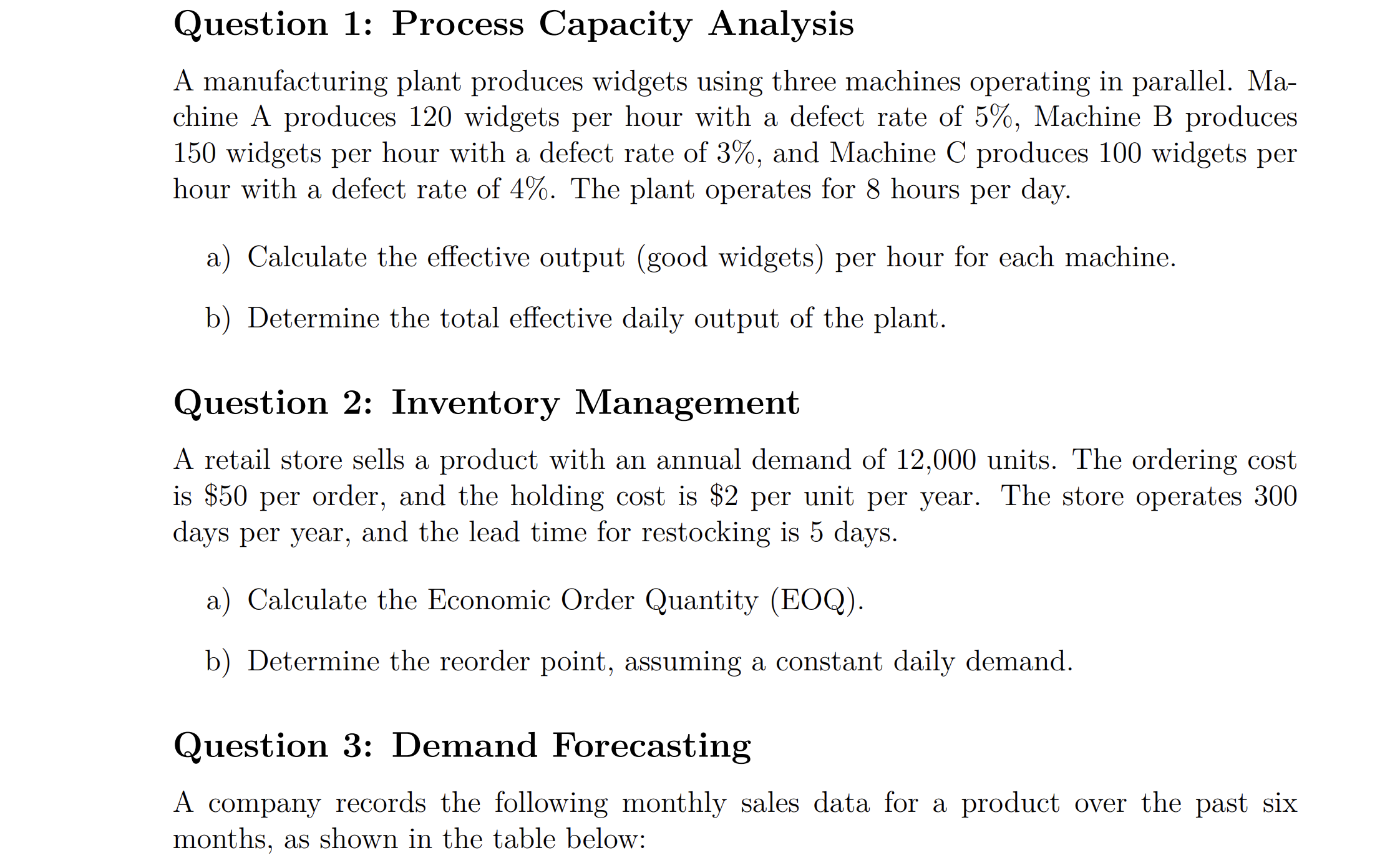
Question: Question 1 : Process Capacity Analysis A manufacturing plant produces widgets using three machines operating in parallel. Machine A produces 1 2 0 widgets per
Question : Process Capacity Analysis
A manufacturing plant produces widgets using three machines operating in parallel. Machine A produces widgets per hour with a defect rate of Machine B produces widgets per hour with a defect rate of and Machine C produces widgets per hour with a defect rate of The plant operates for hours per day.
aCalculate the effective output good widgetsper hour for each machine.
bDetermine the total effective daily output of the plant.
Question : Inventory Management
A retail store sells a product with an annual demand of units The ordering cost is $ per order, and the holding cost is $ per unit per year. The store operates days per year, and the lead time for restocking is days
aCalculate the Economic Order Quantity EOQ
bDetermine the reorder point, assuming a constant daily demand.
Question : Demand Forecasting
A company records the following monthly sales data for a product over the past six months, as shown in the table below:
Question : Demand Forecasting
A company records the following monthly sales data for a product over the past six
months, as shown in the table below:
Table : Monthly Sales Data
a Using a month moving average, forecast the demand for the next month month
b Using exponential smoothing with a smoothing constant of and assuming the
forecast for month was units, calculate the forecast for month
Question : Production Scheduling
A factory produces two products, X and Y on a single machine. The machine requires a
setup time of hours when switching from X to Y and hours when switching from Y
to X Product X takes hours per unit to produce, and Product Y takes hours per
unit. The factory needs to produce units of X and units of Y in a week, and the
machine is available for hours.
a Calculate the total production time required for both products excluding setup
times
b Determine the minimum number of setups required and the total time production
setup to meet the demand. Assume the factory can choose the production
sequence.
Question : Process Flowchart
Based on the production process described in Question draw a flowchart to illustrate the
sequence of steps for producing Products X and Y Include the following steps: receiving
raw materials, setting up the machine, producing Product X producing Product Y
inspecting finished products, and packaging. Clearly indicate decision points for switching
between products and any looping structures for repeated production.
Step by Step Solution
There are 3 Steps involved in it
1 Expert Approved Answer
Step: 1 Unlock

Question Has Been Solved by an Expert!
Get step-by-step solutions from verified subject matter experts
Step: 2 Unlock
Step: 3 Unlock