







Question: Question 1 QUESTION 1 Questions 1-4 are based on the following scenario: 700 income-earning individuals from a district were randomly selected and asked whether they
Question 1
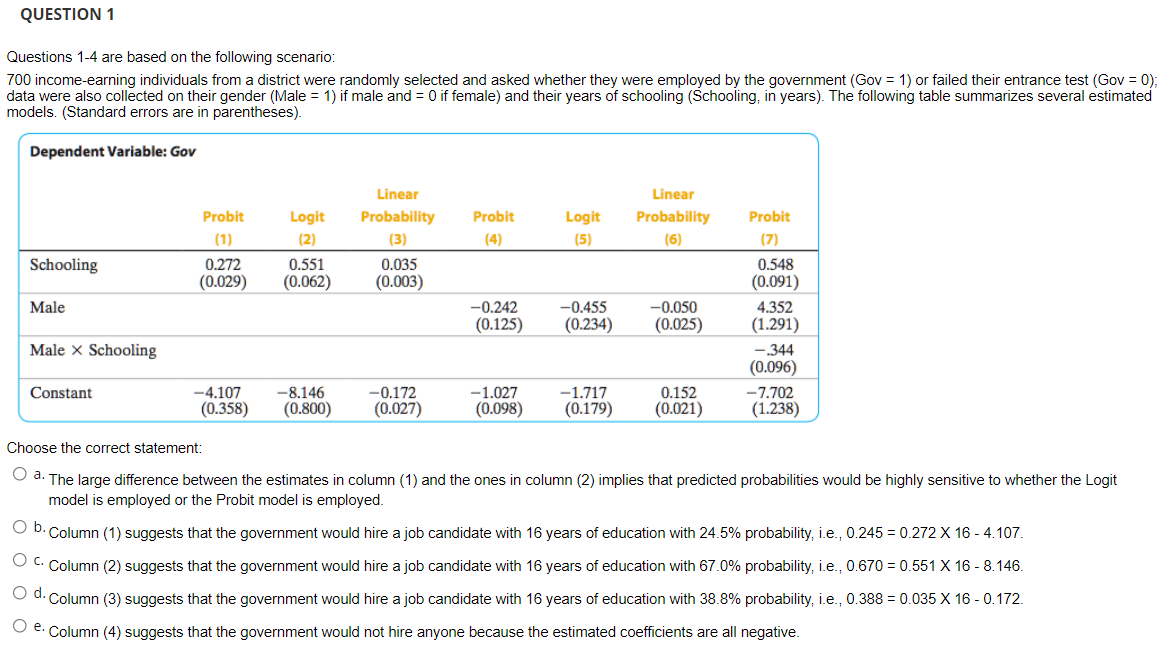
QUESTION 1 Questions 1-4 are based on the following scenario: 700 income-earning individuals from a district were randomly selected and asked whether they were employed by the government (Gov = 1) or failed their entrance test (Gov = 0); data were also collected on their gender (Male = 1) if male and = 0 if female) and their years of schooling (Schooling, in years). The following table summarizes several estimated models. (Standard errors are in parentheses). Dependent Variable: Gov Linear Linear Probit Logit Probability Probit Logit Probability Probit (1) (2) (3) (4) (5) (6) (7) Schooling 0.272 0.551 0.035 0.548 (0.029) (0.062) (0.003) (0.091) Male -0.242 -0.455 -0.050 4.352 (0.125) (0.234) (0.025) (1.291) Male X Schooling -.344 (0.096) Constant -4.107 -8.146 -0.172 -1.027 -1.717 0.152 -7.702 (0.358) (0.800) (0.027) (0.098) (0.179) (0.021) (1.238) Choose the correct statement: 3. The large difference between the estimates in column (1) and the ones in column (2) implies that predicted probabilities would be highly sensitive to whether the Logit model is employed or the Probit model is employed b. Column (1) suggests that the government would hire a job candidate with 16 years of education with 24.5% probability, i.e., 0.245 = 0.272 X 16 - 4. 107. C. Column (2) suggests that the government would hire a job candidate with 16 years of education with 67.0% probability, i.e., 0.670 = 0.551 X 16 - 8.146. d. Column (3) suggests that the government would hire a job candidate with 16 years of education with 38.8% probability, i.e., 0.388 = 0.035 X 16 - 0.172. O e. Column (4) suggests that the government would not hire anyone because the estimated coefficients are all negative
Step by Step Solution
There are 3 Steps involved in it

Get step-by-step solutions from verified subject matter experts
 Study Help