







Question: Question 1: Question 2: Consider the equation (5xy + 6xy + 4xy) dx + (2x + 3x+y + 3xy) dy = 0. (a) Show
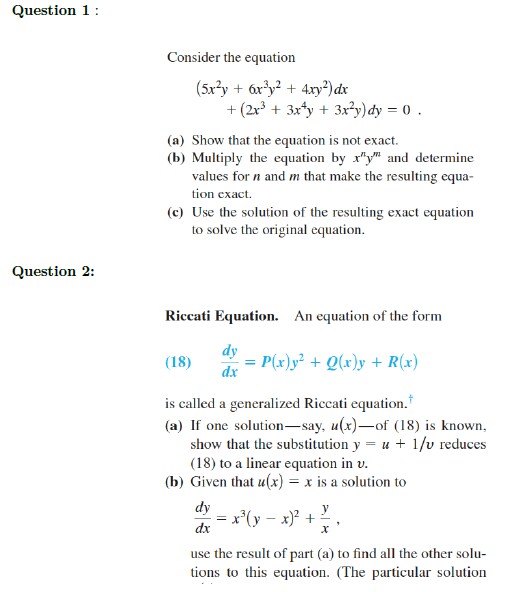
Question 1: Question 2: Consider the equation (5xy + 6xy + 4xy) dx + (2x + 3x+y + 3xy) dy = 0. (a) Show that the equation is not exact. (b) Multiply the equation by x"y" and determine values for n and m that make the resulting equa- tion exact. (c) Use the solution of the resulting exact equation to solve the original equation. (18) Riccati Equation. An equation of the form dy dx = P(x)y + Q(x)y + R(x) is called a generalized Riccati equation.* (a) If one solution-say, u(x)-of (18) is known, show that the substitution y = u + 1/v reduces (18) to a linear equation in v. (b) Given that u(x) = x is a solution to dy = x ( y x) + /2 - dx use the result of part (a) to find all the other solu- tions to this equation. (The particular solution
Step by Step Solution
3.53 Rating (156 Votes )
There are 3 Steps involved in it

Get step-by-step solutions from verified subject matter experts
 Study Help