







Question: question #1 & question #2 please Suppose you purchase a 30 -year, zero-coupon bond with a yield to maturity of 6.2%. You hold the bond
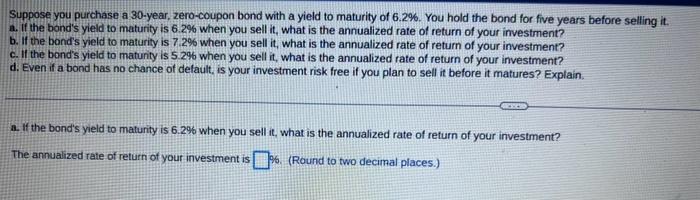
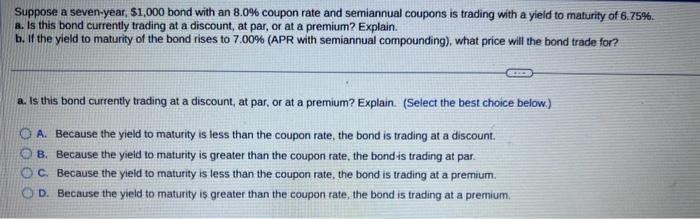
Suppose you purchase a 30 -year, zero-coupon bond with a yield to maturity of 6.2%. You hold the bond for five years before selling it. a. if the bond's yleld to maturity is 6.2% when you sell it, what is the annualized rate of return of your investment? b. If the bond's yield to maturity is 7.2% when you sell it, what is the annualized rate of return of your investment? c. If the bond's yield to maturity is 5.2% when you sell it, what is the annualized rate of return of your investment? d. Even if a bond has no chance of default, is your investment risk free if you plan to sell it before it matures? Explain. a. If the bond's yield to maturity is 6.2% when you sell it, what is the annualized rate of return of your investment? The annualized rate of return of your investment is \%. (Round to two decimal places.) Suppose a seven-year, $1,000 bond with an 8.0% coupon rate and semiannual coupons is trading with a yield to maturity of 6.75%. a. Is this bond currently trading at a discount, at par, or at a premium? Explain. b. If the yield to maturity of the bond rises to 7.00% (APR with semiannual compounding), what price will the bond trade for? a. Is this bond currently trading at a discount, at par, or at a premium? Explain. (Select the best choice below.) A. Because the yield to maturity is less than the coupon rate, the bond is trading at a discount. B. Because the yield to maturity is greater than the coupon rate, the bond is trading at par. C. Because the yield to maturity is less than the coupon rate, the bond is trading at a premium. D. Because the yield to maturity is greater than the coupon rate, the bond is trading at a premium
Step by Step Solution
There are 3 Steps involved in it

Get step-by-step solutions from verified subject matter experts
 Study Help