







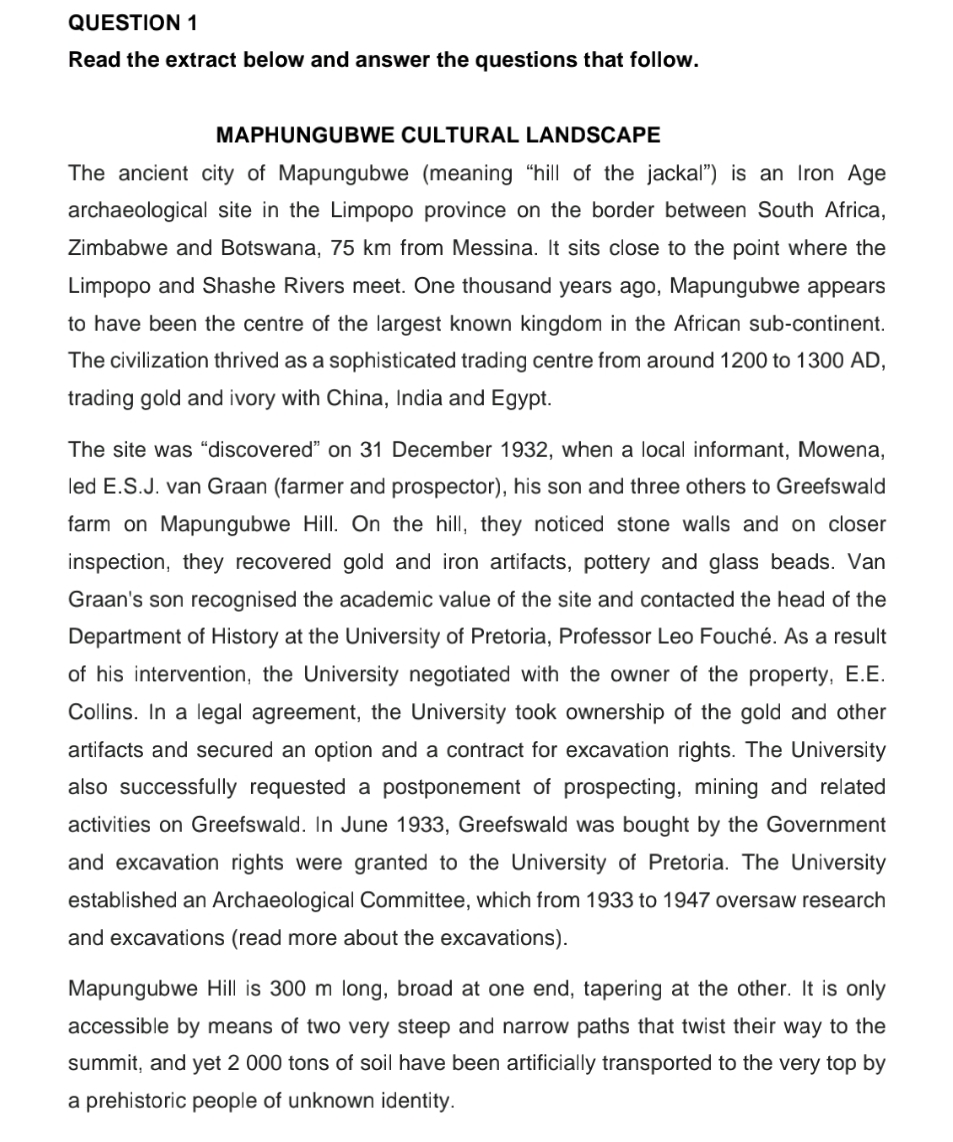
Question: QUESTION 1 Read the extract below and answer the questions that follow. MAPHUNGUBWE CULTURAL LANDSCAPE The ancient city of Mapungubwe ( meaning hill of the
QUESTION
Read the extract below and answer the questions that follow.
MAPHUNGUBWE CULTURAL LANDSCAPE
The ancient city of Mapungubwe meaning "hill of the jackal" is an Iron Age archaeological site in the Limpopo province on the border between South Africa, Zimbabwe and Botswana, km from Messina. It sits close to the point where the Limpopo and Shashe Rivers meet. One thousand years ago, Mapungubwe appears to have been the centre of the largest known kingdom in the African subcontinent. The civilization thrived as a sophisticated trading centre from around to AD trading gold and ivory with China, India and Egypt.
The site was "discovered" on December when a local informant, Mowena, led ESJ van Graan farmer and prospector his son and three others to Greefswald farm on Mapungubwe Hill. On the hill, they noticed stone walls and on closer inspection, they recovered gold and iron artifacts, pottery and glass beads. Van Graan's son recognised the academic value of the site and contacted the head of the Department of History at the University of Pretoria, Professor Leo Fouch As a result of his intervention, the University negotiated with the owner of the property, EE Collins. In a legal agreement, the University took ownership of the gold and other artifacts and secured an option and a contract for excavation rights. The University also successfully requested a postponement of prospecting, mining and related activities on Greefswald. In June Greefswald was bought by the Government and excavation rights were granted to the University of Pretoria. The University established an Archaeological Committee, which from to oversaw research and excavations read more about the excavations
Mapungubwe Hill is m long, broad at one end, tapering at the other. It is only accessible by means of two very steep and narrow paths that twist their way to the summit, and yet tons of soil have been artificially transported to the very top by a prehistoric people of unknown identity.
Step by Step Solution
There are 3 Steps involved in it
1 Expert Approved Answer
Step: 1 Unlock

Question Has Been Solved by an Expert!
Get step-by-step solutions from verified subject matter experts
Step: 2 Unlock
Step: 3 Unlock
 Study Help