







Question: QUESTION 1 : search algorithms - ( 5 % ) QUESTION 1 a - 2 % Consider the following search problem.
QUESTION : search algorithms
QUESTION a
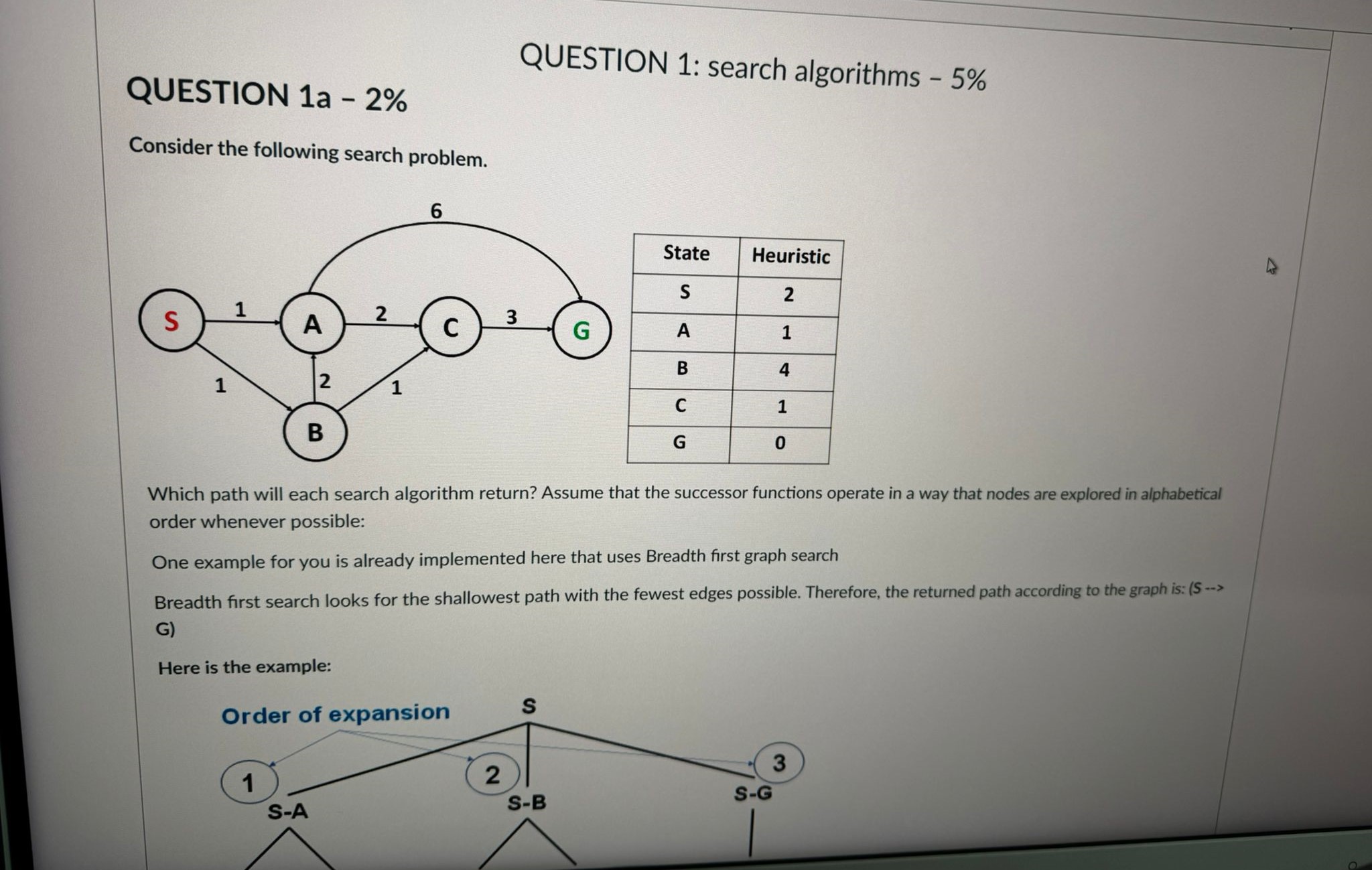
Consider the following search problem.
Which path will each search algorithm return? Assume that the successor functions operate in a way that nodes are explored in alphabetical order whenever possible:
One example for you is already implemented here that uses Breadth first graph search
Breadth first search looks for the shallowest path with the fewest edges possible. Therefore, the returned path according to the graph is: m G
Here is the examole: QUESTION : search algorithms
QUESTION a
Consider the following search problem.
Which path will each search algorithm return? Assume that the successor functions operate in a way that nodes are explored in alphabetical order whenever possible:
One example for you is already implemented here that uses Breadth first graph search
Breadth first search looks for the shallowest path with the fewest edges possible. Therefore, the returned path according to the graph is: m G
Here is the examole: Which path will each search algorithm return? Assume that the successor functions operate in a way that nodes are explored in alphabetical order whenever possible:
One example for you is already implemented here that uses Breadth first graph search
Breadth first search looks for the shallowest path with the fewest edges possible. Therefore, the returned path according to the graph is: mathrmSmathrm G
Here is the example:
Expanded states S A B G Keturnea pain: mathcalO
Uniform cost graph search
Depth first graph search
A graph search
Is the heuristic given in the table above consistent? Yes or No If yes, then write "The heuristic is consistent. If no note down the node for which the heuristic value should be changed. For example, if hA needs to be changed, then write "Change hA QUESTION b
You have the following search tree with the goal state highlighted as node Supposed you are asked to write down the sequences of nodes expanded by BFS and DFS when applied on this search tree. What will be the sequence for?
Breadth first search:
Depth first search:
Iterative deepening from level to as covered in the class QUESTION D
Assume the standard lefttoright tree traversal, cross off at least nodes that will not be evaluated when alphabeta pruning:
Step by Step Solution
There are 3 Steps involved in it
1 Expert Approved Answer
Step: 1 Unlock

Question Has Been Solved by an Expert!
Get step-by-step solutions from verified subject matter experts
Step: 2 Unlock
Step: 3 Unlock
 Study Help