







Question: . Question 1 Suppose that consumer spending initially rises by $5 billion for every 1 percent rise in household wealth and that investment spending initially
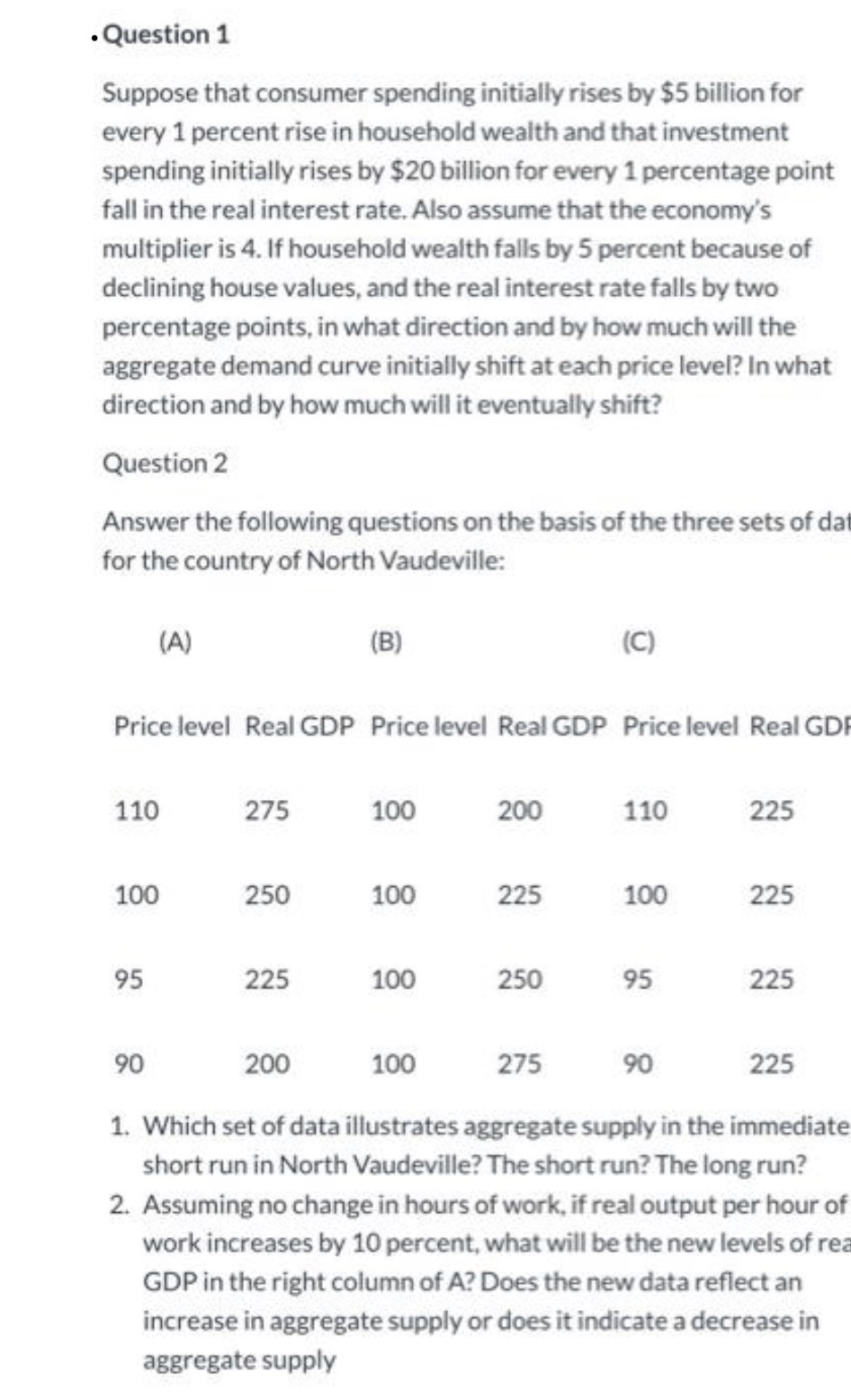
. Question 1 Suppose that consumer spending initially rises by $5 billion for every 1 percent rise in household wealth and that investment spending initially rises by $20 billion for every 1 percentage point fall in the real interest rate. Also assume that the economy's multiplier is 4. If household wealth falls by 5 percent because of declining house values, and the real interest rate falls by two percentage points, in what direction and by how much will the aggregate demand curve initially shift at each price level? In what direction and by how much will it eventually shift? Question 2 Answer the following questions on the basis of the three sets of da for the country of North Vaudeville: (A) (B) (C) Price level Real GDP Price level Real GDP Price level Real GD 110 275 100 200 110 225 100 250 100 225 100 225 95 225 100 250 95 225 90 200 100 275 90 225 1. Which set of data illustrates aggregate supply in the immediate short run in North Vaudeville? The short run? The long run? 2. Assuming no change in hours of work, if real output per hour of work increases by 10 percent, what will be the new levels of rea GDP in the right column of A? Does the new data reflect an increase in aggregate supply or does it indicate a decrease in aggregate supply
Step by Step Solution
There are 3 Steps involved in it

Get step-by-step solutions from verified subject matter experts
 Study Help