







Question: Question 1. This question concerns error-control coding. a. Suppose a convolutional encoder has generator polynomials 91(D) =1 + D2 92(D) =1+D+D2 For each input, the
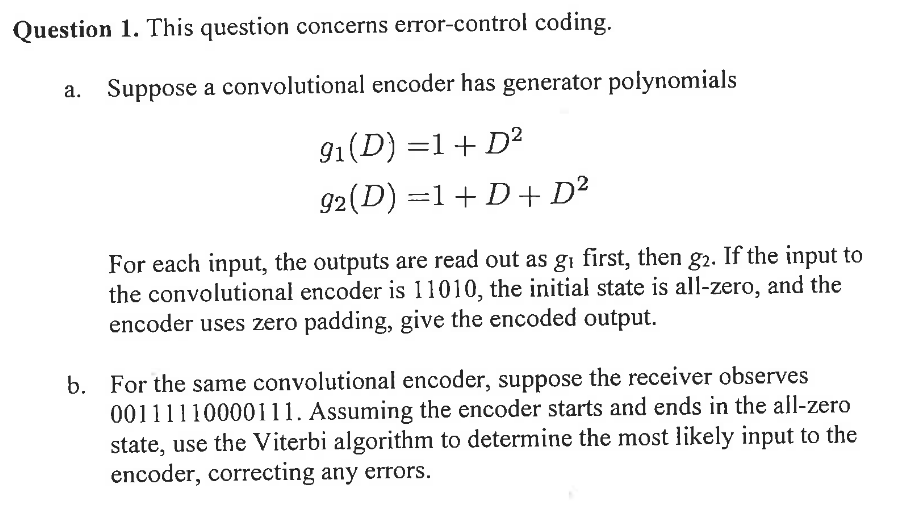
Question 1. This question concerns error-control coding. a. Suppose a convolutional encoder has generator polynomials 91(D) =1 + D2 92(D) =1+D+D2 For each input, the outputs are read out as gi first, then g2. If the input to the convolutional encoder is 11010, the initial state is all-zero, and the encoder uses zero padding, give the encoded output. b. For the same convolutional encoder, suppose the receiver observes 00111110000111. Assuming the encoder starts and ends in the all-zero state, use the Viterbi algorithm to determine the most likely input to the encoder, correcting any errors. Question 1. This question concerns error-control coding. a. Suppose a convolutional encoder has generator polynomials 91(D) =1 + D2 92(D) =1+D+D2 For each input, the outputs are read out as gi first, then g2. If the input to the convolutional encoder is 11010, the initial state is all-zero, and the encoder uses zero padding, give the encoded output. b. For the same convolutional encoder, suppose the receiver observes 00111110000111. Assuming the encoder starts and ends in the all-zero state, use the Viterbi algorithm to determine the most likely input to the encoder, correcting any errors
Step by Step Solution
There are 3 Steps involved in it

Get step-by-step solutions from verified subject matter experts
 Study Help