







Question: Question 1 Use the data table to answer the question that follows. GDP $20 billion Household consumption $12 billion Government tax revenue | $4 billion
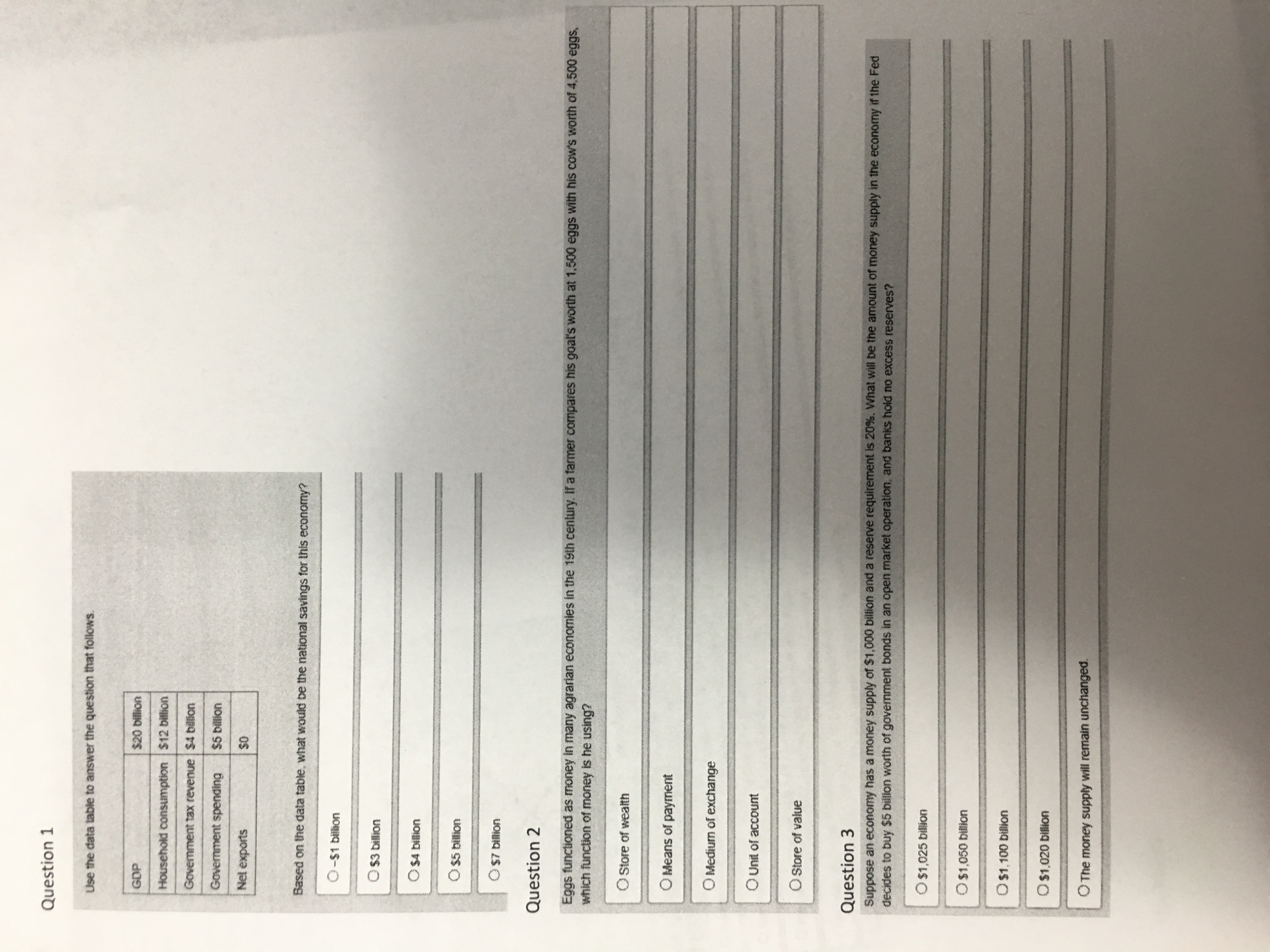
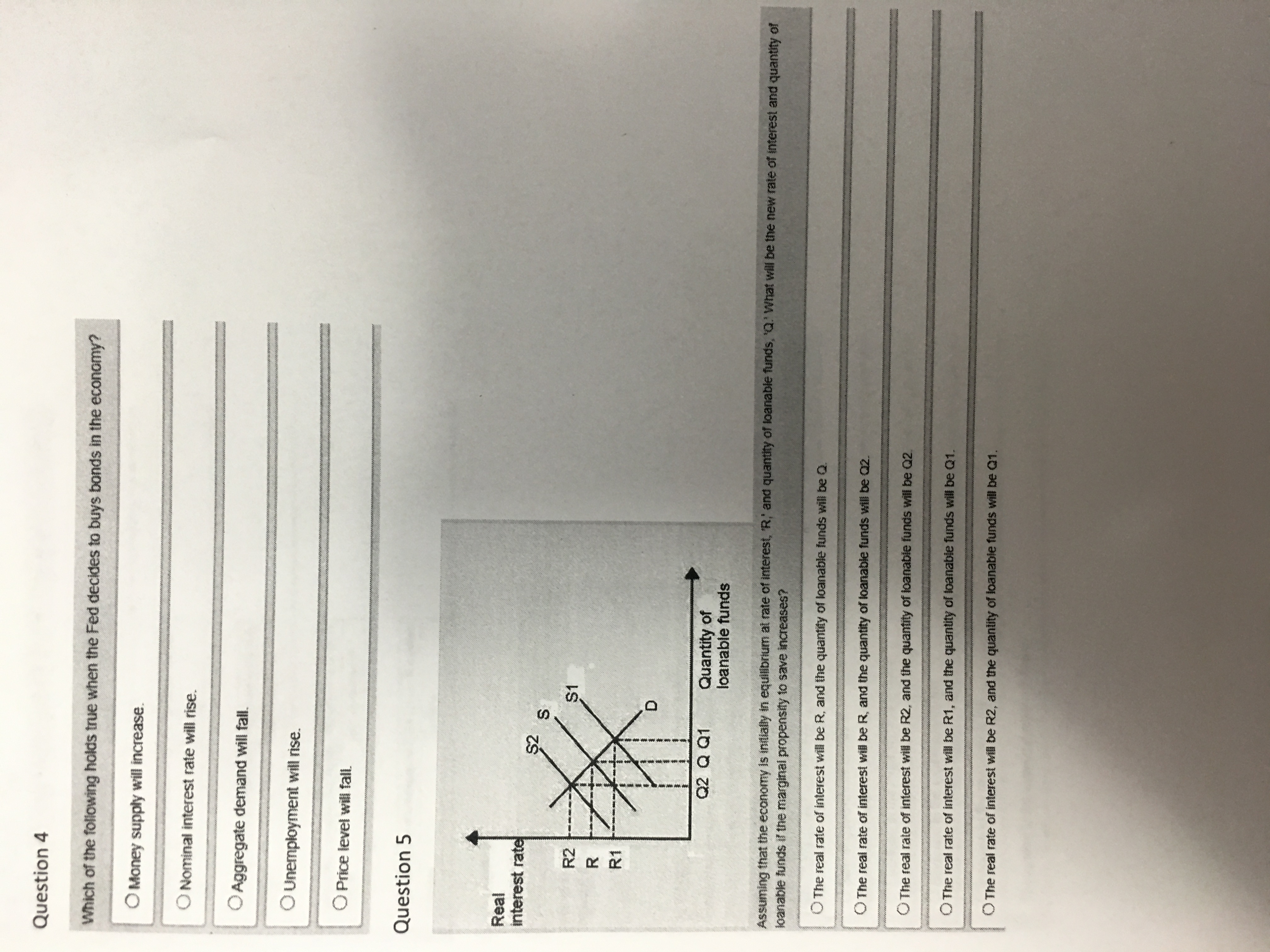
Question 1 Use the data table to answer the question that follows. GDP $20 billion Household consumption $12 billion Government tax revenue | $4 billion Government spending $5 billion Net exports SO Based on the data table, what would be the national savings for this economy? O-$1 billion $3 billion $4 billion $5 billion $7 billion Question 2 Eggs functioned as money in many agrarian economies in the 19th century. If a farmer compares his goat's worth at 1.500 eggs with his cow's worth of 4,500 eggs, which function of money is he using? O Store of wealth O Means of payment O Medium of exchange O Unit of account O Store of value Question 3 Suppose an economy has a money supply of $1,000 billion and a reserve requirement is 20%. What will be the amount of money supply in the economy if the Fed decides to buy $5 billion worth of government bonds in an open market operation, and banks hold no excess reserves? $1,025 billion $1,050 billion $1, 100 billion $1,020 billion The money supply will remain unchangedQuestion 4 Which of the following holds true when the Fed decides to buys bonds in the economy? O Money supply will increase. O Nominal interest rate will rise. OAggregate demand will fall. O Unemployment will rise. O Price level will fall. Question 5 Real interest rate R2 R R1 Q2 Q Q1 Quantity of loanable funds Assuming that the economy is initially in equilibrium at rate of interest, 'R' and quantity of loanable funds, 'Q.' What will be the new rate of interest and quantity of loanable funds if the marginal propensity to save increases? The real rate of interest will be R, and the quantity of loanable funds will be Q. The real rate of interest will be R, and the quantity of loanable funds will be Q2. The real rate of interest will be R2, and the quantity of loanable funds will be Q2. The real rate of interest will be R1, and the quantity of loanable funds will be Q1. .) The real rate of interest will be R2, and the quantity of loanable funds will be Q1
Step by Step Solution
There are 3 Steps involved in it

Get step-by-step solutions from verified subject matter experts
 Study Help