







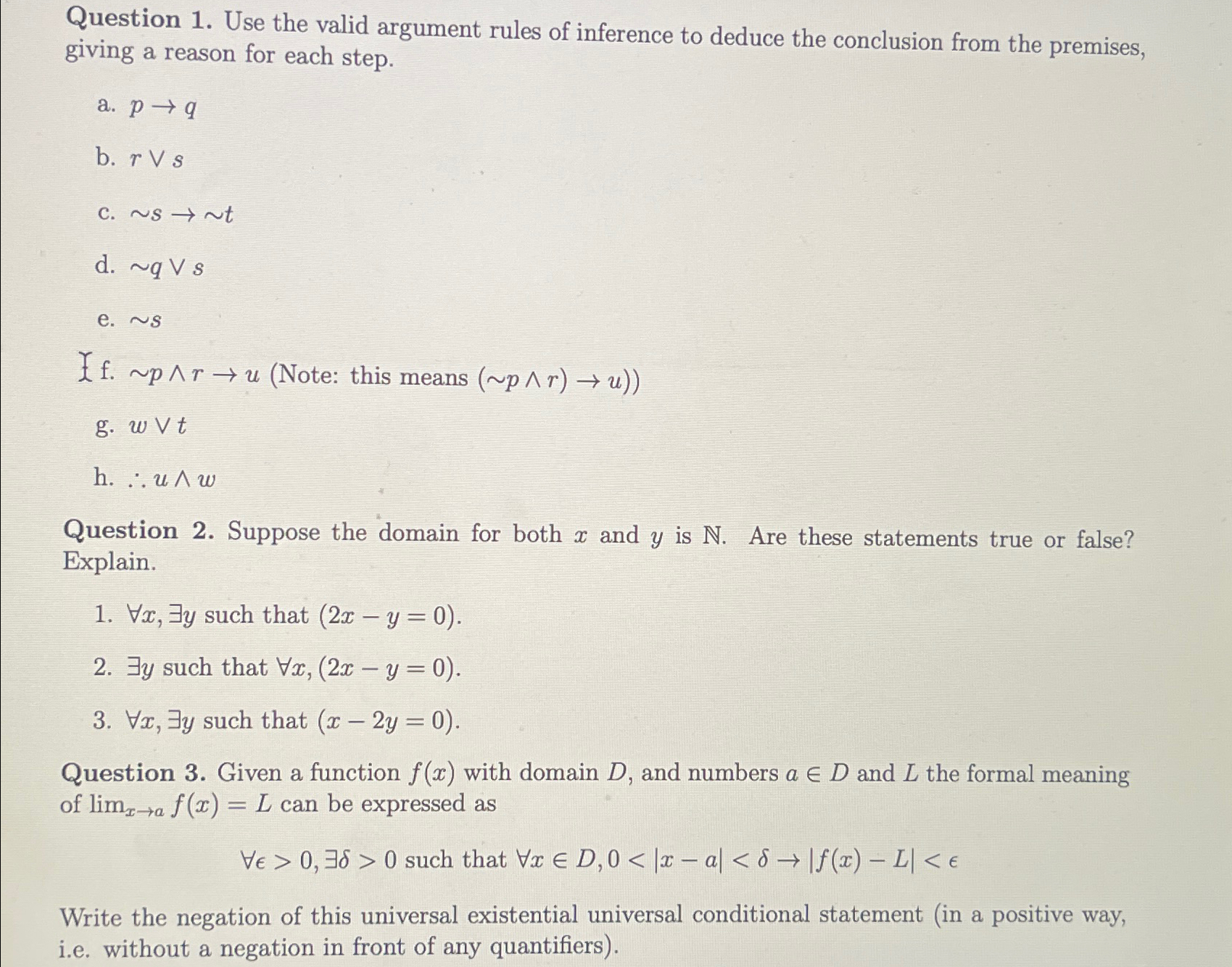
Question: Question 1 . Use the valid argument rules of inference to deduce the conclusion from the premises, giving a reason for each step. a .
Question Use the valid argument rules of inference to deduce the conclusion from the premises, giving a reason for each step.
a
b
c
d
e
fNote: this means
g
h :
Question Suppose the domain for both and is Are these statements true or false? Explain.
AAx,EEy such that
EEy such that
AAx,EEy such that
Question Given a function with domain and numbers ainD and the formal meaning of can be expressed as
such that AAxinD,
Write the negation of this universal existential universal conditional statement in a positive way, ie without a negation in front of any quantifiers
Step by Step Solution
There are 3 Steps involved in it
1 Expert Approved Answer
Step: 1 Unlock

Lets address each question step by step Question 1 Use the valid argument rules of inference to dedu... View full answer
Question Has Been Solved by an Expert!
Get step-by-step solutions from verified subject matter experts
Step: 2 Unlock
Step: 3 Unlock
 Study Help