







Question: Question 1 Using the chain rule, determine a formula for the derivative of g(x) = at(*). Let f(x) be a differentiable function, and let a
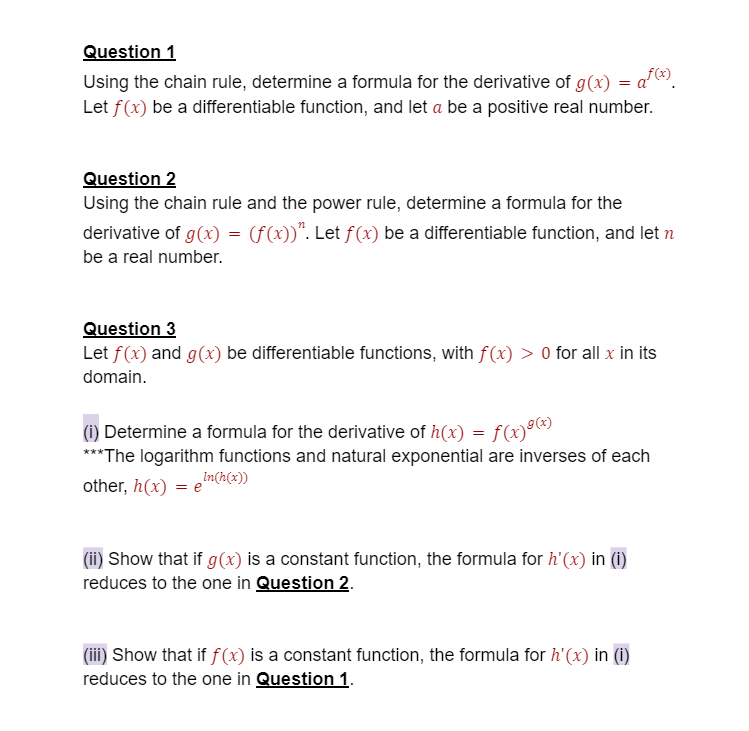
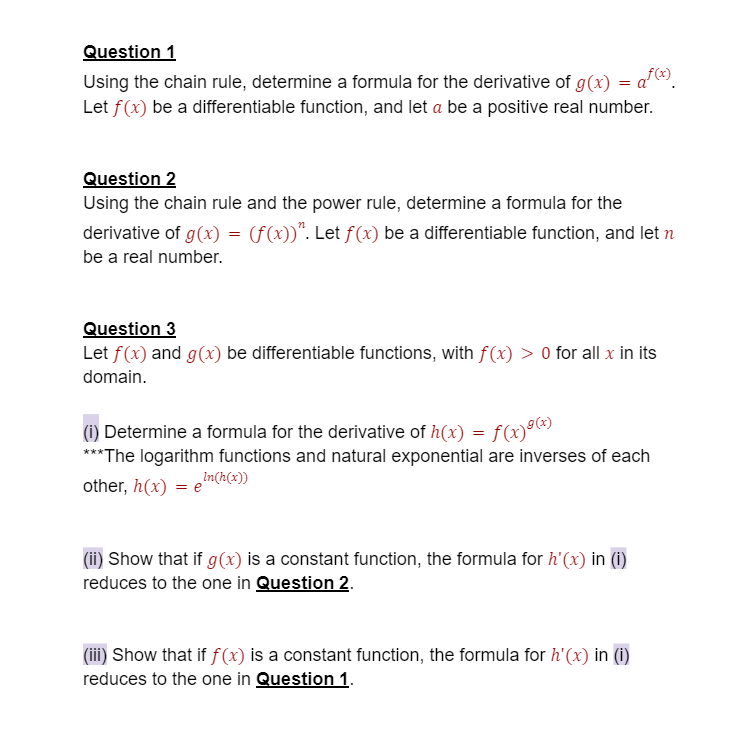
Question 1 Using the chain rule, determine a formula for the derivative of g(x) = at(*). Let f(x) be a differentiable function, and let a be a positive real number. Question 2 Using the chain rule and the power rule, determine a formula for the derivative of g(x) = (f(x))". Let f(x) be a differentiable function, and let n be a real number. Question 3 Let f(x) and g(x) be differentiable functions, with f(x) > 0 for all x in its domain. (i) Determine a formula for the derivative of h(x) = f(x)() ***The logarithm functions and natural exponential are inverses of each other, h(x) = e In(h(x)) (ii) Show that if g(x) is a constant function, the formula for h'(x) in (i) reduces to the one in Question 2. (ii) Show that if f(x) is a constant function, the formula for h'(x) in (i) reduces to the one in Question 1
Step by Step Solution
There are 3 Steps involved in it

Get step-by-step solutions from verified subject matter experts
 Study Help