







Question: QUESTION 1 We use independent variables to predict the value of multiple dependent variables when conducting a Two-sample hypothesis test One-factor ANOVA Bivariate regression Multivariate
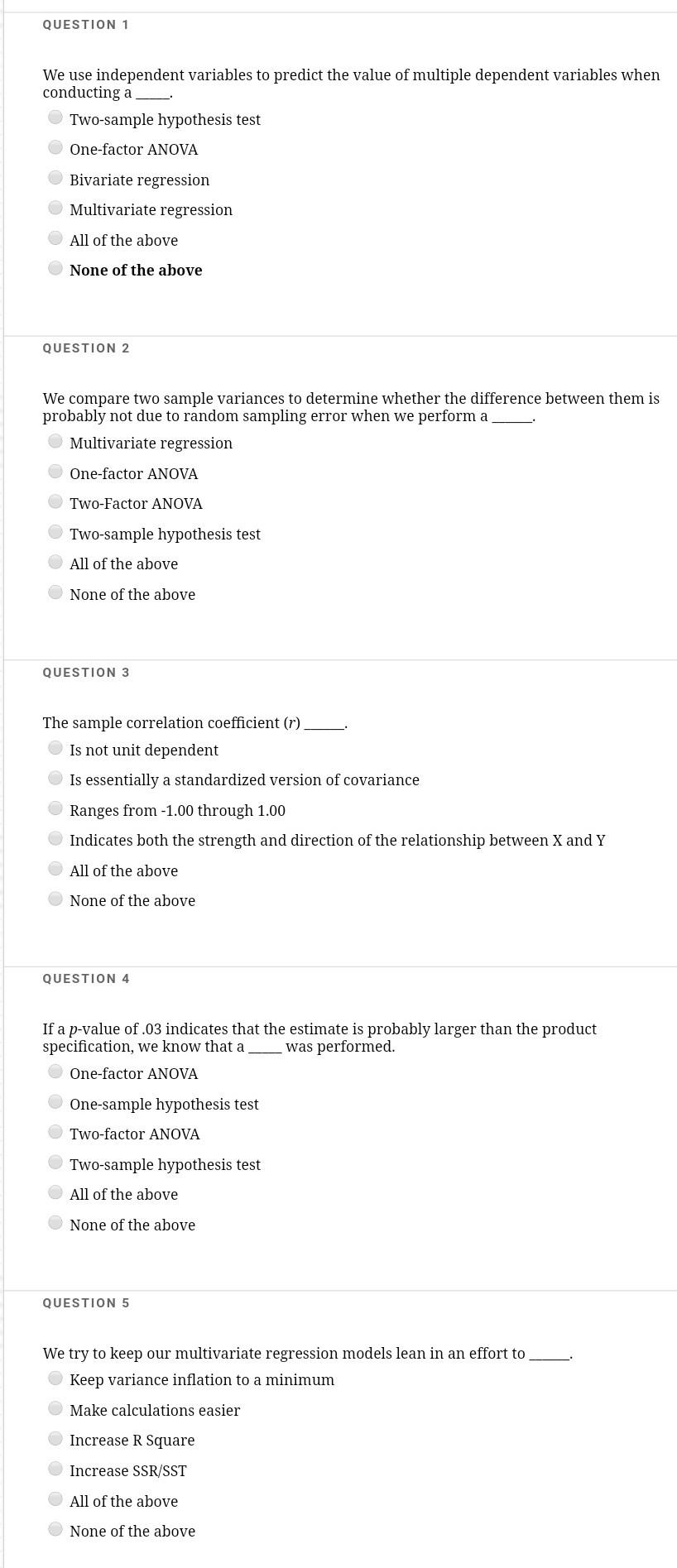
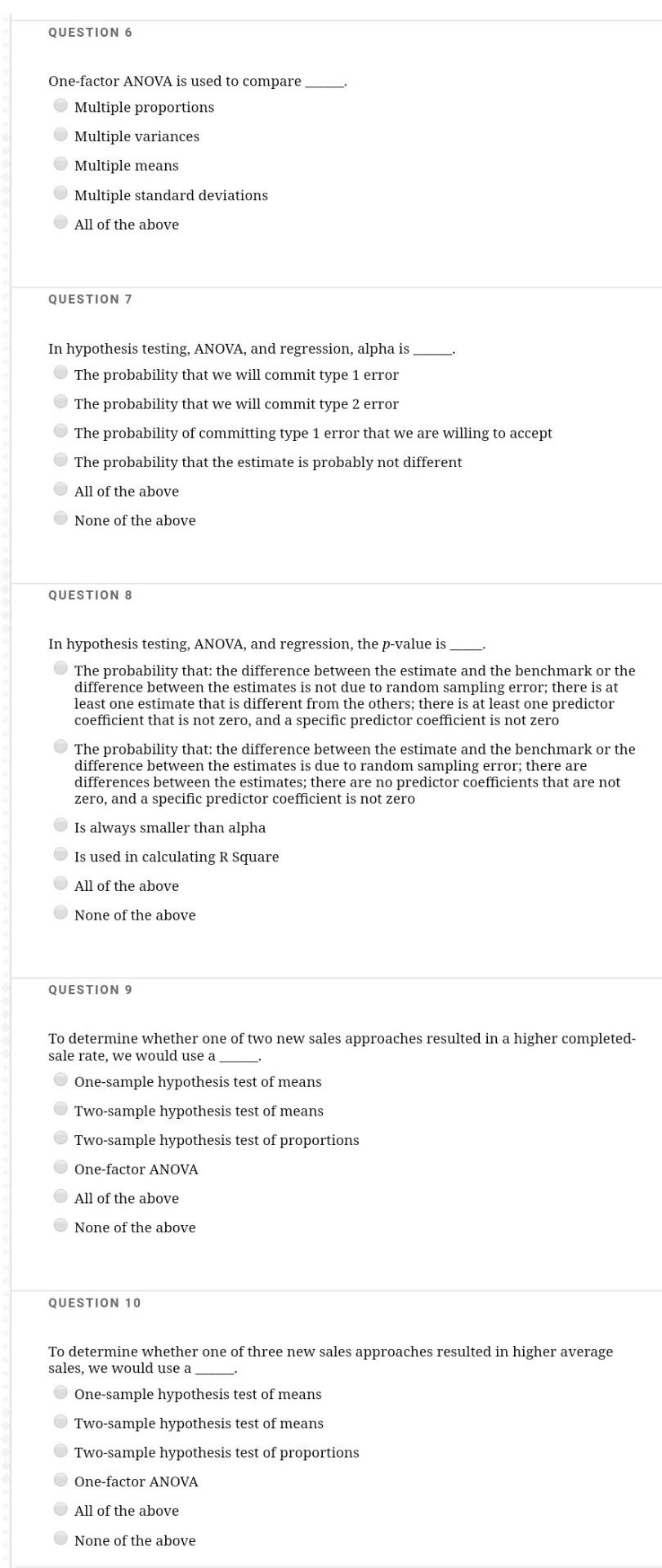
QUESTION 1 We use independent variables to predict the value of multiple dependent variables when conducting a Two-sample hypothesis test One-factor ANOVA Bivariate regression Multivariate regression All of the above None of the above QUESTION 2 We compare two sample variances to determine whether the difference between them is probably not due to random sampling error when we perform a Multivariate regression One-factor ANOVA Two-Factor ANOVA Two-sample hypothesis test All of the above None of the above QUESTION 3 The sample correlation coefficient (r) Is not unit dependent Is essentially a standardized version of covariance Ranges from -1.00 through 1.00 Indicates both the strength and direction of the relationship between X and Y All of the above None of the above QUESTION 4 If a p-value of .03 indicates that the estimate is probably larger than the product specification, we know that a was performed. One-factor ANOVA One-sample hypothesis test Two-factor ANOVA Two-sample hypothesis test All of the above None of the above QUESTION 5 We try to keep our multivariate regression models lean in an effort to Keep variance inflation to a minimum Make calculations easier Increase R Square Increase SSR/SST All of the above None of the above QUESTION 6 One-factor ANOVA is used to compare Multiple proportions Multiple variances Multiple means Multiple standard deviations All of the above QUESTION 7 In hypothesis testing, ANOVA, and regression, alpha is The probability that we will commit type 1 error The probability that we will commit type 2 error The probability of committing type 1 error that we are willing to accept The probability that the estimate is probably not different All of the above None of the above QUESTION 8 In hypothesis testing, ANOVA, and regression, the p-value is The probability that: the difference between the estimate and the benchmark or the difference between the estimates is not due to random sampling error; there is at least one estimate that is different from the others, there is at least one predictor coefficient that is not zero, and a specific predictor coefficient is not zero The probability that: the difference between the estimate and the benchmark or the difference between the estimates is due to random sampling error; there are differences between the estimates; there are no predictor coefficients that are not zero, and a specific predictor coefficient is not zero Is always smaller than alpha Is used in calculating R Square All of the above None of the above QUESTION 9 To determine whether one of two new sales approaches resulted in a higher completed- sale rate, we would use a One-sample hypothesis test of means Two-sample hypothesis test of means Two-sample hypothesis test of proportions One-factor ANOVA All of the above None of the above QUESTION 10 To determine whether one of three new sales approaches resulted in higher average sales, we would use a One-sample hypothesis test of means Two-sample hypothesis test of means Two-sample hypothesis test of proportions One-factor ANOVA All of the above None of the above
Step by Step Solution
There are 3 Steps involved in it
1 Expert Approved Answer
Step: 1 Unlock

Question Has Been Solved by an Expert!
Get step-by-step solutions from verified subject matter experts
Step: 2 Unlock
Step: 3 Unlock
 Study Help