







Question: Question: 1. What are the issues that Gillian faces? 2. Evaluate Gillian's proposal to increase the number of farm visitors in 1999 by 50 percent.
Question:
1. What are the issues that Gillian faces? 2. Evaluate Gillian's proposal to increase the number of farm visitors in 1999 by 50 percent. You may wish to: Y
a) Evaluate the sales forecasts
b) Analyse the capacities and identify the capacity constraints within these businesses.
3. What factors should Gillian consider when deciding to increase the number of flavors from four to ten?
Note: For any calculations, assume that each month consists of four weeks. The effects of Bank Holidays (statutory holidays) should be ignored for the purpose of this initial analysis.
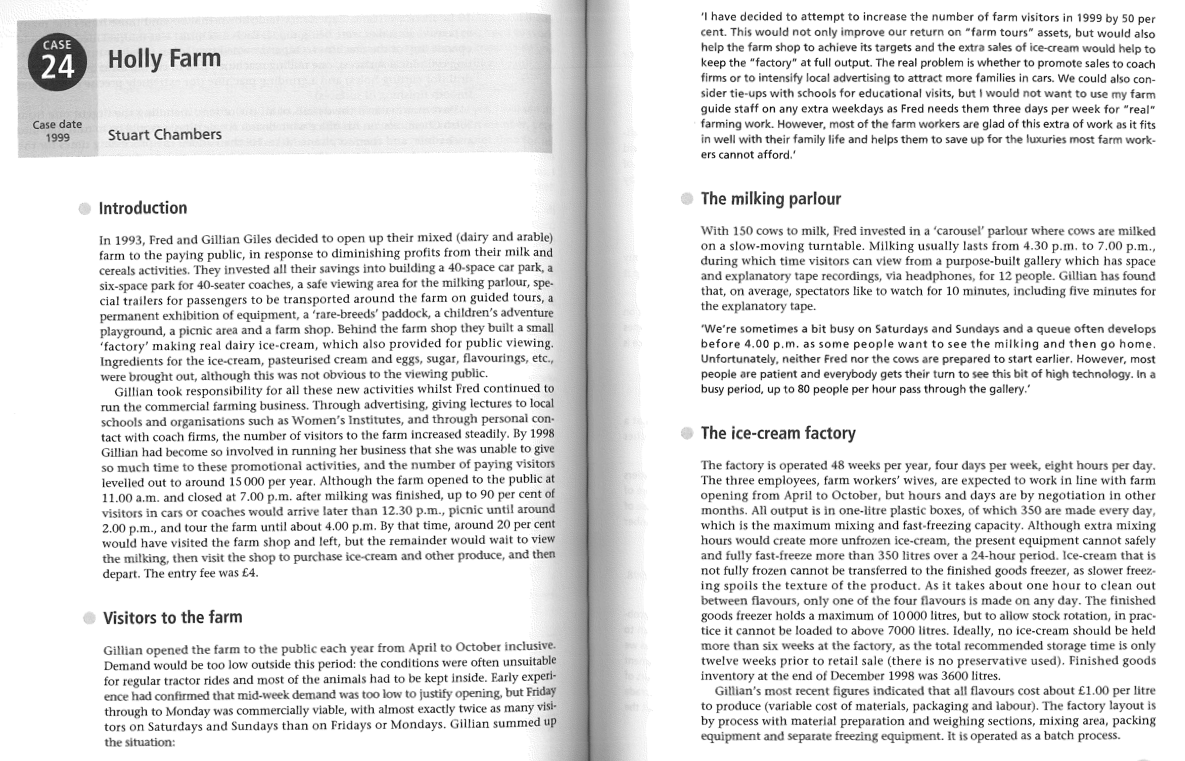
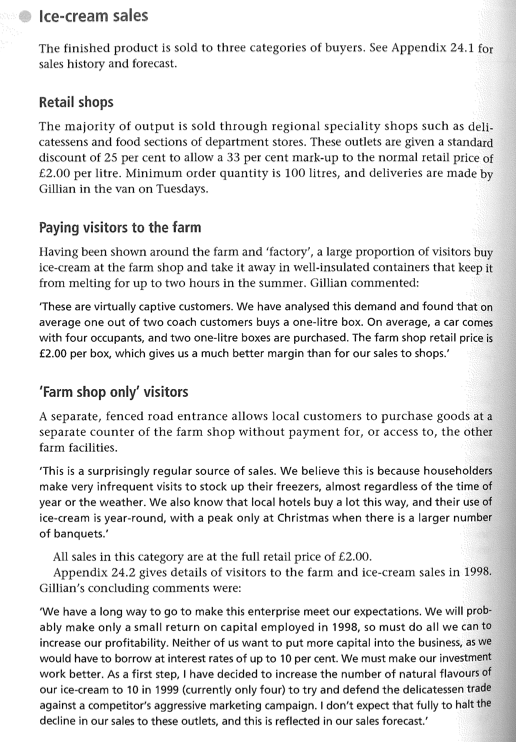
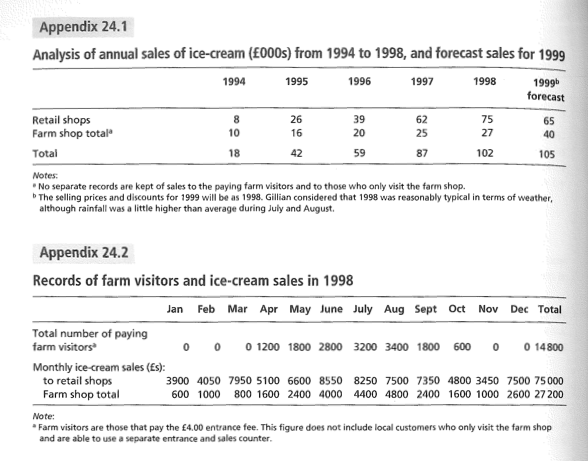
CASE 24 Holly Farm 'I have decided to attempt to increase the number of farm visitors in 1999 by 50 per cent. This would not only improve our return on "farm tours" assets, but would also help the farm shop to achieve its targets and the extra sales of ice-cream would help to keep the "factory" at full output. The real problem is whether to promote sales to coach firms or to intensify local advertising to attract more families in cars. We could also con- sider tie-ups with schools for educational visits, but I would not want to use my farm guide staff on any extra weekdays as Fred needs them three days per week for "real" farming work. However, most of the farm workers are glad of this extra of work as it fits in well with their family life and helps them to save up for the luxuries most farm work- ers cannot afford.' Case date 1999 Stuart Chambers Introduction The milking parlour With 150 cows to milk, Fred invested in a 'carousel' parlour where cows are milked on a slow-moving turntable. Milking usually lasts from 4.30 p.m. to 7.00p.m., during which time visitors can view from a purpose-built gallery which has space and explanatory tape recordings, via headphones, for 12 people. Gillian has found that, on average, spectators like to watch for 10 minutes, including five minutes for the explanatory tape. 'We're sometimes a bit busy on Saturdays and Sundays and a queue often develops before 4.00p.m. as some people want to see the milking and then go home. Unfortunately, neither Fred nor the cows are prepared to start earlier. However, most people are patient and everybody gets their turn to see this bit of high technology. In a busy period, up to 80 people per hour pass through the gallery.' In 1993, Fred and Gillian Giles decided to open up their mixed (dairy and arable) farm to the paying public, in response to diminishing profits from their milk and cereals activities. They invested all their savings into building a 40-space car park, a six-space park for 40-seater coaches, a safe viewing area for the milking parlour, spe. cial trailers for passengers to be transported around the farm on guided tours, a permanent exhibition of equipment, a 'rare-breeds' paddock, a children's adventure playground, a picnic area and a farm shop. Behind the farm shop they built a small 'factory' making real dairy ice-cream, which also provided for public viewing. Ingredients for the ice-cream, pasteurised cream and eggs, sugar, flavourings, etc., were brought out, although this was not obvious to the viewing public. Gillian took responsibility for all these new activities whilst Fred continued to run the commercial farming business. Through advertising, giving lectures to local schools and organisations such as Women's Institutes, and through personal con tact with coach firms, the number of visitors to the farm increased steadily. By 1998 Gillian had become so involved in running her business that she was unable to give so much time to these promotional activities, and the number of paying visitors levelled out to around 15 000 per year. Although the farm opened to the public at 11.00 a.m. and closed at 7.00 p.m. after milking was finished, up to 90 per cent of visitors in cars or coaches would arrive later than 12.30 p.m., picnic until around 2.00p.m., and tour the farm until about 4.00 p.m. By that time, around 20 per cent would have visited the farm shop and left, but the remainder would wait to view the milking, then visit the shop to purchase ice-cream and other produce, and then depart. The entry fee was 4. The ice-cream factory The factory is operated 48 weeks per year, four days per week, eight hours per day. The three employees, farm workers' wives, are expected to work in line with farm opening from April to October, but hours and days are by negotiation in other months. An output is in one-litre plastic boxes, of which 350 are made every day, which is the maximum mixing and fast-freezing capacity. Although extra mixing hours would create more unfrozen ice-cream, the present equipment cannot safely and fully fast-freeze more than 350 litres over a 24-hour period. Ice-cream that is not fully frozen cannot be transferred to the finished goods freezer, as slower freez- ing spoils the texture of the product. As it takes about one hour to clean out between flavours, only one of the four flavours is made on any day. The finished goods freezer holds a maximum of 10000 litres, but to allow stock rotation, in prac. tice it cannot be loaded to above 7000 litres. Ideally, no ice-cream should be held more than six weeks at the factory, as the total recommended storage time is only twelve weeks prior to retail sale (there is no preservative used). Finished goods inventory at the end of December 1998 was 3600 litres. Gillian's most recent figures indicated that all flavours cost about 1.00 per litre to produce (variable cost of materials, packaging and labour). The factory layout is by process with material preparation and weighing sections, mixing area, packing equipment and separate freezing equipment. It is operated as a batch process. Visitors to the farm Gillian opened the farm to the public each year from April to October inclusive. Demand would be too low outside this period: the conditions were often unsuitable for regular tractor rides and most of the animals had to be kept inside. Early experi- ence had confirmed that mid-week demand was too low to justify opening, but Friday through to Monday was commercially viable, with almost exactly twice as many visi- tors on Saturdays and Sundays than on Fridays or Mondays. Gillian summed up the situation: Ice-cream sales The finished product is sold to three categories of buyers. See Appendix 24.1 for sales history and forecast. Retail shops The majority of output is sold through regional speciality shops such as deli- catessens and food sections of department stores. These outlets are given a standard discount of 25 per cent to allow a 33 per cent mark-up to the normal retail price of 2.00 per litre. Minimum order quantity is 100 litres, and deliveries are made by Gillian in the van on Tuesdays. Paying visitors to the farm Having been shown around the farm and 'factory', a large proportion of visitors buy ice-cream at the farm shop and take it away in well-insulated containers that keep it from melting for up to two hours in the summer. Gillian commented: These are virtually captive customers. We have analysed this demand and found that on average one out of two coach customers buys a one-litre box. On average, a car comes with four occupants, and two one-litre boxes are purchased. The farm shop retail price is 2.00 per box, which gives us a much better margin than for our sales to shops.' 'Farm shop only' visitors A separate, fenced road entrance allows local customers to purchase goods at a separate counter of the farm shop without payment for, or access to the other farm facilities. 'This is a surprisingly regular source of sales. We believe this is because householders make very infrequent visits to stock up their freezers, almost regardless of the time of year or the weather. We also know that local hotels buy a lot this way, and their use of ice-cream is year-round, with a peak only at Christmas when there is a larger number of banquets. All sales in this category are at the full retail price of 2.00. Appendix 24.2 gives details of visitors to the farm and ice-cream sales in 1998. Gillian's concluding comments were: We have a long way to go to make this enterprise meet our expectations. We will prob- ably make only a small return on capital employed in 1998, so must do all we can to increase our profitability. Neither of us want to put more capital into the business, as we would have to borrow at interest rates of up to 10 per cent. We must make our investment work better. As a first step, I have decided to increase the number of natural flavours of our ice-cream to 10 in 1999 (currently only four) to try and defend the delicatessen trade against a competitor's aggressive marketing campaign. I don't expect that fully to halt the decline in our sales to these outlets, and this is reflected in our sales forecast.' 1997 19996 Appendix 24.1 Analysis of annual sales of ice-cream (000s) from 1994 to 1998, and forecast sales for 1999 1994 1995 1996 1998 forecast Retail shops Farm shop total Total 8 10 26 16 39 20 62 25 75 27 65 40 18 42 59 87 102 105 Notes: No separate records are kept of sales to the paying farm visitors and to those who only visit the farm shop. The selling prices and discounts for 1999 will be as 1998. Gillian considered that 1998 was reasonably typical in terms of weather, although rainfall was a little higher than average during July and August Dec Total Appendix 24.2 Records of farm visitors and ice-cream sales in 1998 Jan Feb Mar Apr May June July Aug Sept Oct Nov Total number of paying farm visitors 0 1200 1800 2800 3200 3400 1800 Monthly ice-cream sales (Es): to retail shops 3900 4050 7950 5100 6600 8550 8250 7500 7350 4800 3450 7500 75 000 Farm shop total 600 1000 800 1600 2400 4000 4400 4800 2400 1600 1000 2600 27200 Note: * Farm visitors are those that pay the 4.00 entrance fee. This figure does not include local customers who only visit the farm shop and are able to use a separate entrance and sales counter 0 600 0 0 14800Step by Step Solution
There are 3 Steps involved in it
1 Expert Approved Answer
Step: 1 Unlock

Question Has Been Solved by an Expert!
Get step-by-step solutions from verified subject matter experts
Step: 2 Unlock
Step: 3 Unlock
 Study Help