







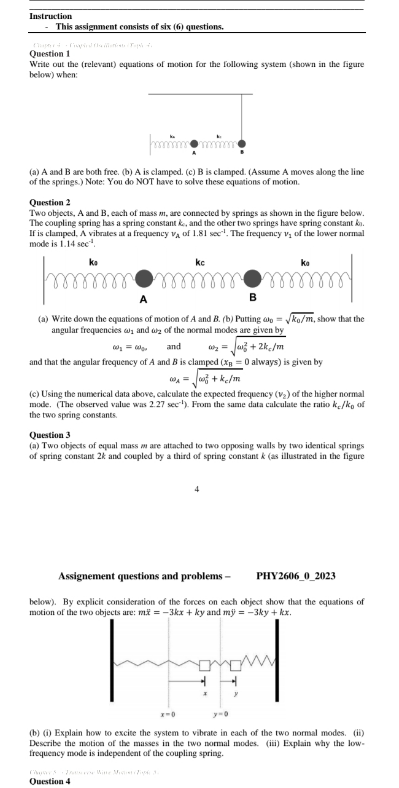
Question: Question 1 Write out the ( relevant ) equations of motion for the following system ( shown in the figure belowy ) when: ( a
Question
Write out the relevant equations of motion for the following system shown in the figure
belowy when:
a A and B are boch free. b A is clamped. c B is clamped. Assume A moves along the line
of the springs. Note: You do NOT have to solve these equations of motion.
Question
Two objects, A and B each of mass m are connected by springs as shown in the figure below.
The coupling spring bas a spring constant and the other two springs hawe spring coestant
If is clamped, vibrates at a frequency of The frequency of the lower normal
mode is
a Write down the equations of motion of A and b Putting show that the
angular frequencies and of the normal modes are given by
and
and that the angular frequency of A and is clamped always is given by
c Using the numerical data above, calculate the expected frequency of the higher normal
mode. The observed value was From the same data calculate the ratio of
the two spring constants.
Question
a Two objects of equal mass are attached to two opposing walls by two identical springs
of spring constant and coupled by a third of spring constant as illustrated in the figure
Assignement questions and problems
PHY
below By explicit consideration of the forces on each object show that the equations of
motion of the two obiects are: and
bi Explain how to excie the system to vibrate in each of the two normal modes. ii
Describe the motion of the masses in the two normal modes. iii Explain why the low
frequency mode is independent of the coupling spring.
Ouestion
Step by Step Solution
There are 3 Steps involved in it
1 Expert Approved Answer
Step: 1 Unlock

Question Has Been Solved by an Expert!
Get step-by-step solutions from verified subject matter experts
Step: 2 Unlock
Step: 3 Unlock
 Study Help