







Question: Question 1: Write Specific Case to brief is Flying Fish Bikes, Inc. v. Giant Bicycle, Inc., 181 F.Supp.3d 957? Grading Rubric for Case Brief Written
Question 1:
Write Specific Case to brief is Flying Fish Bikes, Inc. v. Giant Bicycle, Inc., 181 F.Supp.3d 957?
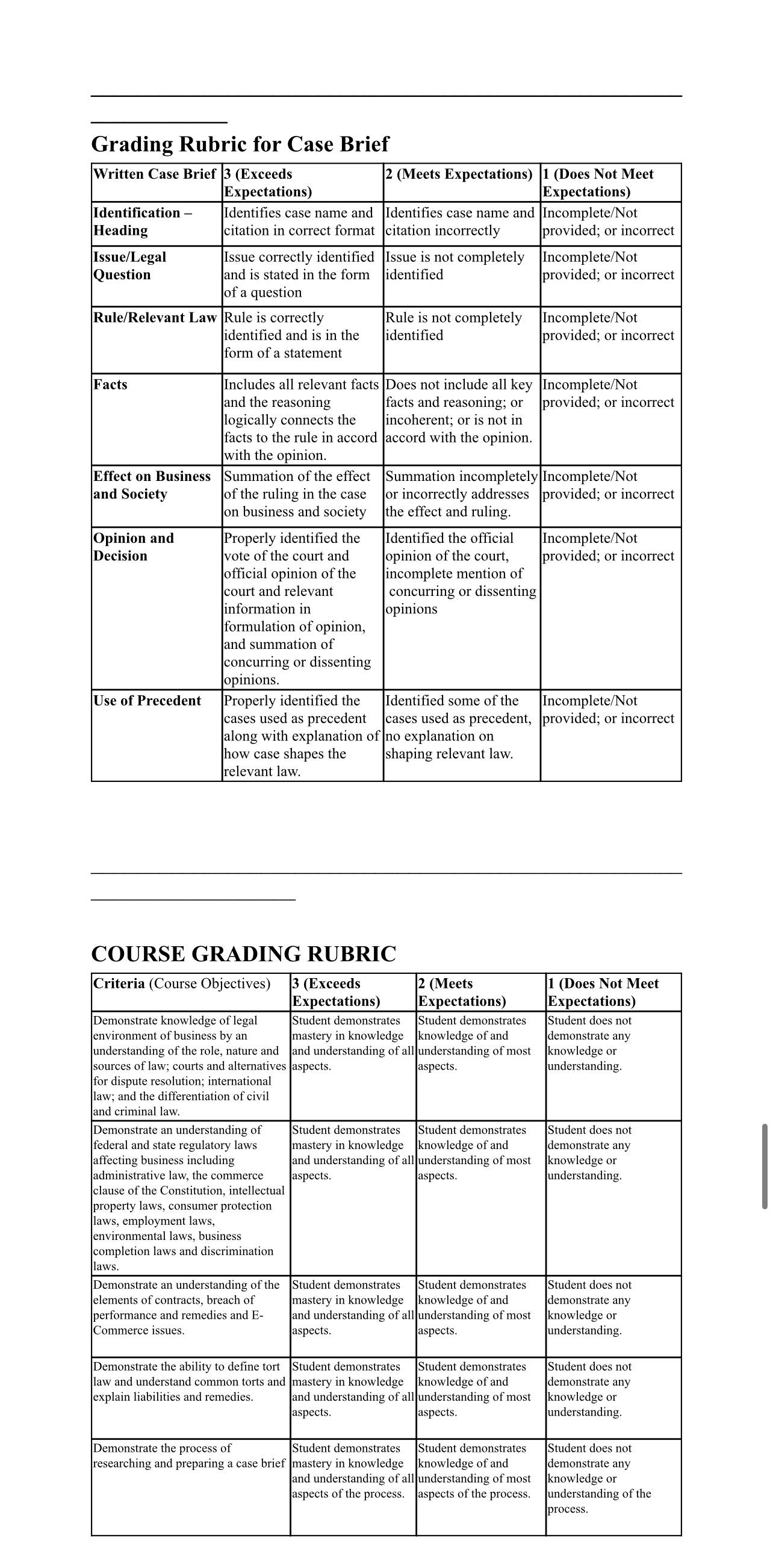
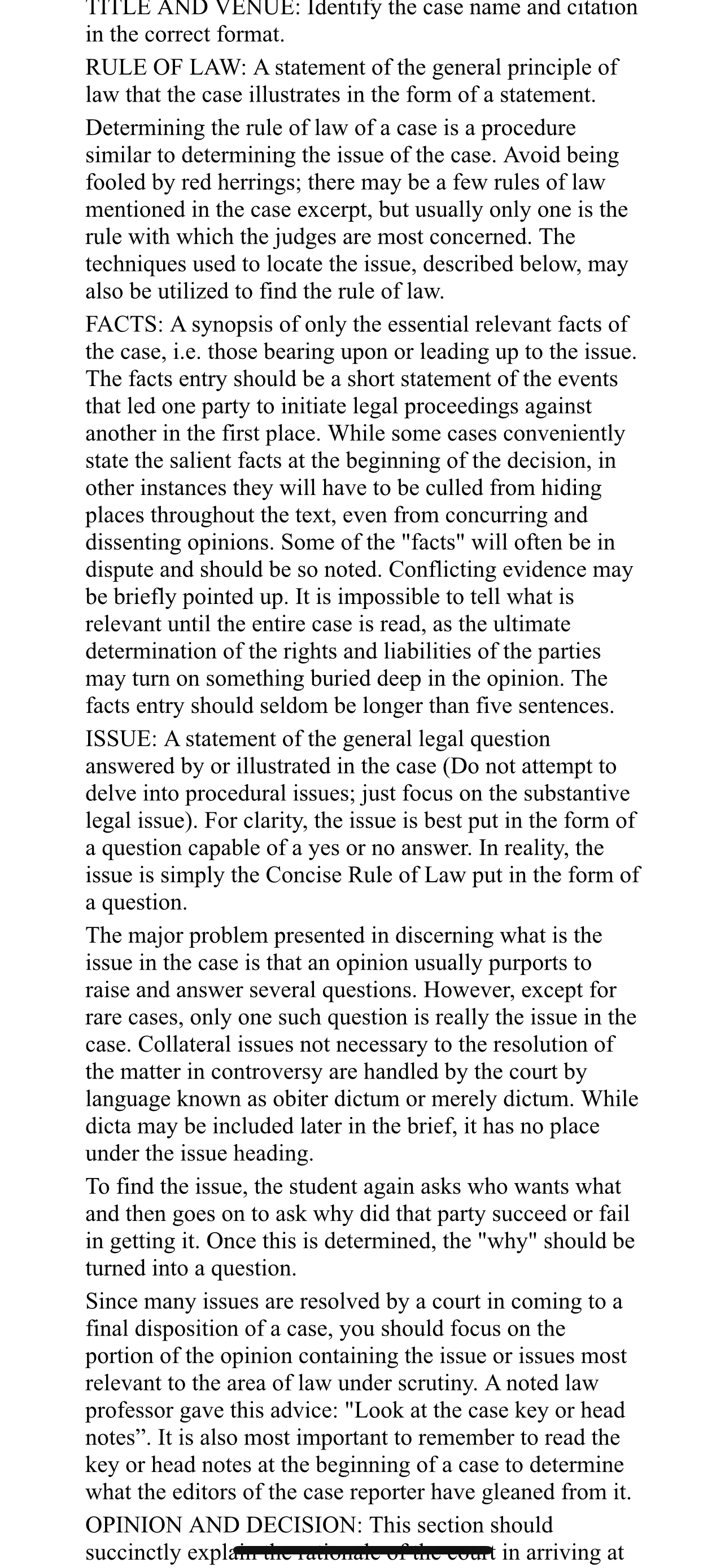
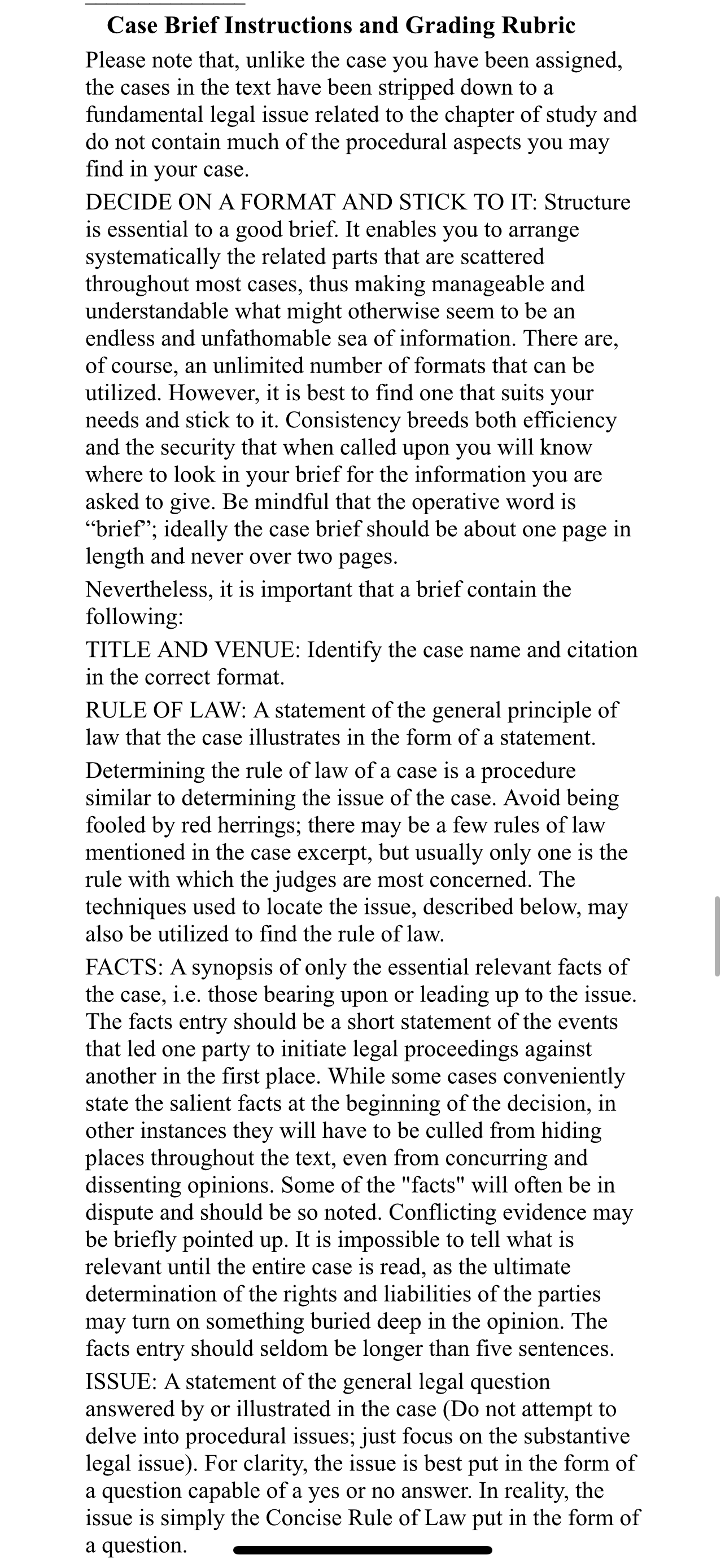
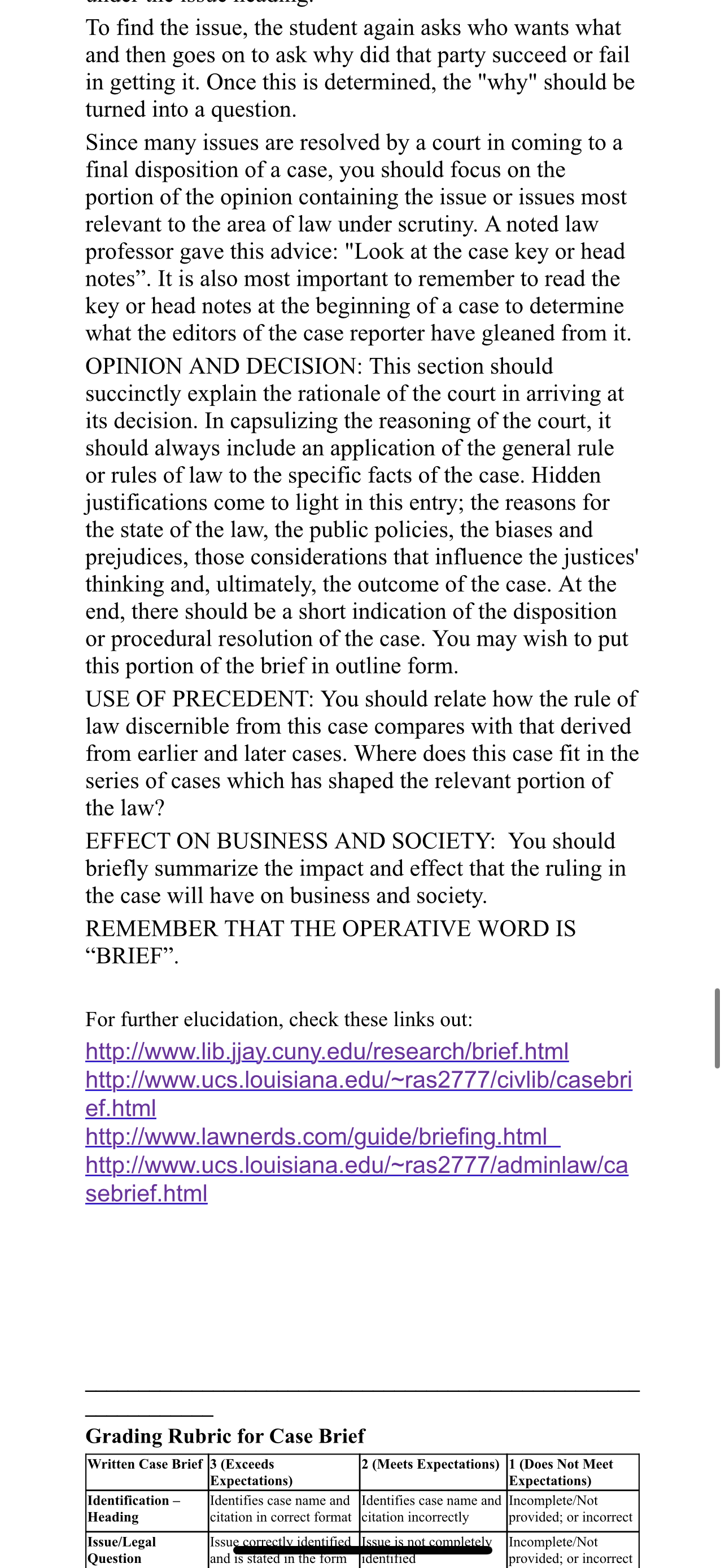
Grading Rubric for Case Brief Written Case Brief 3 (Exceeds 2 (Meets Expectations) 1 (Does Not Meet Expectations) Expectations) Identification - dentifies case name and Identifies case name and Incomplete/Not Heading citation in correct format citation incorrectly provided; or incorrect Issue/Legal Issue correctly identified Issue is not completely Incomplete/Not Question and is stated in the form identified provided; or incorrect of a question Rule/Relevant Law Rule is correctly Rule is not completely Incomplete/Not identified and is in the identified provided; or incorrect form of a statement Facts Includes all relevant facts Does not include all key Incomplete/Not and the reasoning facts and reasoning; or provided; or incorrect logically connects the incoherent; or is not in facts to the rule in accord accord with the opinion. with the opinion. Effect on Business Summation of the effect Summation incompletely Incomplete/Not and Society of the ruling in the case or incorrectly addresses provided; or incorrect on business and society the effect and ruling. Opinion and Properly identified the Identified the official Incomplete/Not Decision vote of the court and opinion of the court, provided; or incorrect official opinion of the incomplete mention of court and relevant concurring or dissenting information in opinions formulation of opinion, and summation of concurring or dissenting opinions. Use of Precedent Properly identified the Identified some of the Incomplete/Not cases used as precedent cases used as precedent, provided; or incorrect along with explanation of no explanation on how case shapes the shaping relevant law. relevant law. COURSE GRADING RUBRIC Criteria (Course Objectives) 3 (Exceeds 2 (Meets 1 (Does Not Meet Expectations) Expectations) Expectations) Demonstrate knowledge of legal Student demonstrates Student demonstrates Student does not environment of business by an mastery in knowledge knowledge of and demonstrate any understanding of the role, nature and and understanding of all understanding of most knowledge or sources of law; courts and alternatives aspects. aspects. understanding. for dispute resolution; international law; and the differentiation of civil and criminal law. Demonstrate an understanding of Student demonstrates Student demonstrates Student does not federal and state regulatory laws mastery in knowledge knowledge of and demonstrate any affecting business including and understanding of all understanding of most knowledge or administrative law, the commerce aspects. aspects. understanding. clause of the Constitution, intellectual property laws, consumer protection laws, employment laws, environmental laws, business completion laws and discrimination laws. Demonstrate an understanding of the Student demonstrates Student demonstrates Student does not elements of contracts, breach of mastery in knowledge knowledge of and demonstrate any performance and remedies and E- and understanding of all understanding of most knowledge or Commerce issues. aspects. aspects. understanding. Demonstrate the ability to define tort Student demonstrates Student demonstrates Student does not law and understand common torts and mastery in knowledge knowledge of and lemonstrate any explain liabilities and remedies. and understanding of all understanding of most knowledge or aspects. aspects. understanding. Demonstrate the process of Student demonstrates Student demonstrates Student does not researching and preparing a case brief mastery in knowledge knowledge of and demonstrate any and understanding of all understanding of most knowledge or aspects of the process. aspects of the process. understanding of the process.TITLE AND VEN UE: Identify the case name and Citation in the correct format. RULE OF LAW: A statement of the general principle of law that the case illustrates in the form of a statement. Determining the rule of law of a case is a procedure similar to determining the issue of the case. Avoid being fooled by red herrings; there may be a few rules of law mentioned in the case excerpt, but usually only one is the rule with which the judges are most concerned. The techniques used to locate the issue, described below, may also be utilized to nd the rule of law. FACTS: A synopsis of only the essential relevant facts of the case, i.e. those bearing upon or leading up to the issue. The facts entry should be a short statement of the events that led one party to initiate legal proceedings against another in the first place. While some cases conveniently state the salient facts at the beginning of the decision, in other instances they will have to be culled from hiding places throughout the text, even from concurring and dissenting opinions. Some of the "facts" will often be in dispute and should be so noted. Conicting evidence may be briey pointed up. It is impossible to tell what is relevant until the entire case is read, as the ultimate determination of the rights and liabilities of the parties may turn on something buried deep in the opinion. The facts entry should seldom be longer than ve sentences. ISSUE: A statement of the general legal question answered by or illustrated in the case (Do not attempt to delve into procedural issues; just focus on the substantive legal issue). For clarity, the issue is best put in the form of a question capable of a yes or no answer. In reality, the issue is simply the Concise Rule of Law put in the form of a question. The major problem presented in discerning what is the issue in the case is that an opinion usually purports to raise and answer several questions. However, except for rare cases, only one such question is really the issue in the case. Collateral issues not necessary to the resolution of the matter in controversy are handled by the court by language known as obiter dictum or merely dictum. While dicta may be included later in the brief, it has no place under the issue heading. To nd the issue, the student again asks who wants what and then goes on to ask why did that party succeed or fail in getting it. Once this is determined, the "why" should be turned into a question. Since many issues are resolved by a court in coming to a nal disposition of a case, you should focus on the portion of the opinion containing the issue or issues most relevant to the area of law under scrutiny. A noted law professor gave this advice: \"Look at the case key or head notes\". It is also most important to remember to read the key or head notes at the beginning of a case to determine what the editors of the case reporter have gleaned from it. OPINION AND DECISION: This section should succinctly explm in arriving at Case Brief Instructions and Grading Rubric Please note that, unlike the case you have been assigned, the cases in the text have been stripped down to a fundamental legal issue related to the chapter of study and do not contain much of the procedural aspects you may nd in your case. DECIDE ON A FORMAT AND STICK TO IT: Structure is essential to a good brief. It enables you to arrange systematically the related parts that are scattered throughout most cases, thus making manageable and understandable what might otherwise seem to be an endless and unfathomable sea of information. There are, of course, an unlimited number of formats that can be utilized. However, it is best to nd one that suits your needs and stick to it. Consistency breeds both efciency and the security that when called upon you will know where to look in your brief for the information you are asked to give. Be mindful that the operative word is \"brief '; ideally the case brief should be about one page in length and never over two pages. Nevertheless, it is important that a brief contain the following: TITLE AND VENUE: Identify the case name and citation in the correct format. RULE OF LAW: A statement of the general principle of law that the case illustrates in the form of a statement. Determining the rule of law of a case is a procedure similar to determining the issue of the case. Avoid being fooled by red herrings; there may be a few rules of law mentioned in the case excerpt, but usually only one is the rule with which the judges are most concerned. The techniques used to locate the issue, described below, may also be utilized to nd the rule of law. FACTS: A synopsis of only the essential relevant facts of the case, i.e. those bearing upon or leading up to the issue. The facts entry should be a short statement of the events that led one party to initiate legal proceedings against another in the rst place. While some cases conveniently state the salient facts at the beginning of the decision, in other instances they will have to be culled from hiding places throughout the text, even from concurring and dissenting opinions. Some of the "facts" will often be in dispute and should be so noted. Conicting evidence may be briey pointed up. It is impossible to tell what is relevant until the entire case is read, as the ultimate determination of the rights and liabilities of the parties may turn on something buried deep in the opinion. The facts entry should seldom be longer than ve sentences. ISSUE: A statement of the general legal question answered by or illustrated in the case (Do not attempt to delve into procedural issues; just focus on the substantive legal issue). For clarity, the issue is best put in the form of a question capable of a yes or no answer. In reality, the issue is simply the Concise Rule of Law put in the form of a question. vu-WVA u-v -v~..v A--v...---o. To nd the issue, the student again asks who wants what and then goes on to ask why did that party succeed or fail in getting it. Once this is determined, the "why" should be turned into a question. Since many issues are resolved by a court in coming to a nal disposition of a case, you should focus on the portion of the opinion containing the issue or issues most relevant to the area of law under scrutiny. A noted law professor gave this advice: "Look at the case key or head notes\". It is also most important to remember to read the key or head notes at the beginning of a case to determine What the editors of the case reporter have gleaned from it. OPINION AND DECISION: This section should succinctly explain the rationale of the court in arriving at its decision. In capsulizing the reasoning of the court, it should always include an application of the general rule or rules of law to the specic facts of the case. Hidden justications come to light in this entry; the reasons for the state of the law, the public policies, the biases and prejudices, those considerations that inuence the justices' thinking and, ultimately, the outcome of the case. At the end, there should be a short indication of the disposition or procedural resolution of the case. You may wish to put this portion of the brief in outline form. USE OF PRECEDENT: You should relate how the rule of law discernible from this case compares with that derived from earlier and later cases. Where does this case t in the series of cases which has shaped the relevant portion of the law? EFFECT ON BUSINESS AND SOCIETY: You should briey summarize the impact and effect that the ruling in the case will have on business and society. REMEMBER THAT THE OPERATIVE WORD IS \"BRIEF\". For further elucidation, check these links out: mpJ/www.Iib.ijaycunyedu/research/brief.html mpj/wwwucs.Iouisiana.edu/~rasZ777/civlib/casebri ef.htm| mpj/www.lawnerds.com/guide/briefing.html mpj/wwwucs.Iouisiana.edu/~ra32777/adminlaw/ca m Grading Rubric for Case Brief Written Case Brief 3 (Exceeds 2 (Meets Expectations) 1 (Does Not Meet Expectations) Expectations) Identication 7 Identies case name and Identies case name and Incomplete/Not Heading citation in correct format citation incorrectly provided; or incorrect Issue/Legal - - Incomplete/Not Question and 1s sta en Int 6 mm 1 en 1 1e provided; or incorrect
Step by Step Solution
There are 3 Steps involved in it

Get step-by-step solutions from verified subject matter experts
 Study Help