







Question: QUESTION 10 0.2278 points Save Answer An essential function of a central bank is to: issue debt. O manage the money supply. collect taxes. O
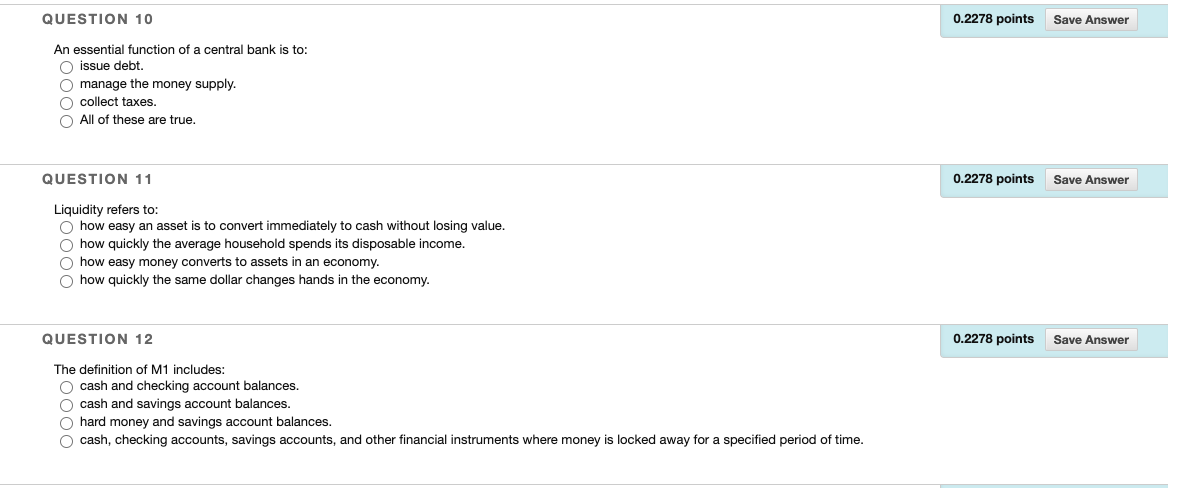
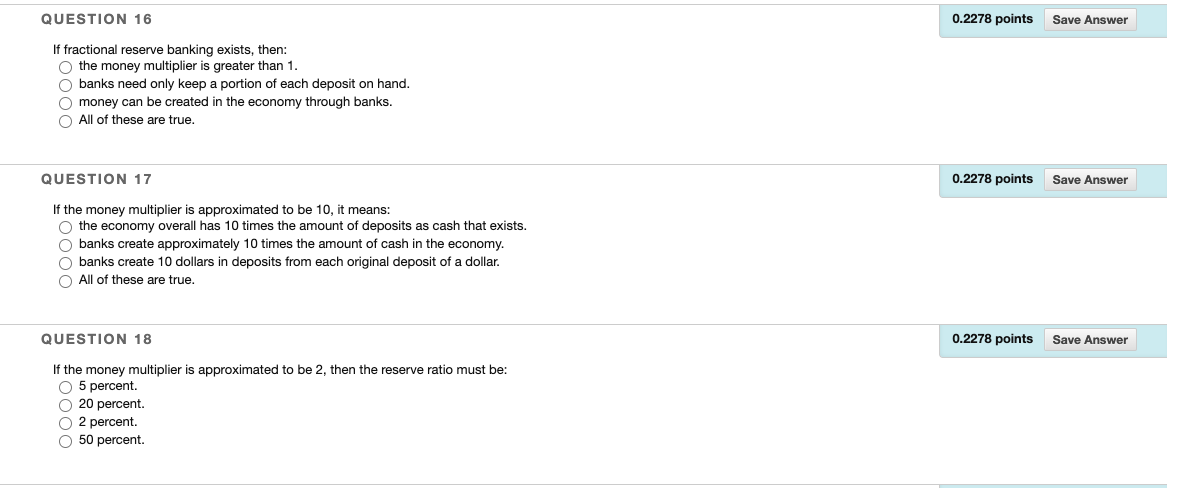
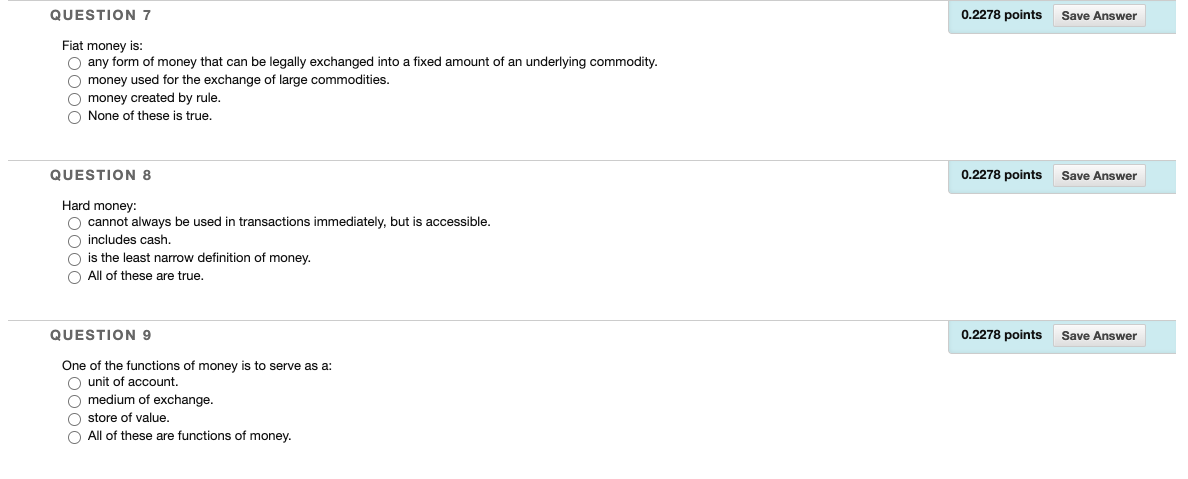
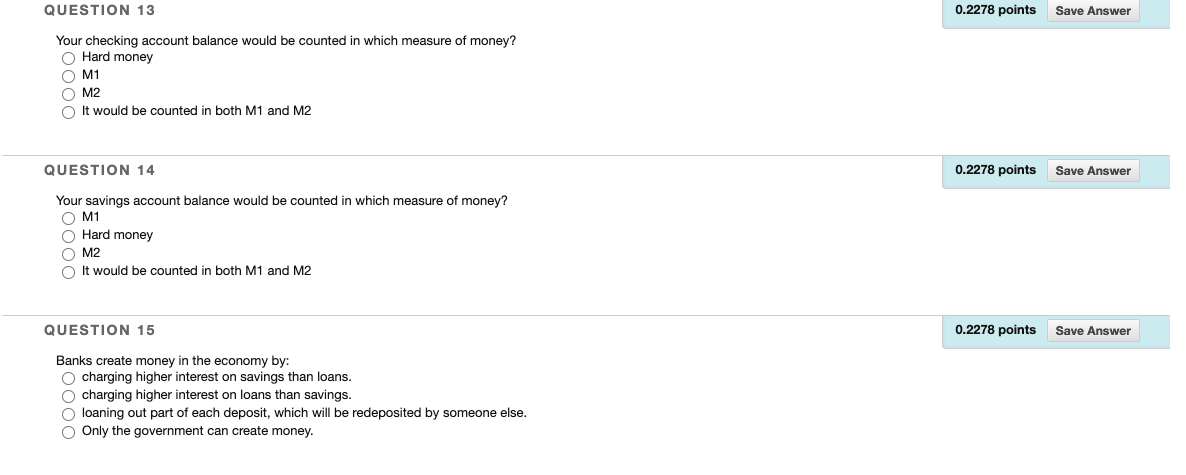
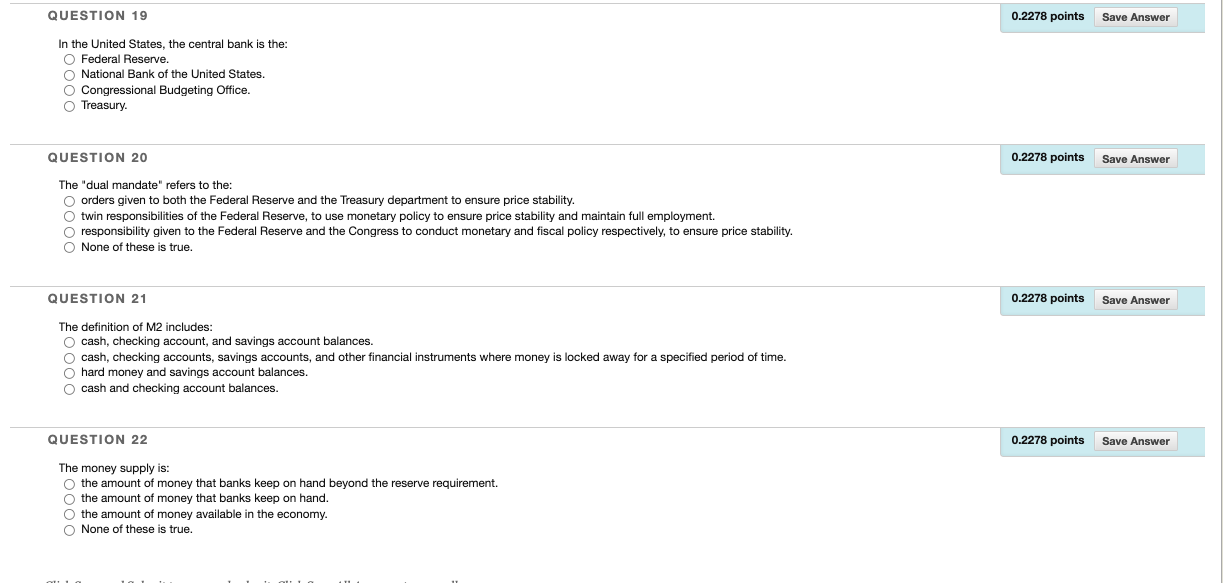
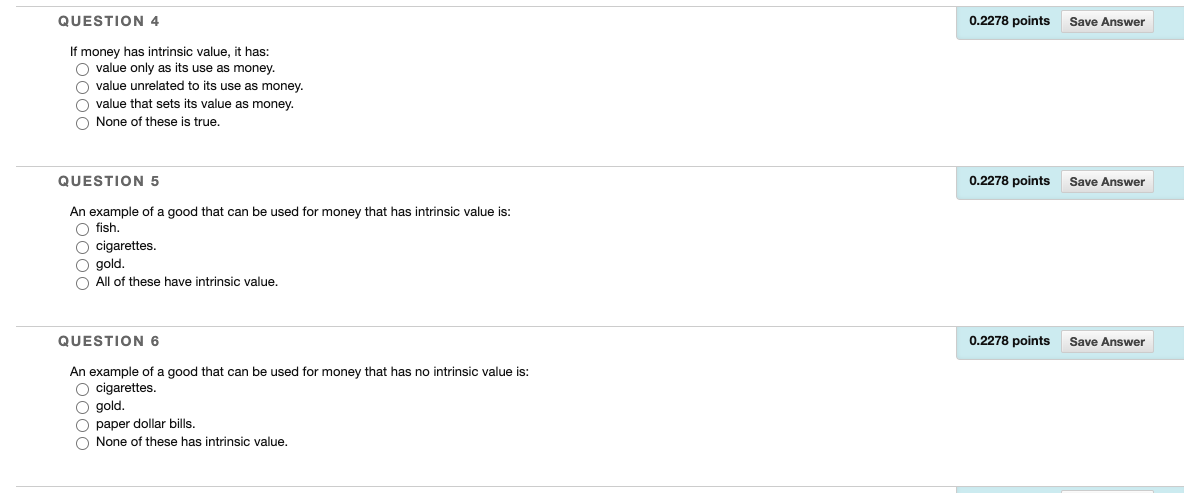
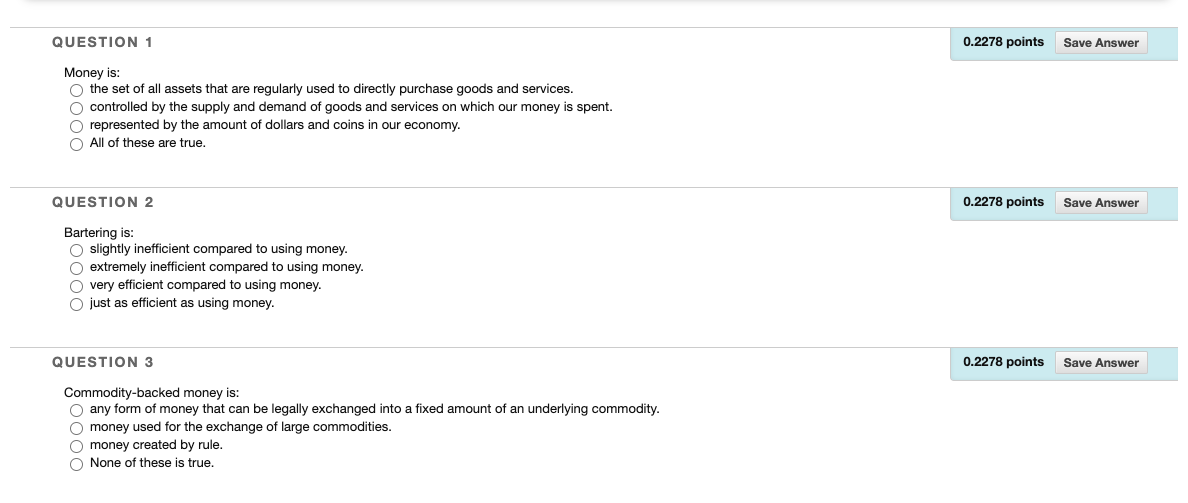
QUESTION 10 0.2278 points Save Answer An essential function of a central bank is to: issue debt. O manage the money supply. collect taxes. O All of these are true. QUESTION 11 0.2278 points Save Answer Liquidity refers to: O how easy an asset is to convert immediately to cash without losing value. O how quickly the average household spends its disposable income. how easy money converts to assets in an economy. O how quickly the same dollar changes hands in the economy. QUESTION 12 0.2278 points Save Answer The definition of M1 includes: cash and checking account balances. O cash and savings account balances. hard money and savings account balances. O cash, checking accounts, savings accounts, and other financial instruments where money is locked away for a specified period of time.QUESTION 16 0.2278 points Save Answer If fractional reserve banking exists, then: the money multiplier is greater than 1. O banks need only keep a portion of each deposit on hand. money can be created in the economy through banks. O All of these are true. QUESTION 17 0.2278 points Save Answer If the money multiplier is approximated to be 10, it means: the economy overall has 10 times the amount of deposits as cash that exists. banks create approximately 10 times the amount of cash in the economy. banks create 10 dollars in deposits from each original deposit of a dollar. All of these are true. QUESTION 18 0.2278 points Save Answer If the money multiplier is approximated to be 2, then the reserve ratio must be: 5 percent. O 20 percent. 2 percent. O 50 percent.QUESTION 7 0.2278 points Save Answer Fiat money is: O any form of money that can be legally exchanged into a fixed amount of an underlying commodity. O money used for the exchange of large commodities. O money created by rule. None of these is true. QUESTION 8 0.2278 points Save Answer Hard money: O) cannot always be used in transactions immediately, but is accessible. O includes cash. is the least narrow definition of money. O All of these are true. QUESTION 9 0.2278 points Save Answer One of the functions of money is to serve as a: O unit of account. O medium of exchange. O store of value. All of these are functions of money.QUESTION 13 0.2278 points Save Answer Your checking account balance would be counted in which measure of money? O Hard money M1 M2 It would be counted in both M1 and M2 QUESTION 14 0.2278 points Save Answer Your savings account balance would be counted in which measure of money? O M1 Hard money M2 It would be counted in both M1 and M2 QUESTION 15 0.2278 points Save Answer Banks create money in the economy by: O charging higher interest on savings than loans. O charging higher interest on loans than savings. loaning out part of each deposit, which will be redeposited by someone else. O Only the government can create money.QUESTION 19 0.2278 points Save Answer In the United States, the central bank is the: Federal Reserve. O National Bank of the United States. O Congressional Budgeting Office. O Treasury. QUESTION 20 0.2278 points Save Answer The "dual mandate" refers to the: O orders given to both the Federal Reserve and the Treasury department to ensure price stability. twin responsibilities of the Federal Reserve, to use monetary policy to ensure price stability and maintain full employment. responsibility given to the Federal Reserve and the Congress to conduct monetary and fiscal policy respectively, to ensure price stability. None of these is true. QUESTION 21 0.2278 points Save Answer The definition of M2 includes: O cash, checking account, and savings account balances. cash, checking accounts, savings accounts, and other financial instruments where money is locked away for a specified period of time. hard money and savings account balances. O cash and checking account balances. QUESTION 22 0.2278 points Save Answer The money supply is: O the amount of money that banks keep on hand beyond the reserve requirement. the amount of money that banks keep on hand. OO the amount of money available in the economy. None of these is true.QUESTION 4 0.2278 points Save Answer If money has intrinsic value, it has: O value only as its use as money. O value unrelated to its use as money. value that sets its value as money. O None of these is true. QUESTION 5 0.2278 points Save Answer An example of a good that can be used for money that has intrinsic value is: O fish. O cigarettes. O gold. O All of these have intrinsic value. QUESTION 6 0.2278 points Save Answer An example of a good that can be used for money that has no intrinsic value is: O cigarettes. O gold. O paper dollar bills. None of these has intrinsic value.QUESTION 1 0.2278 points Save Answer Money is: O the set of all assets that are regularly used to directly purchase goods and services. controlled by the supply and demand of goods and services on which our money is spent. OO represented by the amount of dollars and coins in our economy. O All of these are true. QUESTION 2 0.2278 points Save Answer Bartering is: O slightly inefficient compared to using money. O extremely inefficient compared to using money. O very efficient compared to using money. O just as efficient as using money. QUESTION 3 0.2278 points Save Answer Commodity-backed money is: O any form of money that can be legally exchanged into a fixed amount of an underlying commodity. money used for the exchange of large commodities. money created by rule. OO None of these is true
Step by Step Solution
There are 3 Steps involved in it

Get step-by-step solutions from verified subject matter experts
 Study Help