



Question: QUESTION 10 A pension fund manager is considering three mutual funds. The first is a stock fund, the second is a long-term government and corporate
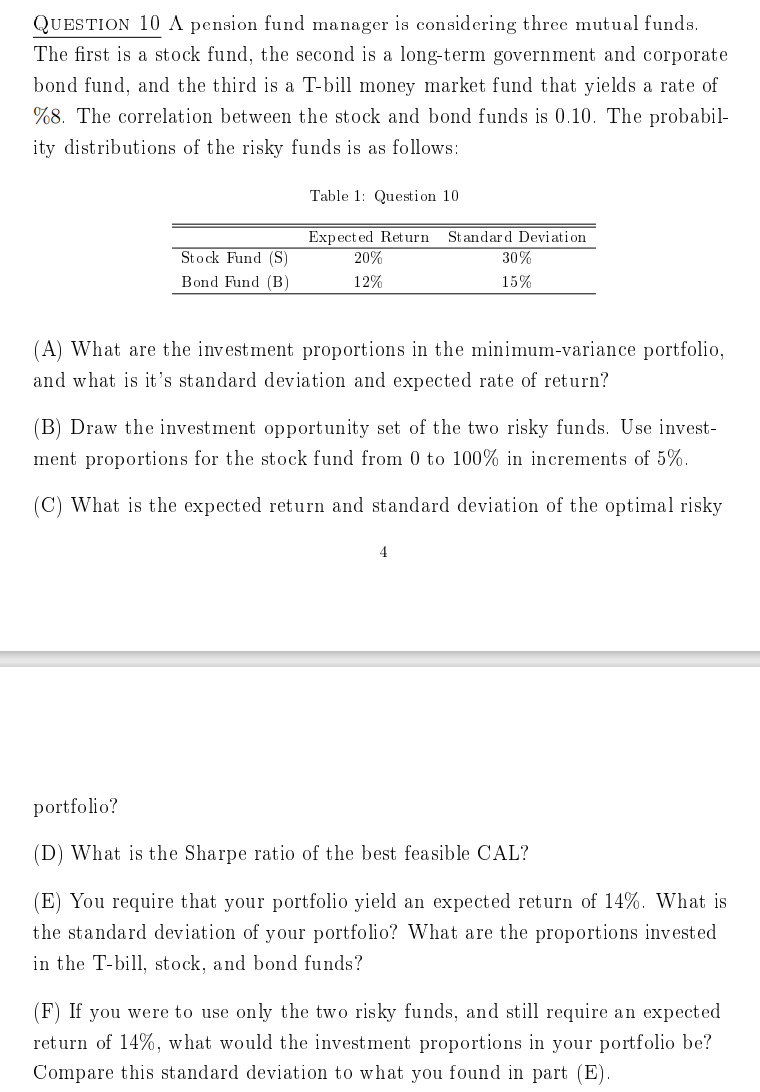
QUESTION 10 A pension fund manager is considering three mutual funds. The first is a stock fund, the second is a long-term government and corporate bond fund, and the third is a T-bill money market fund that yields a rate of %8. The correlation between the stock and bond funds is 0.10. The probabil- ity distributions of the risky funds is as follows: Table 1: Question 10 Stock Fund (S) Bond Fund (B Expected Return 20% 12% Standard Deviation 30% 15% (A) What are the investment proportions in the minimum-variance portfolio, and what is it's standard deviation and expected rate of return? (B) Draw the investment opportunity set of the two risky funds. Use invest- ment proportions for the stock fund from 0 to 100% in increments of 5%. (C) What is the expected return and standard deviation of the optimal risky portfolio? (D) What is the Sharpe ratio of the best feasible CAL? (E) You require that your portfolio yield an expected return of 14%. What is the standard deviation of your portfolio? What are the proportions invested in the T-bill, stock, and bond funds? (F) If you were to use only the two risky funds, and still require an expected return of 14%, what would the investment proportions in your portfolio be? Compare this standard deviation to what you found in part (E). QUESTION 10 A pension fund manager is considering three mutual funds. The first is a stock fund, the second is a long-term government and corporate bond fund, and the third is a T-bill money market fund that yields a rate of %8. The correlation between the stock and bond funds is 0.10. The probabil- ity distributions of the risky funds is as follows: Table 1: Question 10 Stock Fund (S) Bond Fund (B Expected Return 20% 12% Standard Deviation 30% 15% (A) What are the investment proportions in the minimum-variance portfolio, and what is it's standard deviation and expected rate of return? (B) Draw the investment opportunity set of the two risky funds. Use invest- ment proportions for the stock fund from 0 to 100% in increments of 5%. (C) What is the expected return and standard deviation of the optimal risky portfolio? (D) What is the Sharpe ratio of the best feasible CAL? (E) You require that your portfolio yield an expected return of 14%. What is the standard deviation of your portfolio? What are the proportions invested in the T-bill, stock, and bond funds? (F) If you were to use only the two risky funds, and still require an expected return of 14%, what would the investment proportions in your portfolio be? Compare this standard deviation to what you found in part (E)
Step by Step Solution
There are 3 Steps involved in it

Get step-by-step solutions from verified subject matter experts