







Question: 10 Consider the function defined implicitly by the following equation. { (x^2 + y^2 - 4x)^2 = 2(x^2 + y^2) } a) Apply implicit

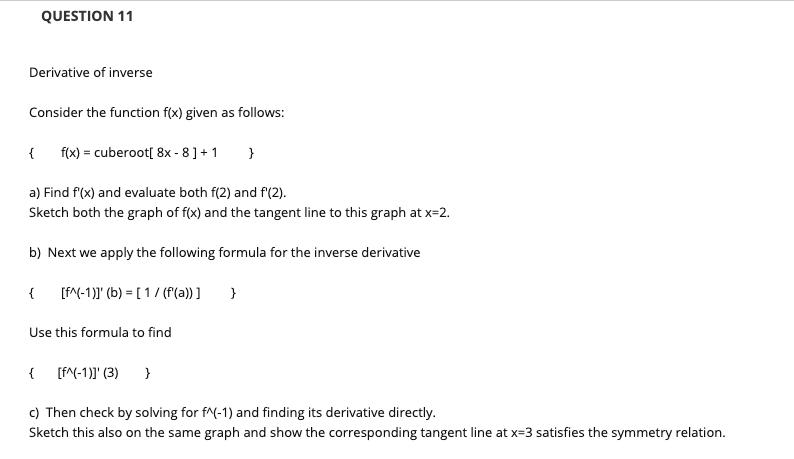
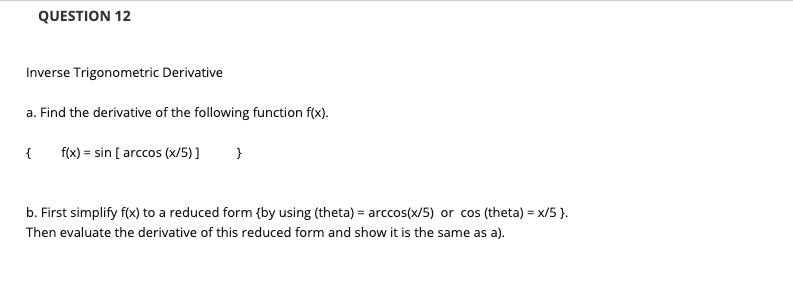
10 Consider the function defined implicitly by the following equation. { (x^2 + y^2 - 4x)^2 = 2(x^2 + y^2) } a) Apply implicit differentiation to find (dy/dx). b) Use this to find the equation of the tangent line to the graph at the point (1,-1). QUESTION 11 Derivative of inverse Consider the function f(x) given as follows: { f(x) = cuberoot[ 8x - 8] + 1 a) Find f(x) and evaluate both f(2) and f(2). Sketch both the graph of f(x) and the tangent line to this graph at x-2. b) Next we apply the following formula for the inverse derivative { [F^(-1)]" (b) = [1/ (f(a)) ] } Use this formula to find { [F^(-1)]' (3) } c) Then check by solving for f^(-1) and finding its derivative directly. Sketch this also on the same graph and show the corresponding tangent line at x=3 satisfies the symmetry relation. QUESTION 12 Inverse Trigonometric Derivative a. Find the derivative of the following function f(x). { f(x) = sin [ arccos (x/5)] b. First simplify f(x) to a reduced form {by using (theta) = arccos(x/5) or cos (theta) = x/5 }. Then evaluate the derivative of this reduced form and show it is the same as a).
Step by Step Solution
3.54 Rating (158 Votes )
There are 3 Steps involved in it

Get step-by-step solutions from verified subject matter experts
 Study Help