



Question: Question 10 SAT before class 970 1010 1130 880 1000 SAT after class 960 1030 1170 870 1010 Use the sample data shown above to
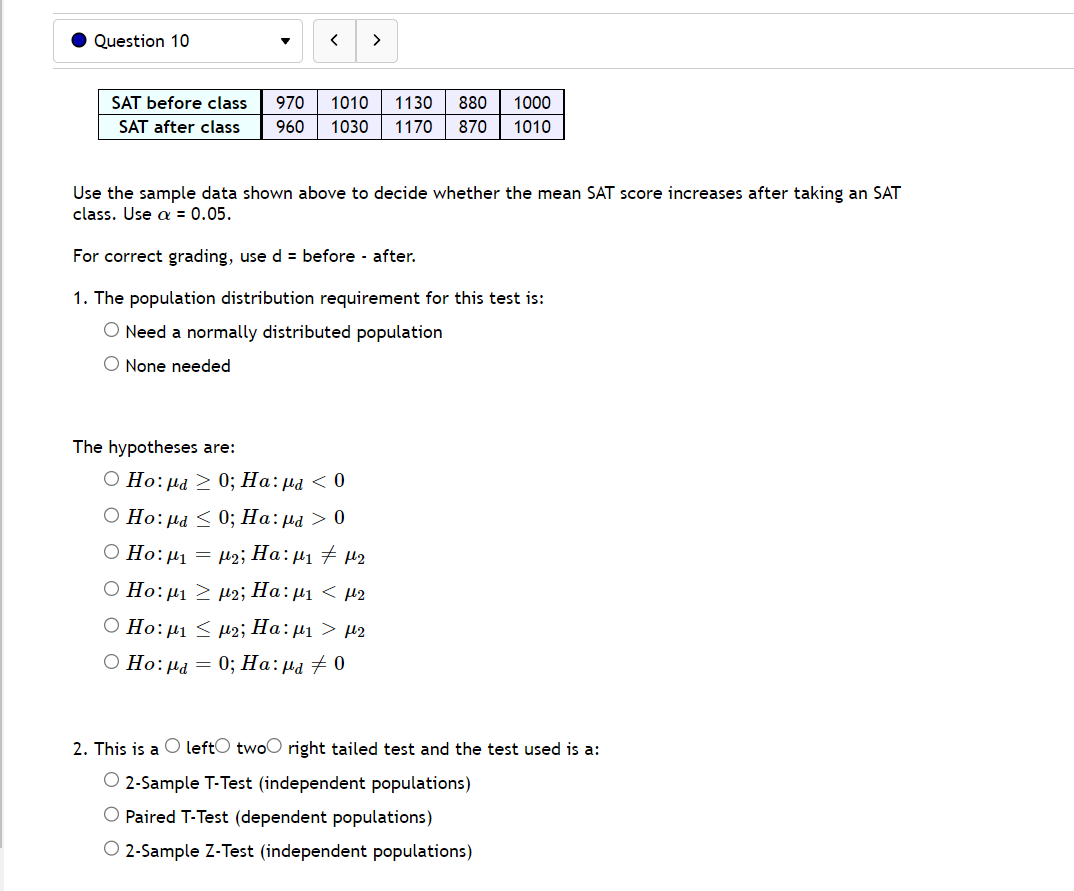
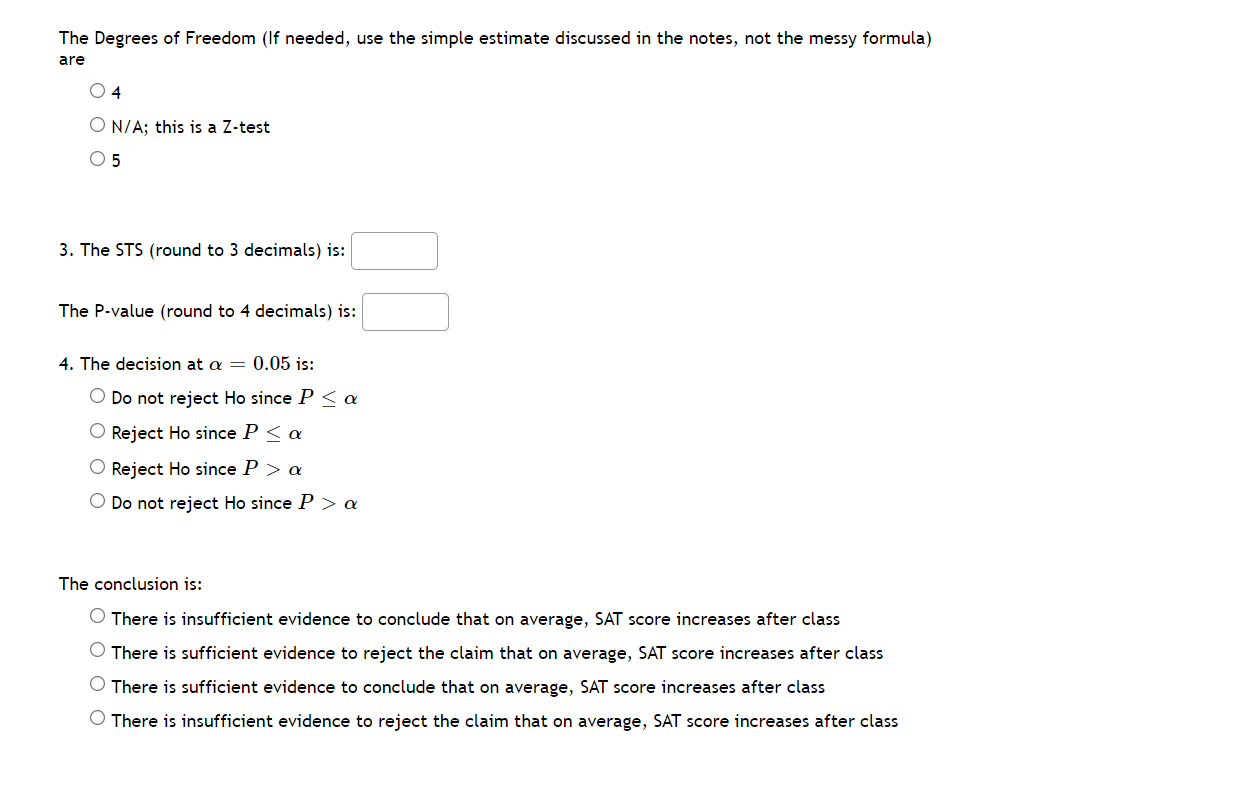
Question 10 SAT before class 970 1010 1130 880 1000 SAT after class 960 1030 1170 870 1010 Use the sample data shown above to decide whether the mean SAT score increases after taking an SAT class. Use a = 0.05. For correct grading, use d = before - after. 1. The population distribution requirement for this test is: O Need a normally distributed population O None needed The hypotheses are: O Ho: Ma 2 0; Ha: Ma 0 O Ho: M1 = 12; Ha: M1 / H2 O Ho: /1 2 12; Ha: p1 M2 O Ho: Ma = 0; Ha: Ha # 0 2. This is a O left two right tailed test and the test used is a: O 2-Sample T-Test (independent populations) O Paired T-Test (dependent populations) O 2-Sample Z-Test (independent populations)The Degrees of Freedom {If needed, use the simple estimate discussed in the notes, not the messy formula) are r"::::- 4 [35' WA; this is a Z-test 5 3. The STS {round to 3 decimals} is: The P-value (round to 4 decimals} is: 4. The decision at or : 0.05 is: Do not reject Ho since P :1 or '33:.3' Reject Ho since P g or Eli-3' Reject Ho since P :> or '5'} Do not reject Ho since P > or The conclusion is: "'3' There is insufficient evidence to conclude that on average, SAT score increases after class "'3' There is sufficient evidence to reject the claim that on average, SAT score increases after class \""3" There is sufficient evidence to conclude that on average, SAT score increases after class \"HZ-33' There is insufficient evidence to reject the claim that on average, SAT score increases after class
Step by Step Solution
There are 3 Steps involved in it

Get step-by-step solutions from verified subject matter experts