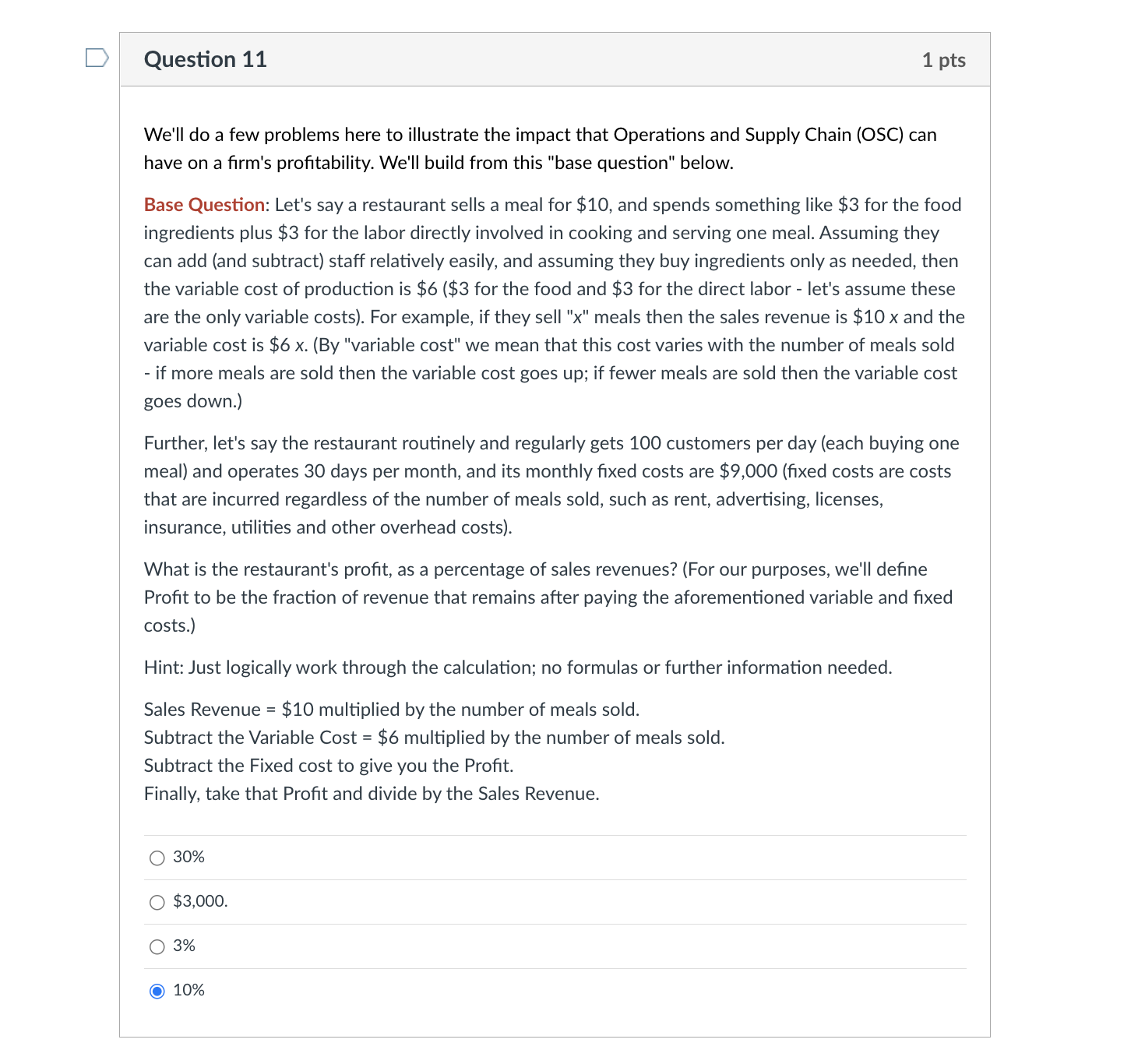
Question: Question 11 1 pts We'll do a few problems here to illustrate the impact that Operations and Supply Chain (05C) can have on a rm's
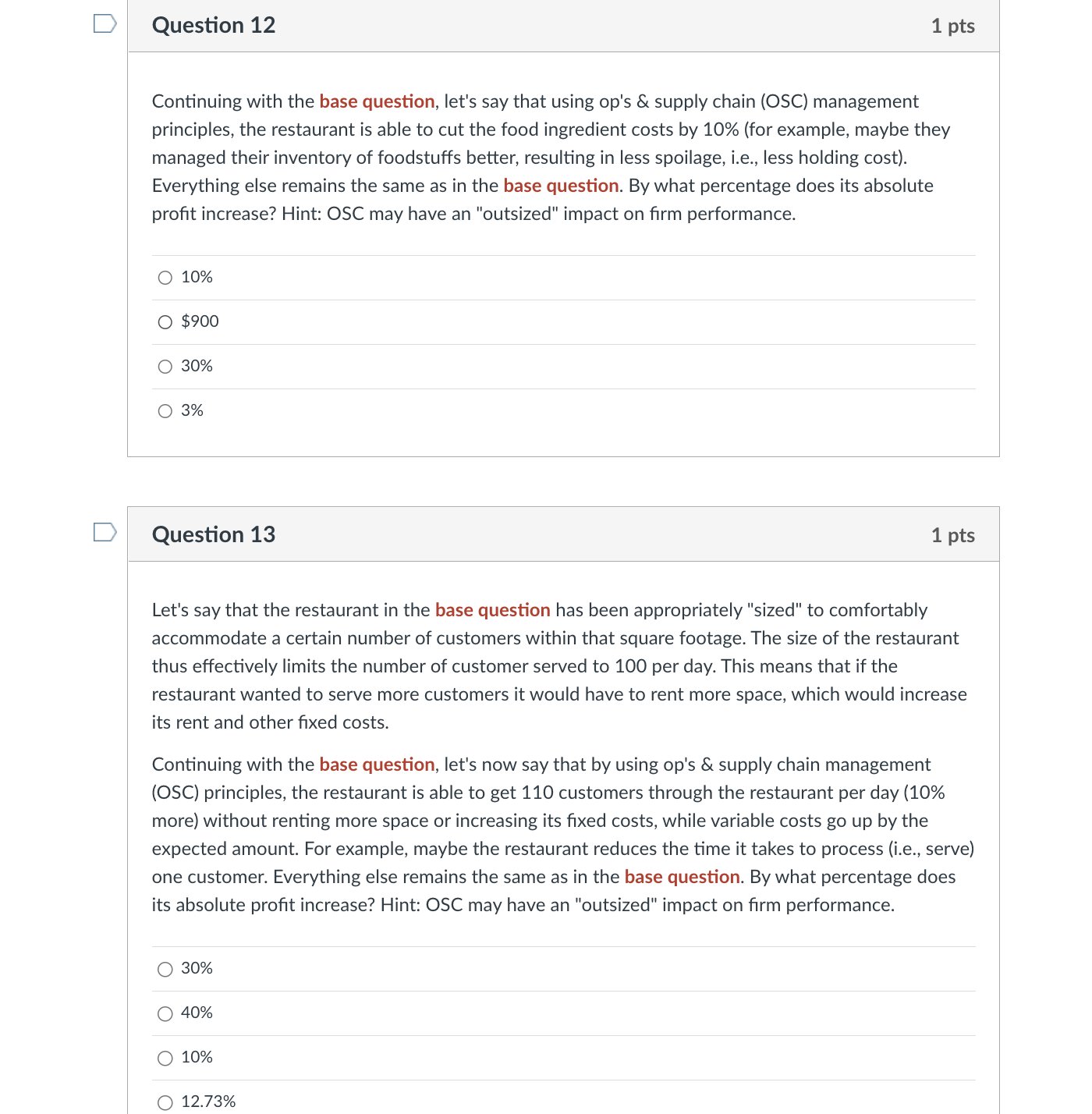
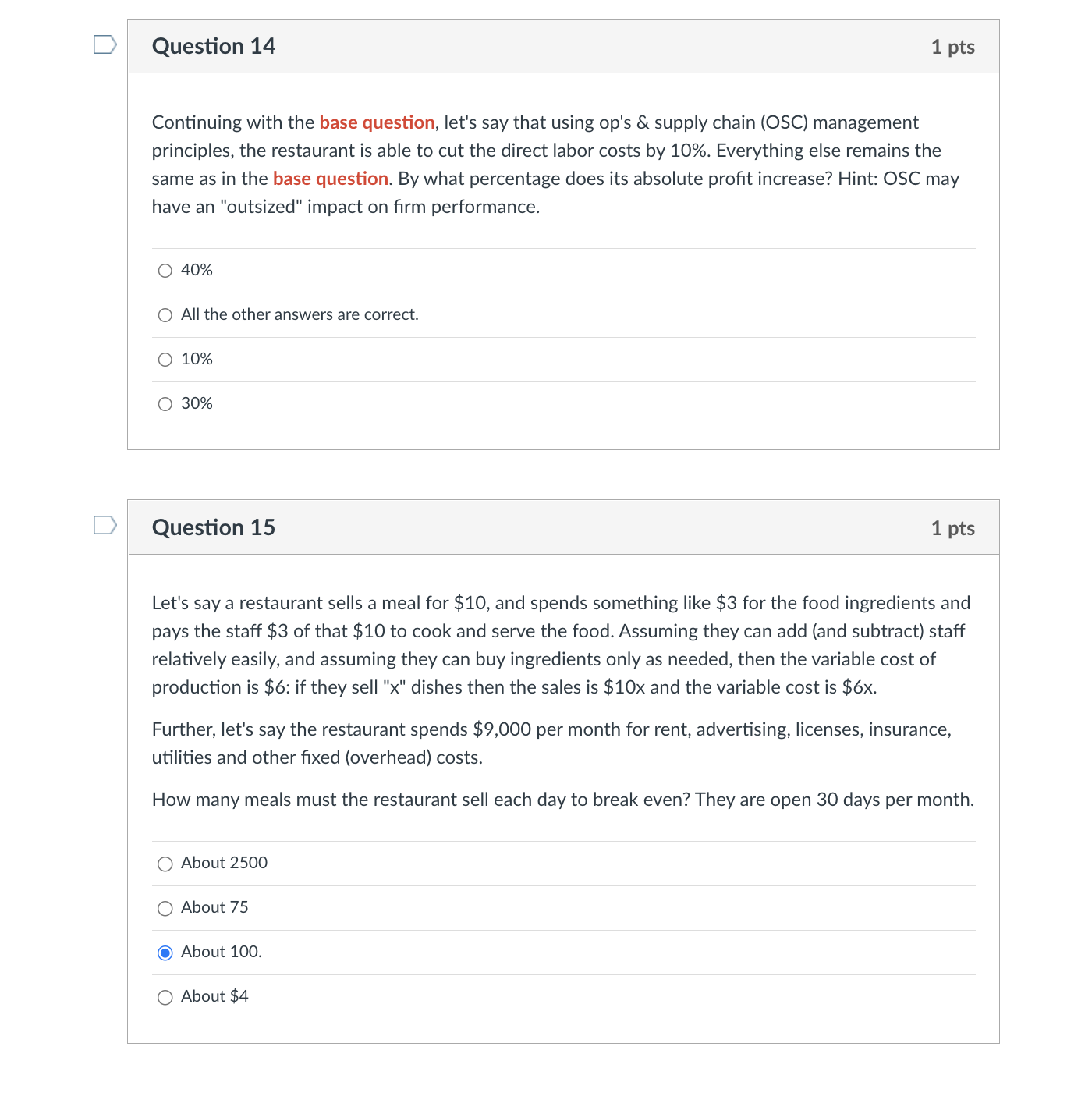
Question 11 1 pts We'll do a few problems here to illustrate the impact that Operations and Supply Chain (05C) can have on a rm's protability. We'll build from this "base question" below. Base Question: Let's say a restaurant sells a meal for $10, and spends something like $3 for the food ingredients plus $3 for the labor directly involved in cooking and sewing one meal. Assuming they can add (and subtract) staff relatively easily, and assuming they buy ingredients only as needed, then the variable cost of production is $6 ($3 for the food and $3 for the direct labor - let's assume these are the only variable costs). For example, if they sell "x" meals then the sales revenue is $10 x and the variable cost is $6 x. (By "variable cost" we mean that this cost varies with the number of meals sold - if more meals are sold then the variable cost goes up; if fewer meals are sold then the variable cost goes down.) Further, let's say the restaurant routinely and regularly gets 100 customers per day (each buying one meal) and operates 30 days per month, and its monthly xed costs are $9,000 (xed costs are costs that are incurred regardless of the number of meals sold, such as rent, advertising, licenses, insurance, utilities and other overhead costs). What is the restaurant's prot, as a percentage of sales revenues? (For our purposes, we'll dene Prot to be the fraction of revenue that remains after paying the aforementioned variable and xed costs.) Hint: Just logically work through the calculation; no formulas or further information needed. Sales Revenue = $10 multiplied by the number of meals sold. Subtract the Variable Cost = $6 multiplied by the number of meals sold. Subtract the Fixed cost to give you the Prot. Finally, take that Prot and divide by the Sales Revenue. 0 30% 0 $3,000. 03% 10% Question 12 1 pts Continuing with the base question, let's say that using op's & supply chain (OSC) management principles, the restaurant is able to cut the food ingredient costs by 10% (for example, maybe they managed their inventory of foodstuffs better, resulting in less spoilage, i.e., less holding cost). Everything else remains the same as in the base question. By what percentage does its absolute prot increase? Hint: OSC may have an "outsized" impact on rm performance. 0 10% 0 $900 0 30% 03% Question 13 1 pts Let's say that the restaurant in the base question has been appropriately "sized" to comfortably accommodate a certain number of customers within that square footage. The size of the restaurant thus effectively limits the number of customer served to 100 per day. This means that if the restaurant wanted to serve more customers it would have to rent more space, which would increase its rent and other xed costs. Continuing with the base question, let's now say that by using op's & supply chain management (OSC) principles, the restaurant is able to get 110 customers through the restaurant per day (10% more) without renting more space or increasing its xed costs, while variable costs go up by the expected amount. For example, maybe the restaurant reduces the time it takes to process (i.e., serve) one customer. Everything else remains the same as in the base question. By what percentage does its absolute prot increase? Hint: OSC may have an "outsized" impact on rm performance. 0 30% Q 40% o 10% O 12.73% Question 14 1 pts Continuing with the base question, let's say that using op's & supply chain (05C) management principles, the restaurant is able to cut the direct labor costs by 10%. Everything else remains the same as in the base question. By what percentage does its absolute prot increase? Hint: OSC may have an "outsized" impact on rm performance. 0 40% 0 All the other answers are correct. 0 10% O 30% Question 15 1 pts Let's say a restaurant sells a meal for $10, and spends something like $3 for the food ingredients and pays the staff $3 of that $10 to cook and serve the food. Assuming they can add (and subtract) staff relatively easily, and assuming they can buy ingredients only as needed, then the variable cost of production is $6: if they sell "x" dishes then the sales is $10x and the variable cost is $6x. Further, let's say the restaurant spends $9,000 per month for rent, advertising, licenses, insurance. utilities and other xed (overhead) costs. How many meals must the restaurant sell each day to break even? They are open 30 days per month. 0 About 2500 0 About 75 About 100. 0 About $4
Step by Step Solution
There are 3 Steps involved in it
1 Expert Approved Answer
Step: 1 Unlock
Question Has Been Solved by an Expert!
Get step-by-step solutions from verified subject matter experts
Step: 2 Unlock
Step: 3 Unlock
Students Have Also Explored These Related General Management Questions!









 Study Help