







Question: Question 12 - (20 pts): For a PID control system, the characteristic equation can be derived based on individual transfer functions from various steps the
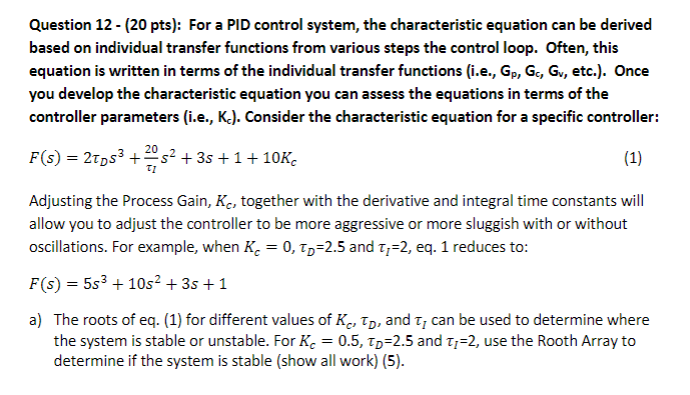
Question 12 - (20 pts): For a PID control system, the characteristic equation can be derived based on individual transfer functions from various steps the control loop. Often, this equation is written in terms of the individual transfer functions (i.e., Gp,Gc,Gv, etc.). Once you develop the characteristic equation you can assess the equations in terms of the controller parameters (i.e., Kc ). Consider the characteristic equation for a specific controller: F(s)=2Ds3+I20s2+3s+1+10Kc Adjusting the Process Gain, Kc, together with the derivative and integral time constants will allow you to adjust the controller to be more aggressive or more sluggish with or without oscillations. For example, when Kc=0,D=2.5 and I=2, eq. 1 reduces to: F(s)=5s3+10s2+3s+1 a) The roots of eq. (1) for different values of KC,D, and I can be used to determine where the system is stable or unstable. For Kc=0.5,D=2.5 and I=2, use the Rooth Array to determine if the system is stable (show all work)
Step by Step Solution
There are 3 Steps involved in it

Get step-by-step solutions from verified subject matter experts
 Study Help