







Question: Question 13. CloudRack provides web hosting services on its five servers. When a person requests a page from one of its hosted websites, the server
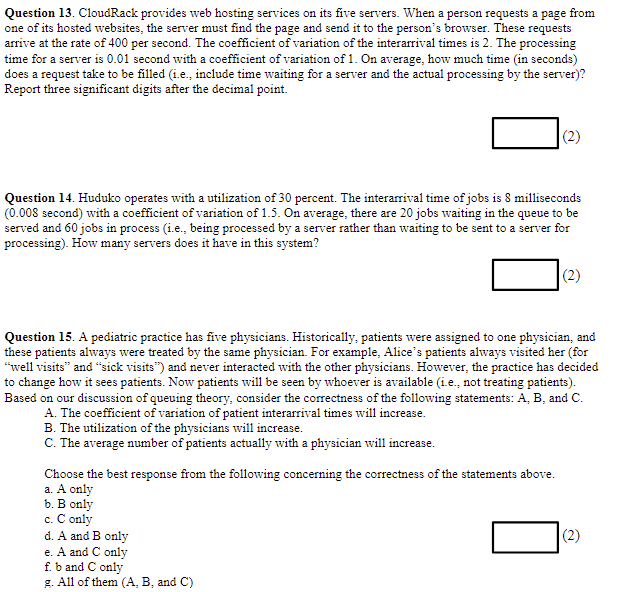
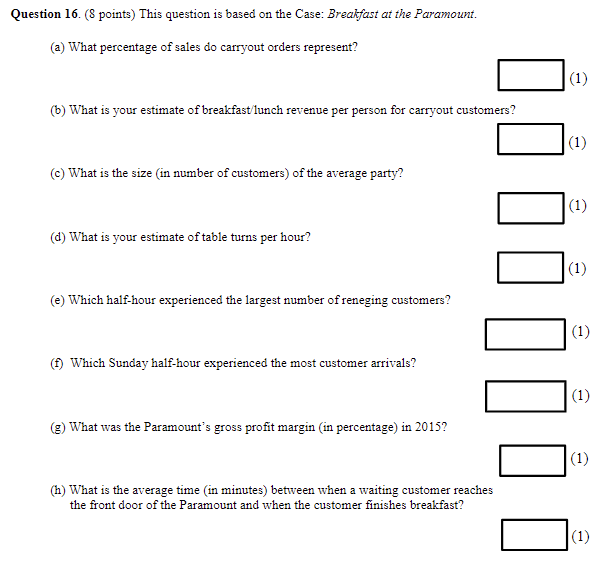
Question 13. CloudRack provides web hosting services on its five servers. When a person requests a page from one of its hosted websites, the server must find the page and send it to the person's browser. These requests arrive at the rate of 400 per second. The coefficient of variation of the interarrival times is 2 . The processing time for a server is 0.01 second with a coefficient of variation of 1 . On average, how much time (in seconds) does a request take to be filled (i.e., include time waiting for a server and the actual processing by the server)? Report three significant digits after the decimal point. Question 14. Huduko operates with a utilization of 30 percent. The interarrival time of jobs is 8 milliseconds (0.008 second) with a coefficient of variation of 1.5 . On average, there are 20 jobs waiting in the queve to be served and 60 jobs in process (i.e., being processed by a server rather than waiting to be sent to a server for processing). How many servers does it have in this system? Question 15. A pediatric practice has five physicians. Historically, patients were assigned to one physician, and these patients always were treated by the same physician. For example, Alice's patients always visited her (for "well visits" and "sick visits") and never interacted with the other physicians. However, the practice has decided to change how it sees patients. Now patients will be seen by whoever is available (i.e., not treating patients). Based on our discussion of queuing theory, consider the correctness of the following statements: A, B, and C. A. The coefficient of variation of patient interarrival times will increase. B. The utilization of the physicians will increase. C. The average number of patients actually with a physician will increase. Choose the best response from the following concerning the correctness of the statements above. a. A only b. B only c. C only d. A and B only (2) e. A and C only f. b and C only g. All of them (A, B, and C) Question 16. ( 8 points) This question is based on the Case: Breakfast at the Paramount. (a) What percentage of sales do carryout orders represent? (b) What is your estimate of breakfast/lunch revenue per person for carryout customers? (c) What is the size (in number of customers) of the average party? (d) What is your estimate of table turns per hour? (e) Which half-hour experienced the largest number of reneging customers? (f) Which Sunday half-hour experienced the most customer arrivals? (g) What was the Paramount's gross profit margin (in percentage) in 2015? (h) What is the average time (in minutes) between when a waiting customer reaches the front door of the Paramount and when the customer finishes breakfast
Step by Step Solution
There are 3 Steps involved in it

Get step-by-step solutions from verified subject matter experts
 Study Help