Question: Question 14 3 pts 14.) What does the term packet mean? (Ch. 6) A collection of binary digits - including message data and control characters
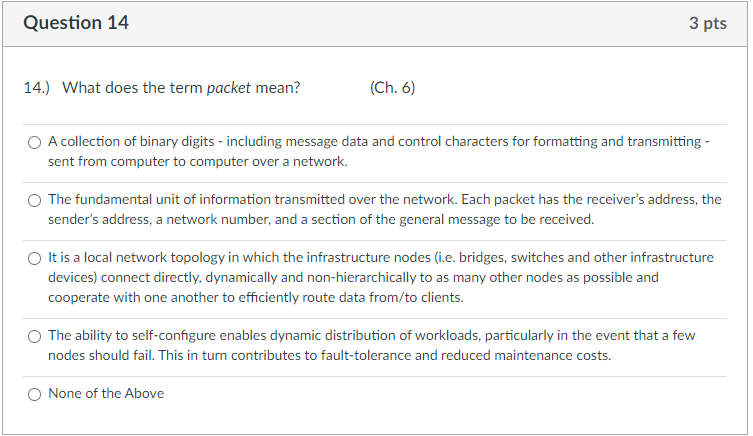
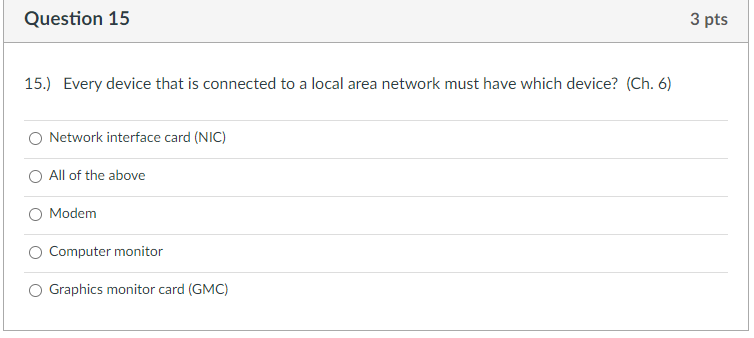
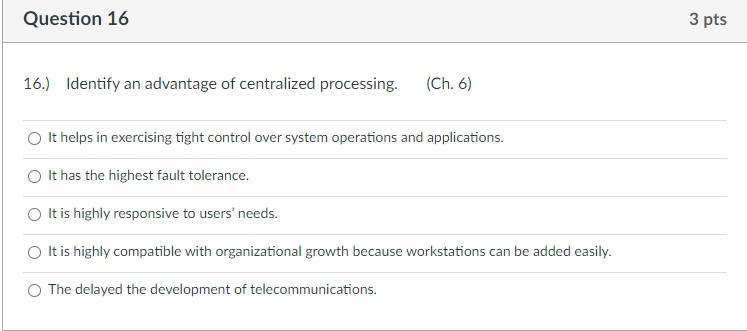
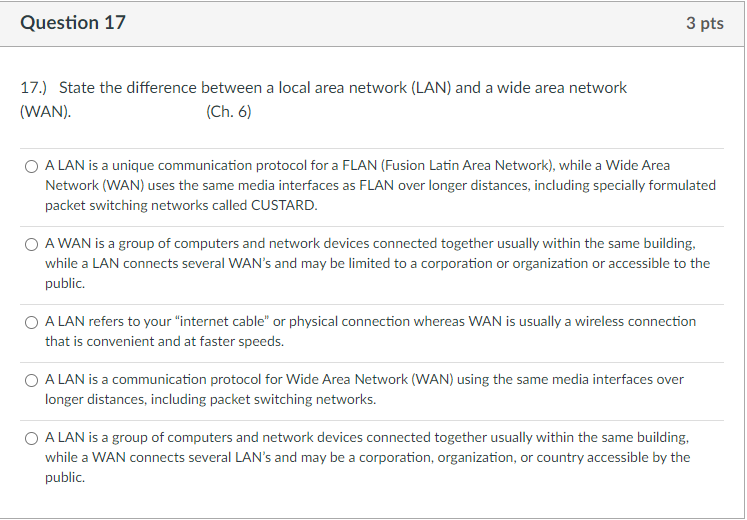
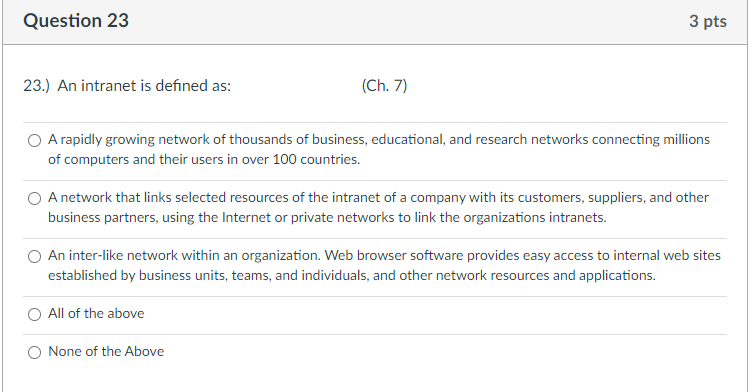
Question 14 3 pts 14.) What does the term packet mean? (Ch. 6) A collection of binary digits - including message data and control characters for formatting and transmitting - sent from computer to computer over a network. The fundamental unit of information transmitted over the network. Each packet has the receiver's address, the sender's address, a network number, and a section of the general message to be received. It is a local network topology in which the infrastructure nodes (i.e. bridges, switches and other infrastructure devices) connect directly, dynamically and non-hierarchically to as many other nodes as possible and cooperate with one another to efficiently route data from/to clients. The ability to self-configure enables dynamic distribution of workloads, particularly in the event that a few nodes should fail. This in turn contributes to fault-tolerance and reduced maintenance costs. None of the Above Question 15 3 pts 15.) Every device that is connected to a local area network must have which device? (Ch. 6) Network interface card (NIC) All of the above Modem Computer monitor Graphics monitor card (GMC) Question 16 16.) Identify an advantage of centralized processing. (Ch. 6) It helps in exercising tight control over system operations and applications. It has the highest fault tolerance. It is highly responsive to users' needs. It is highly compatible with organizational growth because workstations can be added easily. The delayed the development of telecommunications. 3 pts Question 17 3 pts 17.) State the difference between a local area network (LAN) and a wide area network (WAN). (Ch. 6) A LAN is a unique communication protocol for a FLAN (Fusion Latin Area Network), while a Wide Area Network (WAN) uses the same media interfaces as FLAN over longer distances, including specially formulated packet switching networks called CUSTARD. A WAN is a group of computers and network devices connected together usually within the same building, while a LAN connects several WAN's and may be limited to a corporation or organization or accessible to the public. A LAN refers to your "internet cable" or physical connection whereas WAN is usually a wireless connection that is convenient and at faster speeds. A LAN is a communication protocol for Wide Area Network (WAN) using the same media interfaces over longer distances, including packet switching networks. A LAN is a group of computers and network devices connected together usually within the same building, while a WAN connects several LAN's and may be a corporation, organization, or country accessible by the public. Question 23 3 pts 23.) An intranet is defined as: (Ch. 7) A rapidly growing network of thousands of business, educational, and research networks connecting millions of computers and their users in over 100 countries. A network that links selected resources of the intranet of a company with its customers, suppliers, and other business partners, using the Internet or private networks to link the organizations intranets. An inter-like network within an organization. Web browser software provides easy access to internal web sites established by business units, teams, and individuals, and other network resources and applications. All of the above None of the Above









 Study Help