



Question: Question 14 I'll never understand this accounting stuff, Blake Dunn yelled, waving the income statement he had just received from his accountant in the morning
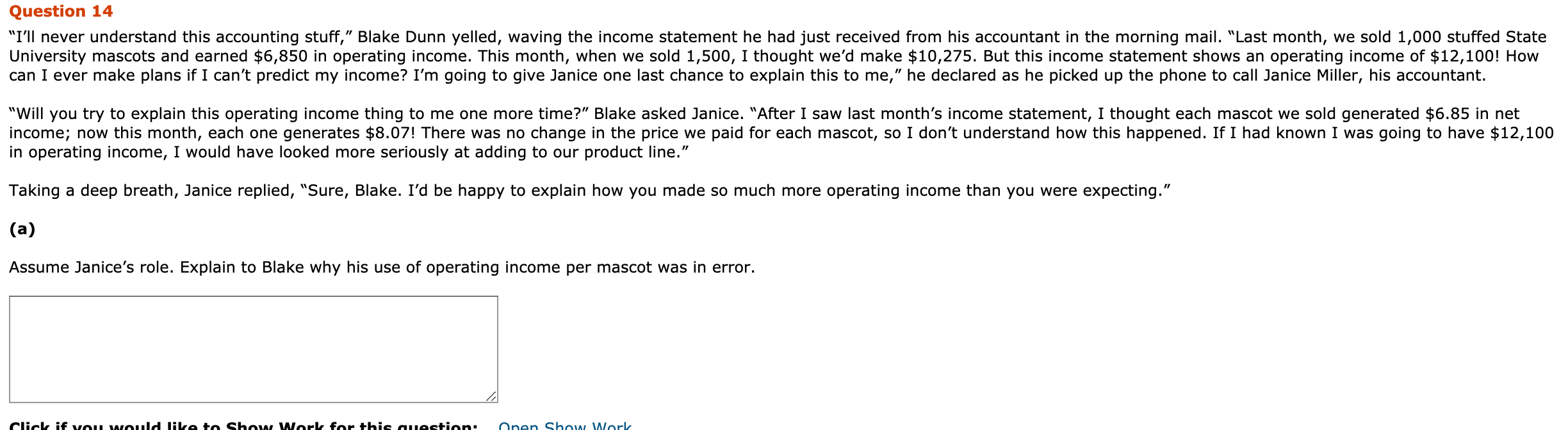
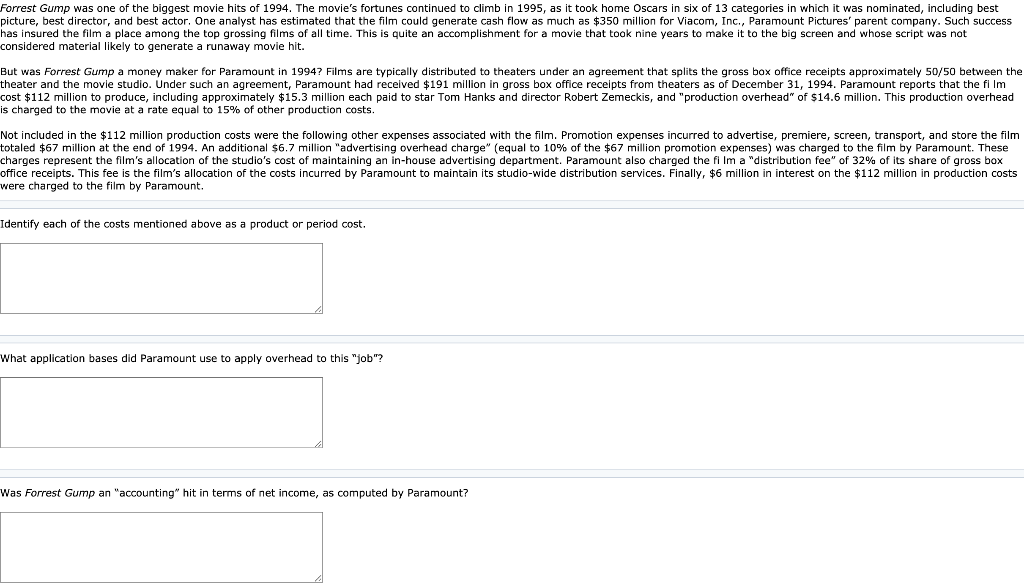
Question 14 "I'll never understand this accounting stuff," Blake Dunn yelled, waving the income statement he had just received from his accountant in the morning mail. "Last month, we sold 1,000 stuffed State University mascots and earned $6,850 in operating income. This month, when we sold 1,500, I thought we'd make $10,275. But this income statement shows an operating income of $12,100! How can I ever make plans if I can't predict my income? I'm going to give Janice one last chance to explain this to me," he declared as he picked up the phone to call Janice Miller, his accountant. "Will you try to explain this operating income thing to me one more time?" Blake asked Janice. "After I saw last month's income statement, I thought each mascot we sold generated $6.85 in net income; now this month, each one generates $8.07! There was no change in the price we paid for each mascot, so I don't understand how this happened. If I had known I was going to have $12,100 in operating income, I would have looked more seriously at adding to our product line." Taking a deep breath, Janice replied, "Sure, Blake. I'd be happy to explain how you made so much more operating income than you were expecting." (a) Assume Janice's role. Explain to Blake why his use of operating income per mascot was in error. Click if you would like to Show Work for this question Open Show Work Forrest Gump was one of the biggest movie hits of 1994. The movie's fortunes continued to climb in 1995, as it took home Oscars in six of 13 categories in which it was nominated, including best picture, best director, and best actor. One analyst has estimated that the film could generate cash flow as much as $350 million for Viacom, Inc., Paramount Pictures' parent company. Such success has insured the film a place among the top grossing films of all time. This is quite an accomplishment for a movie that took nine years to make it to the big screen and whose script was not considered material likely to generate a runaway movie hit. But was Forrest Gump a money maker for Paramount in 1994? Films are typically distributed to theaters under an agreement that splits the gross box office receipts approximately 50/50 between the theater and the movie studio. Under such an agreement, Paramount had received $191 million in gross box office receipts from theaters as of December 31, 1994. Paramount reports that the film cost $112 million to produce, including approximately $15.3 million each paid to star Tom Hanks and director Robert Zemeckis, and production overhead" of $14.6 million. This production overhead is charged to the mavie at a rate equal to 15% of other production costs. Not included in the $112 million production costs were the following other expenses associated with the film. Promotion expenses incurred to advertise, premiere, screen, transport, and store the film totaled $67 million at the end of 1994. An additional $6.7 million "advertising overhead charge" (equal to 10% of the $67 million promotion expenses) was charged to the film by Paramount. These charges represent the film's allocation of the studio's cost of maintaining an in-house advertising department. Paramount also charged the film a "distribution fee of 32% of its share of gross box office receipts. This fee is the film's allocation of the costs incurred by Paramount to maintain its studio-wide distribution services. Finally, $6 million in interest on the $112 million in production costs were charged to the film by Paramount. Identify each of the costs mentioned above as a product or period cost. What application bases did Paramount use to apply overhead to this "job"? Was Forrest Gump an "accounting" hit in terms of net income, as computed by Paramount? Question 14 "I'll never understand this accounting stuff," Blake Dunn yelled, waving the income statement he had just received from his accountant in the morning mail. "Last month, we sold 1,000 stuffed State University mascots and earned $6,850 in operating income. This month, when we sold 1,500, I thought we'd make $10,275. But this income statement shows an operating income of $12,100! How can I ever make plans if I can't predict my income? I'm going to give Janice one last chance to explain this to me," he declared as he picked up the phone to call Janice Miller, his accountant. "Will you try to explain this operating income thing to me one more time?" Blake asked Janice. "After I saw last month's income statement, I thought each mascot we sold generated $6.85 in net income; now this month, each one generates $8.07! There was no change in the price we paid for each mascot, so I don't understand how this happened. If I had known I was going to have $12,100 in operating income, I would have looked more seriously at adding to our product line." Taking a deep breath, Janice replied, "Sure, Blake. I'd be happy to explain how you made so much more operating income than you were expecting." (a) Assume Janice's role. Explain to Blake why his use of operating income per mascot was in error. Click if you would like to Show Work for this question Open Show Work Forrest Gump was one of the biggest movie hits of 1994. The movie's fortunes continued to climb in 1995, as it took home Oscars in six of 13 categories in which it was nominated, including best picture, best director, and best actor. One analyst has estimated that the film could generate cash flow as much as $350 million for Viacom, Inc., Paramount Pictures' parent company. Such success has insured the film a place among the top grossing films of all time. This is quite an accomplishment for a movie that took nine years to make it to the big screen and whose script was not considered material likely to generate a runaway movie hit. But was Forrest Gump a money maker for Paramount in 1994? Films are typically distributed to theaters under an agreement that splits the gross box office receipts approximately 50/50 between the theater and the movie studio. Under such an agreement, Paramount had received $191 million in gross box office receipts from theaters as of December 31, 1994. Paramount reports that the film cost $112 million to produce, including approximately $15.3 million each paid to star Tom Hanks and director Robert Zemeckis, and production overhead" of $14.6 million. This production overhead is charged to the mavie at a rate equal to 15% of other production costs. Not included in the $112 million production costs were the following other expenses associated with the film. Promotion expenses incurred to advertise, premiere, screen, transport, and store the film totaled $67 million at the end of 1994. An additional $6.7 million "advertising overhead charge" (equal to 10% of the $67 million promotion expenses) was charged to the film by Paramount. These charges represent the film's allocation of the studio's cost of maintaining an in-house advertising department. Paramount also charged the film a "distribution fee of 32% of its share of gross box office receipts. This fee is the film's allocation of the costs incurred by Paramount to maintain its studio-wide distribution services. Finally, $6 million in interest on the $112 million in production costs were charged to the film by Paramount. Identify each of the costs mentioned above as a product or period cost. What application bases did Paramount use to apply overhead to this "job"? Was Forrest Gump an "accounting" hit in terms of net income, as computed by Paramount
Step by Step Solution
There are 3 Steps involved in it

Get step-by-step solutions from verified subject matter experts