







Question: Question 1.4 - Parallelizing Counting with Hashing Now imagine you have a hash function which maps from any 64-bit input uniformly to a 32-bit hash
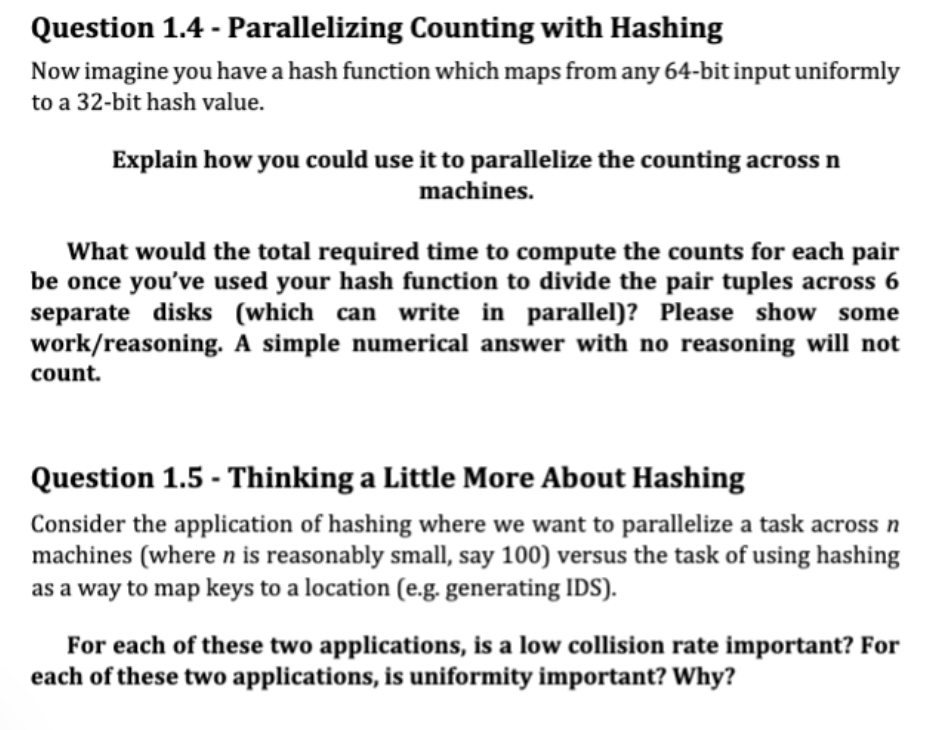
Question 1.4 - Parallelizing Counting with Hashing Now imagine you have a hash function which maps from any 64-bit input uniformly to a 32-bit hash value. Explain how you could use it to parallelize the counting across n machines. What would the total required time to compute the counts for each pair be once you've used your hash function to divide the pair tuples across 6 separate disks (which can write in parallel)? Please show some work/reasoning. A simple numerical answer with no reasoning will not count. Question 1.5 - Thinking a Little More About Hashing Consider the application of hashing where we want to parallelize a task across n machines (where n is reasonably small, say 100) versus the task of using hashing as a way to map keys to a location (e.g. generating IDS). For each of these two applications, is a low collision rate important? For each of these two applications, is uniformity important? Why
Step by Step Solution
There are 3 Steps involved in it

Get step-by-step solutions from verified subject matter experts
 Study Help