







Question: Question 15: Consider a table H which has six columns: col1, col2, col3, col4, col5, col6. Domain of each column is the set of integer
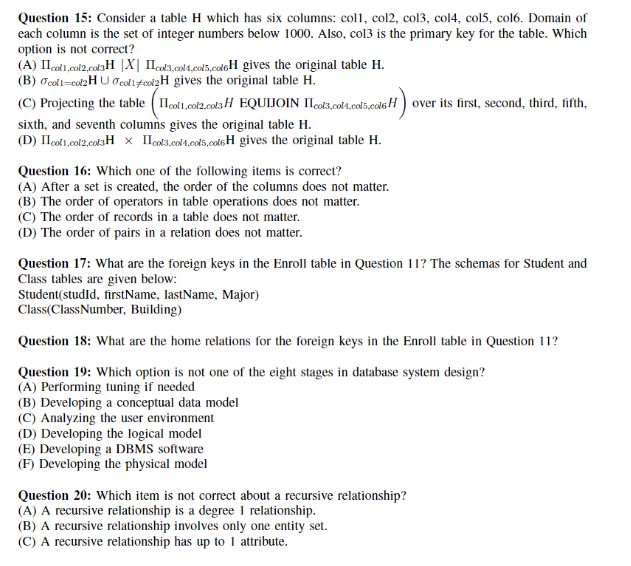
Question 15: Consider a table H which has six columns: col1, col2, col3, col4, col5, col6. Domain of each column is the set of integer numbers below 1000. Also, col3 is the primary key for the table. Which option is not correct? (A) col1,col2,col3HXcol3,coll,col5,col6H gives the original table H. (B) coll1=col2Hcol1=col2H gives the original table H. (C) Projecting the table (col1,col2,col3H EQUIJOIN col3,,col4,col5,col6H) over its first, second, third, fifth, sixth, and seventh columns gives the original table H. (D) col1,col2,col3Hcol3,col, col 5, col 6 H gives the original table H. Question 16: Which one of the following items is correct? (A) After a set is created, the order of the columns does not matter. (B) The order of operators in table operations does not matter. (C) The order of records in a table does not matter. (D) The order of pairs in a relation does not matter. Question 17: What are the foreign keys in the Enroll table in Question 11? The schemas for Student and Class tables are given below: Student(studId, firstName, lastName, Major) Class(ClassNumber, Building) Question 18: What are the home relations for the foreign keys in the Enroll table in Question 11? Question 19: Which option is not one of the eight stages in database system design? (A) Performing tuning if needed (B) Developing a conceptual data model (C) Analyzing the user environment (D) Developing the logical model (E) Developing a DBMS software (F) Developing the physical model Question 20: Which item is not correct about a recursive relationship? (A) A recursive relationship is a degree 1 relationship. (B) A recursive relationship involves only one entity set. (C) A recursive relationship has up to 1 attribute
Step by Step Solution
There are 3 Steps involved in it

Get step-by-step solutions from verified subject matter experts
 Study Help