







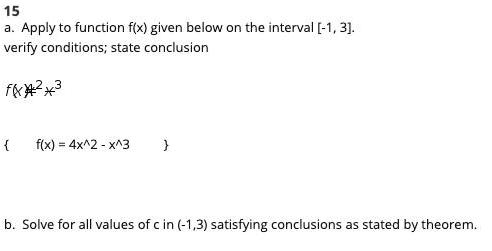
Question: 15 a. Apply to function f(x) given below on the interval [-1, 3]. verify conditions; state conclusion { f(x) = 4x^2 - x^3 b.
![3]. verify conditions; state conclusion { f(x) = 4x^2 - x^3 b.](https://dsd5zvtm8ll6.cloudfront.net/si.experts.images/questions/2021/05/6099f81eb5c7c_ScreenShot20210510at11.20.57PM.png)
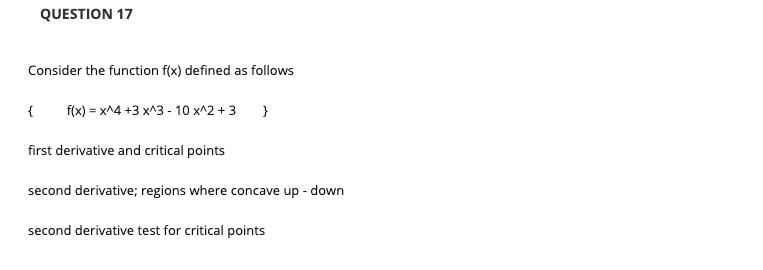

15 a. Apply to function f(x) given below on the interval [-1, 3]. verify conditions; state conclusion { f(x) = 4x^2 - x^3 b. Solve for all values of c in (-1,3) satisfying conclusions as stated by theorem. QUESTION 16 Consider the function f(x) given by the following { f(x) = (x-3)^2 (x+1) } a) Find all critical points of f(x) b) Use these critical points to determine regions where f(x) is Increasing and regions where decreasing. c) Use this information to classify each critical point as a relative maximum, a relative minimum, or neither. Find the second derivative f"(x). Verify the second derivative test also gives the same result. QUESTION 17 Consider the function f(x) defined as follows { f(x) = x^4 +3 x^3 - 10 x^2 + 3 } first derivative and critical points second derivative; regions where concave up - down second derivative test for critical points QUESTION 18 limits at infinity Evaluate each of the following limits at infinity a) { lim_(x -> infty) [ (x^2 + 3x - 2) / (3x^3 - 2x + 1) ] } b) { lim_(x -> infty ) [( e^t)/(2e^t+ e^(-t))] }
Step by Step Solution
3.49 Rating (162 Votes )
There are 3 Steps involved in it

Get step-by-step solutions from verified subject matter experts
 Study Help