







Question: Question 15. Version 1*/1. Score: 111 Suppose at) and f'(x) are continuous but restricted to the interval 0 S m S 20, and assume the
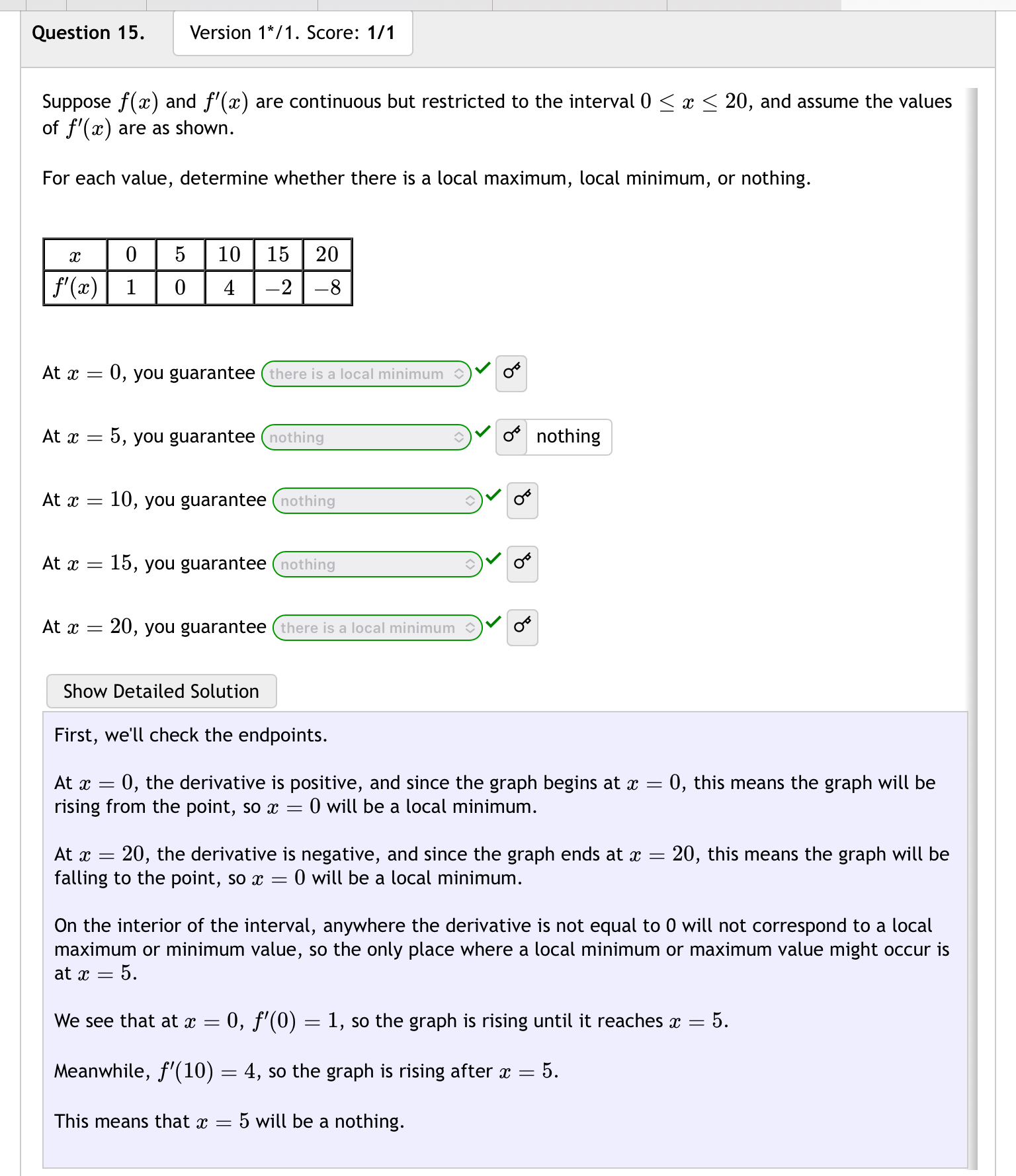
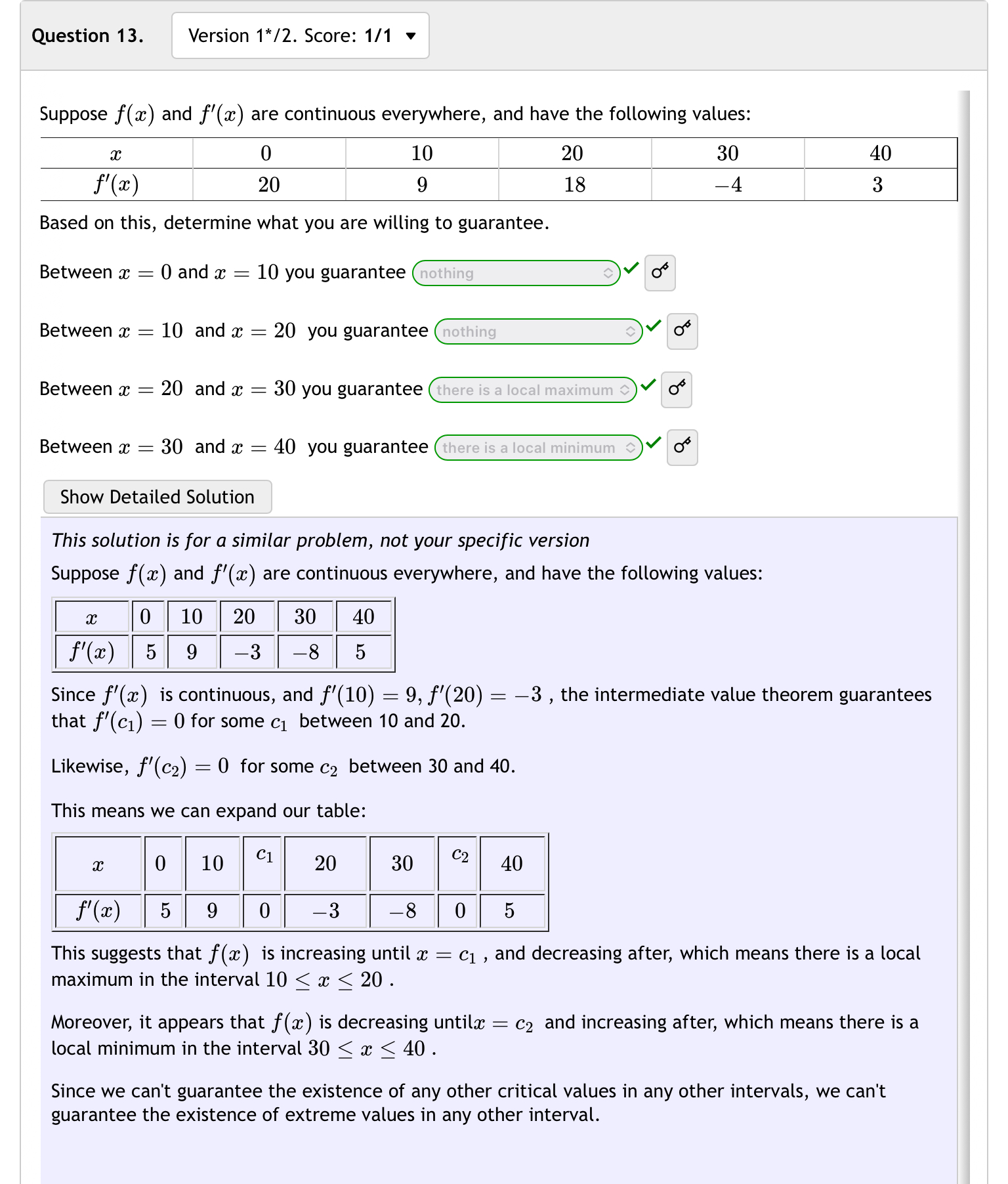
Question 15. Version 1*/1. Score: 111 Suppose at) and f'(x) are continuous but restricted to the interval 0 S m S 20, and assume the values of f'(m) are as shown. For each value, determine whether there is a local maximum, local minimum, or nothing. "II-n "\"3! At .7; = 0, you guarantee :DV 0" At .7; = 5, you guarantee (:V 0\" nothing At a: = 10, you guarantee (:V 0" At .7; = 15, you guarantee 2\" 0" At a: = 20, you guarantee (:V 0" Show Detailed Solution First, we'll check the endpoints. At m : O, the derivative is positive, and since the graph begins at m : 0, this means the graph will be rising from the point, so a: = 0 will be a local minimum. At m : 20, the derivative is negative, and since the graph ends at a: : 20, this means the graph will be falling to the point, so m : 0 will be a local minimum. On the interior of the interval, anywhere the derivative is not equal to 0 will not correspond to a local maximum or minimum value, so the only place where a local minimum or maximum value might occur is at :8 : 5. We see that at a: = 0, f'(0) : 1, so the graph is rising until it reaches x = 5. Meanwhile, f'(10) : 4, so the graph is rising after a: = 5. This means that a: = 5 will be a nothing. Question 13. Version 1*/2. Score: 111 v Suppose at) and f'(a:) are continuous everywhere, and have the following values: :1: O 10 2O 30 4O f'(9:) 20 9 18 i4 3 Based on this, determine what you are willing to guarantee. Between 93 = 0 and 2: = 10 you guarantee (:V cr' Between :1: = 10 and :1: = 20 you guarantee :)V 0\" Between .7; = 20 and :L- = 30 you guarantee 2\" (3' Between a: = 30 and a: = 40 you guarantee :D" 0" Show Detailed Solution This solution is for a similar problem, not your specific version Suppose f(.'B) and f'(m) are continuous everywhere, and have the following values: TWWWWW m) FWWWW Since f'(:1:) is continuous, and f'(10) : 9, f'(20) : 3 , the intermediate value theorem guarantees that f'(cl) : O for some 01 between 10 and 20. Likewise, f'(cz) = O for some (:2 between 30 and 40. This means we can expand our table: at 010 cl 20 30 62 40 WFWWWWWW This suggests that at) is increasing until m = c1 , and decreasing after, which means there is a local maximum in the interval 10 S a\": S 20 . Moreover, it appears that f(.'L') is decreasing untila': : c2 and increasing after, which means there is a local minimum in the interval 30 S :1: S 40 . Since we can't guarantee the existence of any other critical values in any other intervals, we can't guarantee the existence of extreme values in any other interval
Step by Step Solution
There are 3 Steps involved in it

Get step-by-step solutions from verified subject matter experts
 Study Help