







Question: Question 17 (2.5 points) The CREATE DATABASE statement creates two files on the hard drive of the server: a data file and a index file
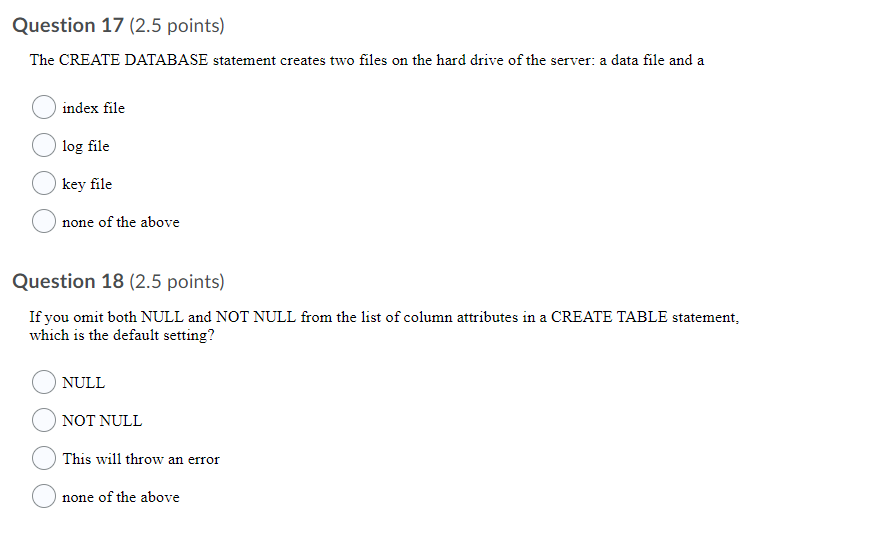
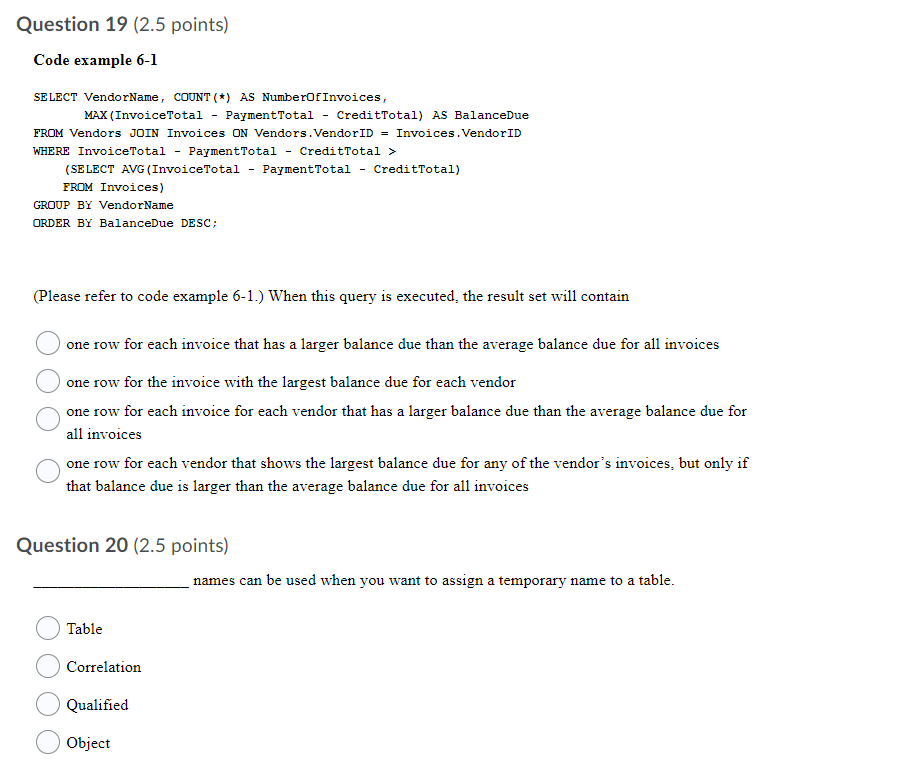
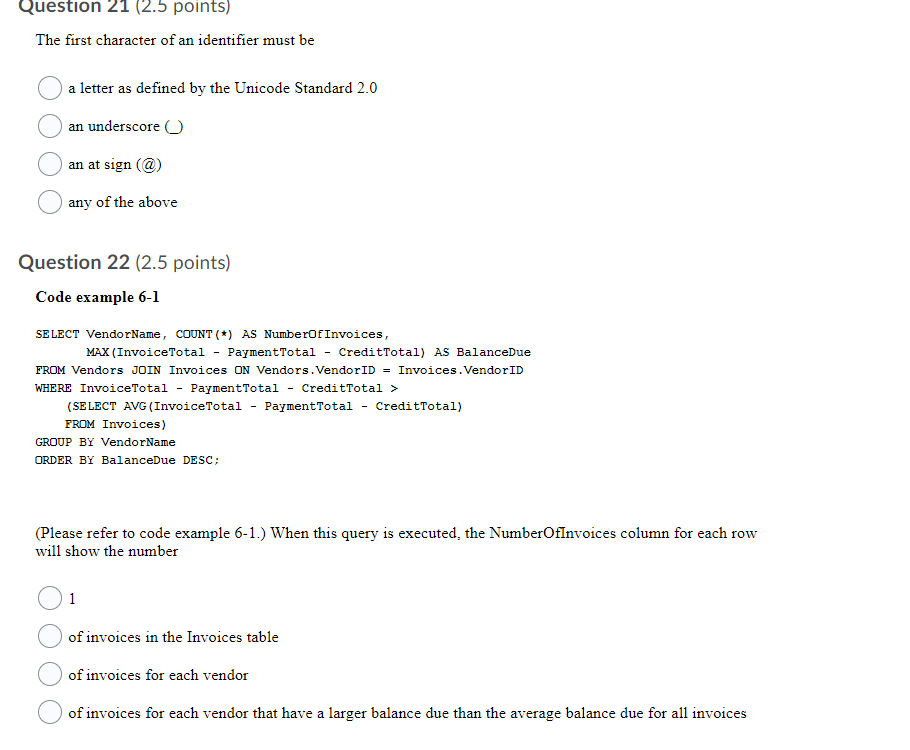
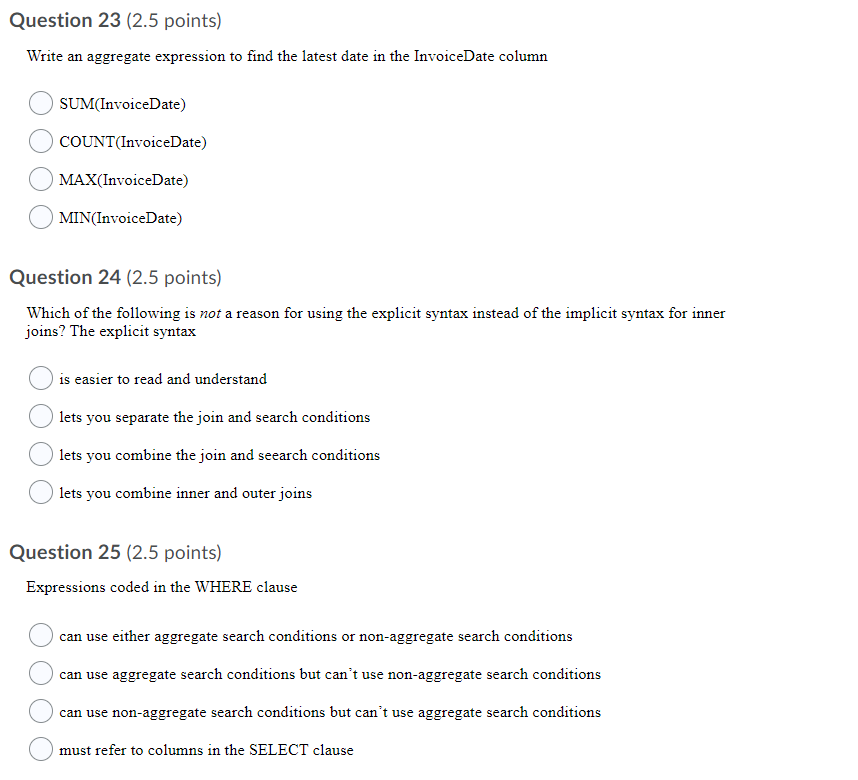
Question 17 (2.5 points) The CREATE DATABASE statement creates two files on the hard drive of the server: a data file and a index file log file key file none of the above Question 18 (2.5 points) If you omit both NULL and NOT NULL from the list of column attributes in a CREATE TABLE statement, which is the default setting? NULL NOT NULL This will throw an error none of the above Question 19 (2.5 points) Code example 6-1 SELECT VendorName, COUNT(*) AS NumberOfInvoices, MAX (InvoiceTotal Payment Total - Credittotal) AS BalanceDue FROM Vendors JOIN Invoices ON Vendors. VendorID = Invoices. VendorID WHERE InvoiceTotal Payment Total CreditTotal > (SELECT AVG(InvoiceTotal Payment Total CreditTotal) FROM Invoices) GROUP BY VendorName ORDER BY BalanceDue DESC; (Please refer to code example 6-1.) When this query is executed, the result set will contain one row for each invoice that has a larger balance due than the average balance due for all invoices one row for the invoice with the largest balance due for each vendor one row for each invoice for each vendor that has a larger balance due than the average balance due for all invoices one row for each vendor that shows the largest balance due for any of the vendor's invoices, but only if that balance due is larger than the average balance due for all invoices Question 20 (2.5 points) names can be used when you want to assign a temporary name to a table. Table Correlation Qualified Object Question 21 (2.5 points) The first character of an identifier must be a letter as defined by the Unicode Standard 2.0 an underscore 0 an at sign (@) any of the above Question 22 (2.5 points) Code example 6-1 SELECT VendorName, COUNT(*) AS NumberOfInvoices, MAX (InvoiceTotal - PaymentTotal - CreditTotal) AS BalanceDue FROM Vendors JOIN Invoices ON Vendors. VendorID = Invoices. VendorID WHERE Invoice Total PaymentTotal CreditTotal > (SELECT AVG(InvoiceTotal Payment Total CreditTotal) FROM Invoices) GROUP BY VendorName ORDER BY BalanceDue DESC; (Please refer to code example 6-1.) When this query is executed, the NumberOfInvoices column for each row will show the number 1 of invoices in the Invoices table of invoices for each vendor of invoices for each vendor that have a larger balance due than the average balance due for all invoices Question 23 (2.5 points) Write an aggregate expression to find the latest date in the InvoiceDate column SUM(InvoiceDate) COUNT(InvoiceDate) MAX(InvoiceDate) MIN(InvoiceDate) Question 24 (2.5 points) Which of the following is not a reason for using the explicit syntax instead of the implicit syntax for inner joins? The explicit syntax is easier to read and understand lets you separate the join and search conditions | lets you combine the join and seearch conditions lets you combine inner and outer joins Question 25 (2.5 points) Expressions coded in the WHERE clause can use either aggregate search conditions or non-aggregate search conditions can use aggregate search conditions but can't use non-aggregate search conditions can use non-aggregate search conditions but can't use aggregate search conditions must refer to columns in the SELECT clause
Step by Step Solution
There are 3 Steps involved in it

Get step-by-step solutions from verified subject matter experts
 Study Help