







Question: Question 17 Consider the following create table statements: ger primary key); create table R (a inte create table S (b integer primary key, c integer
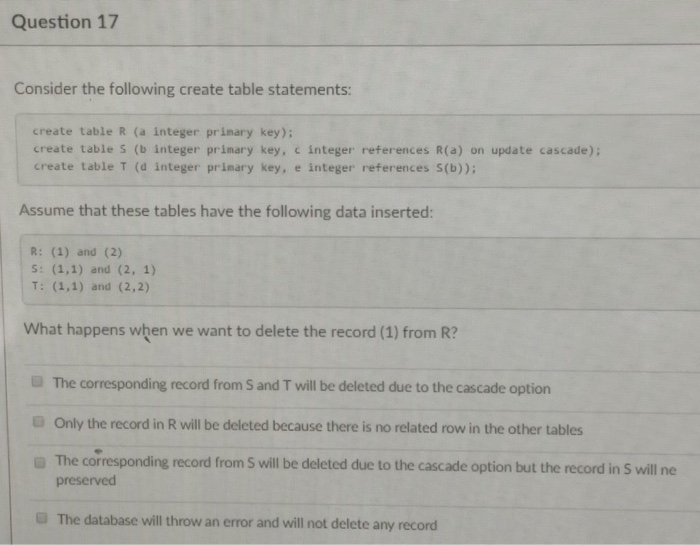
Question 17 Consider the following create table statements: ger primary key); create table R (a inte create table S (b integer primary key, c integer references R(a) on update cascade); create table T (d integer primary key, e integer references S(b)) Assume that these tables have the following data inserted: R: (1) and (2) S: (1,1) and (2, 1) T: (1,1) and (2,2) What happens when we want to delete the record (1) from R? The corresponding record from S and T will be deleted due to the cascade option a Only the record in R will be deleted because there is no related row in the other tables a The corresponding record from S will be deleted due to the cascade option but the record in S will ne preserved The database will throw an error and will not delete any record
Step by Step Solution
There are 3 Steps involved in it

Get step-by-step solutions from verified subject matter experts
 Study Help