





Question: QUESTION 18 10 points Save trener Save Answer check-in process (check-In takes no timex Second, it was discovered that even though customers had appointments every
QUESTION 18 10 points Save trener Save Answer

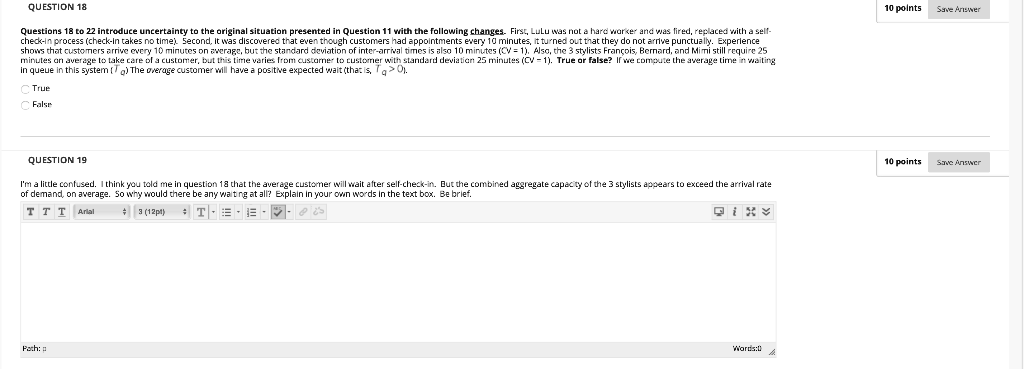
QUESTION 18 10 points Save trener Save Answer check-in process (check-In takes no timex Second, it was discovered that even though customers had appointments every 10 minutes, it turned out that they do not arrive punctually. Experience a shows that customers arrive every 10 minutes on average, but the standard deviation of inter-arrival times is also 10 minutes (CV = 1). Also, the 3 stylists Franois, Bernard, and Mimi still require 25 minutes an average to take care of a customer, but this time varies from customer to customer with standard deviation 25 minutes (C =1). True or false? If we compute the average time in waiting in queue in this system T.) The overage customer will have a positive expected wait (that is 74>0). True False QUESTION 19 10 points Save Answer I'm a little confused. I think you told me in question 18 that the average customer will wait after sell-check-in. But the combined aggregate capacity of the 3 stylists appears to exceed the arrival rate of demand, on average. So why would there be any waiting at all? Explain in your own words in the text box. Be brief. TT T Arlal (121) TEE 5.0 Path: Words:0 QUESTION 18 10 points Save trener Save Answer check-in process (check-In takes no timex Second, it was discovered that even though customers had appointments every 10 minutes, it turned out that they do not arrive punctually. Experience a shows that customers arrive every 10 minutes on average, but the standard deviation of inter-arrival times is also 10 minutes (CV = 1). Also, the 3 stylists Franois, Bernard, and Mimi still require 25 minutes an average to take care of a customer, but this time varies from customer to customer with standard deviation 25 minutes (C =1). True or false? If we compute the average time in waiting in queue in this system T.) The overage customer will have a positive expected wait (that is 74>0). True False QUESTION 19 10 points Save Answer I'm a little confused. I think you told me in question 18 that the average customer will wait after sell-check-in. But the combined aggregate capacity of the 3 stylists appears to exceed the arrival rate of demand, on average. So why would there be any waiting at all? Explain in your own words in the text box. Be brief. TT T Arlal (121) TEE 5.0 Path: Words:0

Step by Step Solution

There are 3 Steps involved in it

1 Expert Approved Answer
Step: 1 Unlock blur-text-image

Question Has Been Solved by an Expert!

Get step-by-step solutions from verified subject matter experts

Step: 2 Unlock
Step: 3 Unlock

Students Have Also Explored These Related General Management Questions!