







Question: Question 19 Not yet answered (Grading details: Correct answer = 6 points (3 points for each of the two answers) / Wrong answer = -3
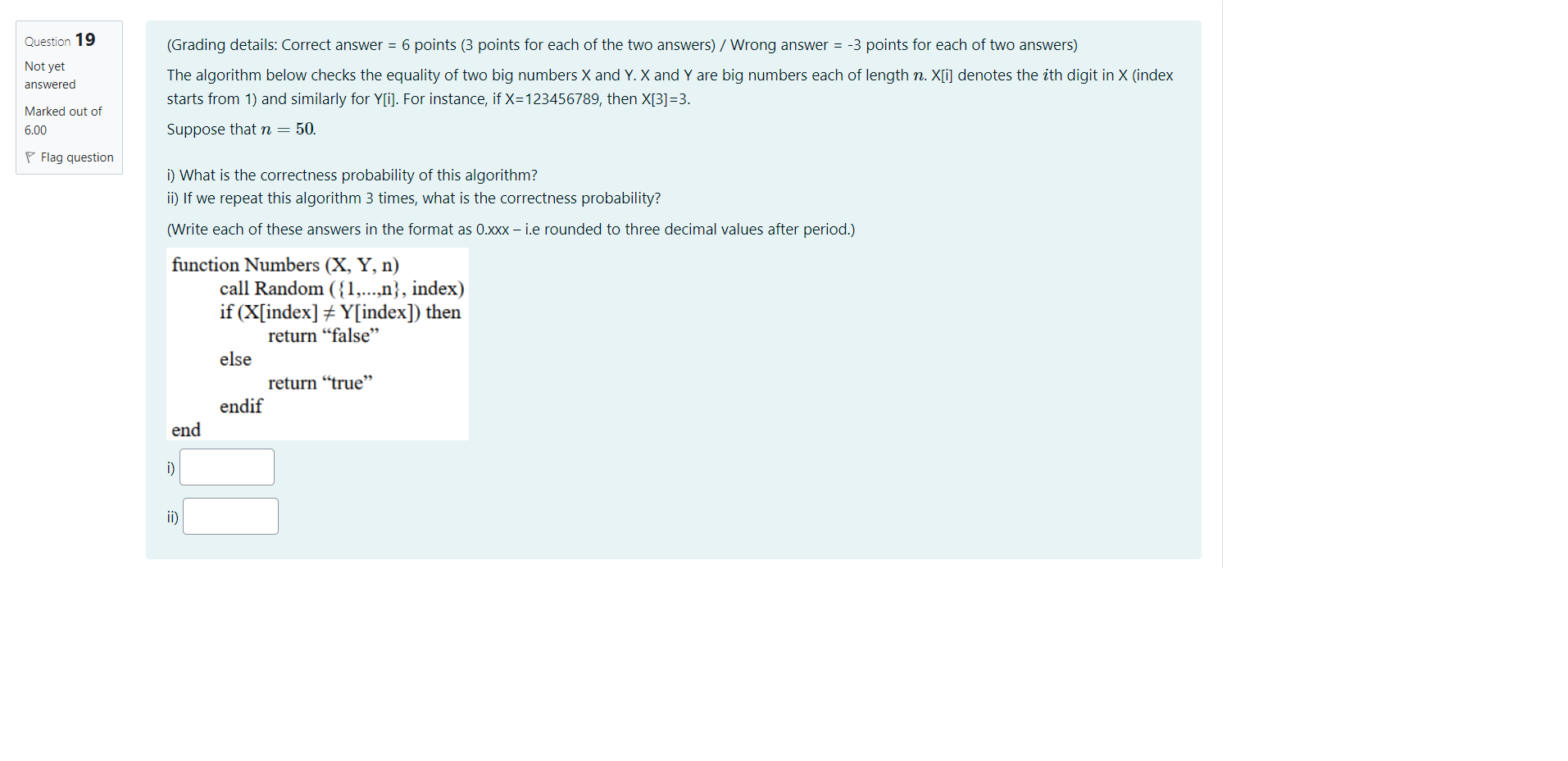
Question 19 Not yet answered (Grading details: Correct answer = 6 points (3 points for each of the two answers) / Wrong answer = -3 points for each of two answers) The algorithm below checks the equality of two big numbers X and Y. X and Y are big numbers each of length n. X[i] denotes the ith digit in X (index starts from 1) and similarly for Y[i]. For instance, if X=123456789, then X[3] =3. Suppose that n = 50. Marked out of 6.00 Flag question i) What is the correctness probability of this algorithm? ii) If we repeat this algorithm 3 times, what is the correctness probability? (Write each of these answers in the format as 0.xxx I.e rounded to three decimal values after period.) function Numbers (X, Y, n) call Random ({1,...,n}, index) if (X[index] #Y[index]) then return "false" else return "true" endif end 1) ii)
Step by Step Solution
There are 3 Steps involved in it

Get step-by-step solutions from verified subject matter experts
 Study Help