







Question: Question: 1-Explain clearly the components ( appears in the case ) that are essential for strategy implementation. Toyota's Strategy Toyota was founded in 1937, and
Question: 1-Explain clearly the components ( appears in the case ) that are essential for strategy implementation.
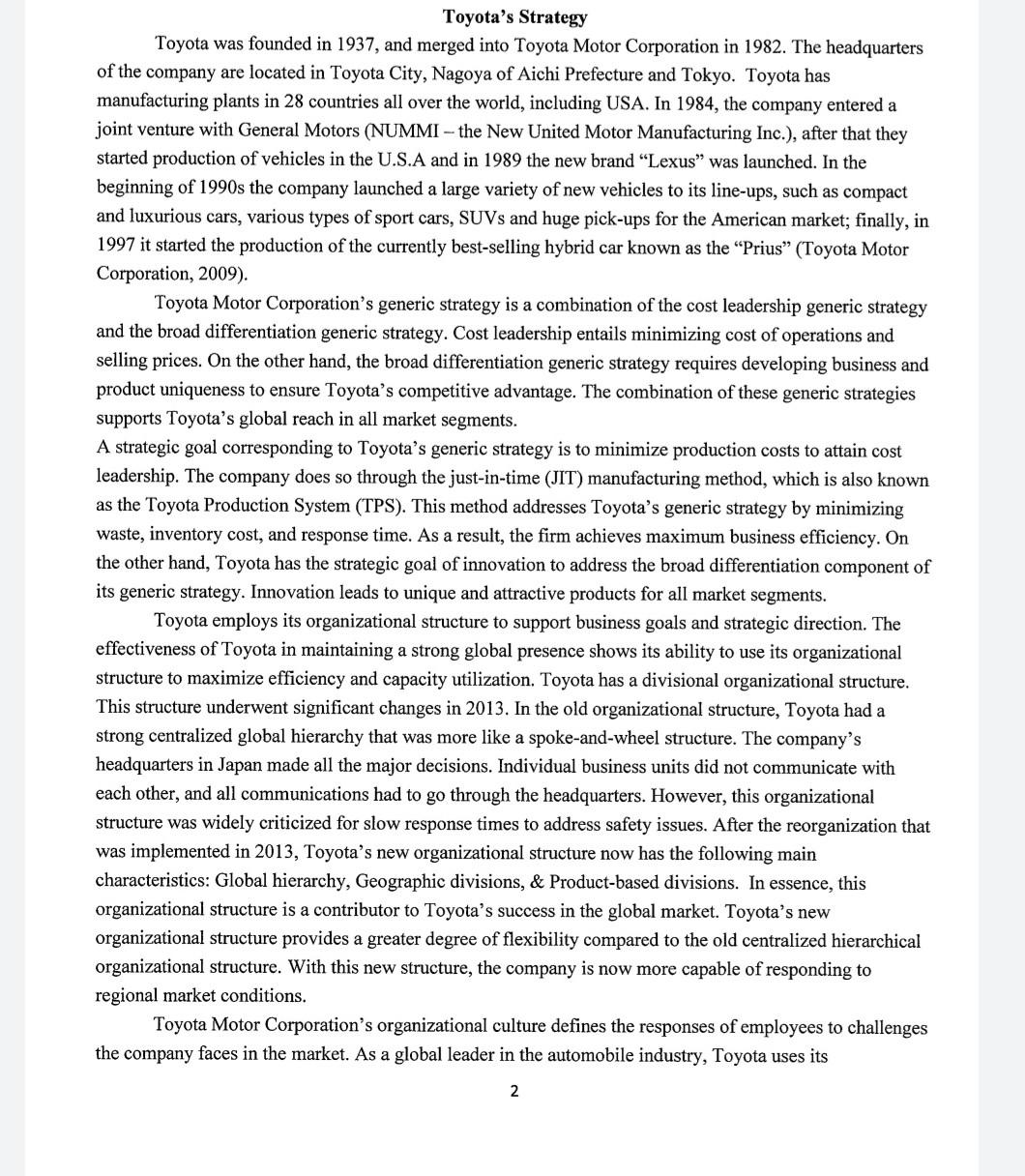
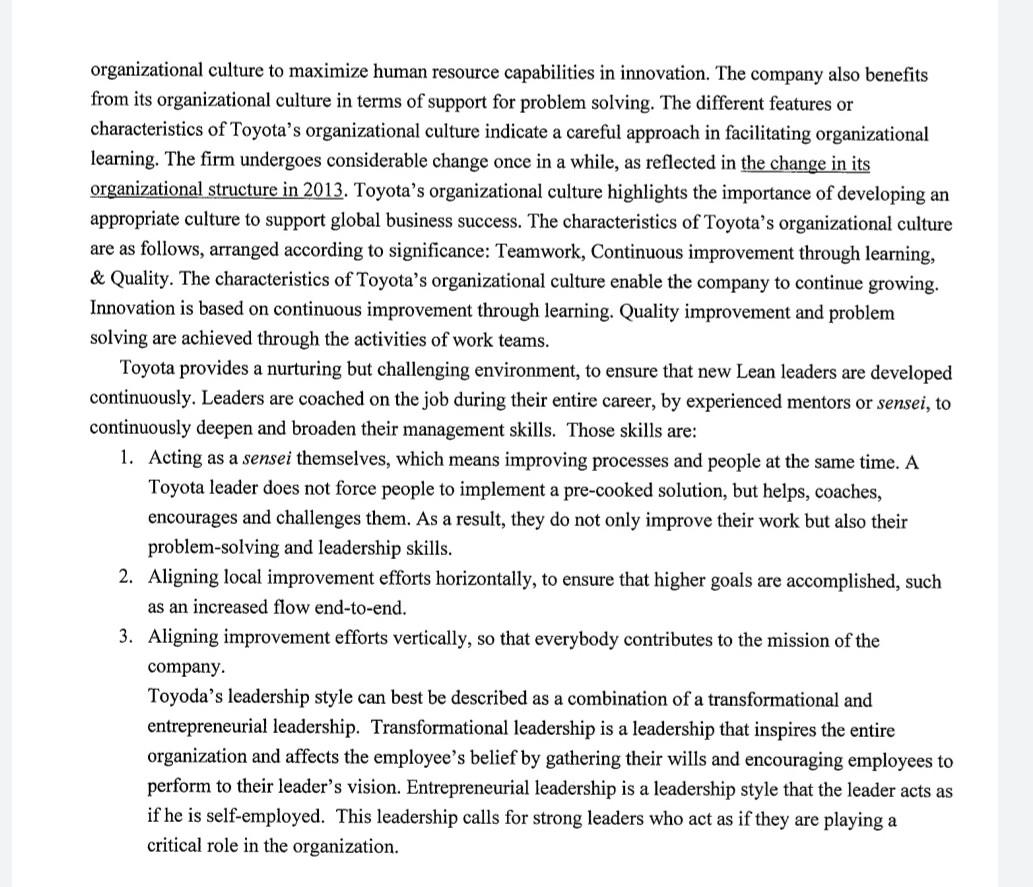
Toyota's Strategy Toyota was founded in 1937, and merged into Toyota Motor Corporation in 1982. The headquarters of the company are located in Toyota City, Nagoya of Aichi Prefecture and Tokyo. Toyota has manufacturing plants in 28 countries all over the world, including USA. In 1984, the company entered a joint venture with General Motors (NUMMI - the New United Motor Manufacturing Inc.), after that they started production of vehicles in the U.S.A and in 1989 the new brand "Lexus" was launched. In the beginning of 1990 s the company launched a large variety of new vehicles to its line-ups, such as compact and luxurious cars, various types of sport cars, SUVs and huge pick-ups for the American market; finally, in 1997 it started the production of the currently best-selling hybrid car known as the "Prius" (Toyota Motor Corporation, 2009). Toyota Motor Corporation's generic strategy is a combination of the cost leadership generic strategy and the broad differentiation generic strategy. Cost leadership entails minimizing cost of operations and selling prices. On the other hand, the broad differentiation generic strategy requires developing business and product uniqueness to ensure Toyota's competitive advantage. The combination of these generic strategies supports Toyota's global reach in all market segments. A strategic goal corresponding to Toyota's generic strategy is to minimize production costs to attain cost leadership. The company does so through the just-in-time (JIT) manufacturing method, which is also known as the Toyota Production System (TPS). This method addresses Toyota's generic strategy by minimizing waste, inventory cost, and response time. As a result, the firm achieves maximum business efficiency. On the other hand, Toyota has the strategic goal of innovation to address the broad differentiation component of its generic strategy. Innovation leads to unique and attractive products for all market segments. Toyota employs its organizational structure to support business goals and strategic direction. The effectiveness of Toyota in maintaining a strong global presence shows its ability to use its organizational structure to maximize efficiency and capacity utilization. Toyota has a divisional organizational structure. This structure underwent significant changes in 2013. In the old organizational structure, Toyota had a strong centralized global hierarchy that was more like a spoke-and-wheel structure. The company's headquarters in Japan made all the major decisions. Individual business units did not communicate with each other, and all communications had to go through the headquarters. However, this organizational structure was widely criticized for slow response times to address safety issues. After the reorganization that was implemented in 2013, Toyota's new organizational structure now has the following main characteristics: Global hierarchy, Geographic divisions, \& Product-based divisions. In essence, this organizational structure is a contributor to Toyota's success in the global market. Toyota's new organizational structure provides a greater degree of flexibility compared to the old centralized hierarchical organizational structure. With this new structure, the company is now more capable of responding to regional market conditions. Toyota Motor Corporation's organizational culture defines the responses of employees to challenges the company faces in the market. As a global leader in the automobile industry, Toyota uses its 2 organizational culture to maximize human resource capabilities in innovation. The company also benefits from its organizational culture in terms of support for problem solving. The different features or characteristics of Toyota's organizational culture indicate a careful approach in facilitating organizational learning. The firm undergoes considerable change once in a while, as reflected in the change in its organizational structure in 2013. Toyota's organizational culture highlights the importance of developing an appropriate culture to support global business success. The characteristics of Toyota's organizational culture are as follows, arranged according to significance: Teamwork, Continuous improvement through learning, \& Quality. The characteristics of Toyota's organizational culture enable the company to continue growing. Innovation is based on continuous improvement through learning. Quality improvement and problem solving are achieved through the activities of work teams. Toyota provides a nurturing but challenging environment, to ensure that new Lean leaders are developed continuously. Leaders are coached on the job during their entire career, by experienced mentors or sensei, to continuously deepen and broaden their management skills. Those skills are: 1. Acting as a sensei themselves, which means improving processes and people at the same time. A Toyota leader does not force people to implement a pre-cooked solution, but helps, coaches, encourages and challenges them. As a result, they do not only improve their work but also their problem-solving and leadership skills. 2. Aligning local improvement efforts horizontally, to ensure that higher goals are accomplished, such as an increased flow end-to-end. 3. Aligning improvement efforts vertically, so that everybody contributes to the mission of the company. Toyoda's leadership style can best be described as a combination of a transformational and entrepreneurial leadership. Transformational leadership is a leadership that inspires the entire organization and affects the employee's belief by gathering their wills and encouraging employees to perform to their leader's vision. Entrepreneurial leadership is a leadership style that the leader acts as if he is self-employed. This leadership calls for strong leaders who act as if they are playing a critical role in the organizationStep by Step Solution
There are 3 Steps involved in it
1 Expert Approved Answer
Step: 1 Unlock

Question Has Been Solved by an Expert!
Get step-by-step solutions from verified subject matter experts
Step: 2 Unlock
Step: 3 Unlock
 Study Help