







Question: Question 1-Game Problem statement Simulate the working of chess with the below sample smaller game board. A player with any piece/coin standing where its opponent
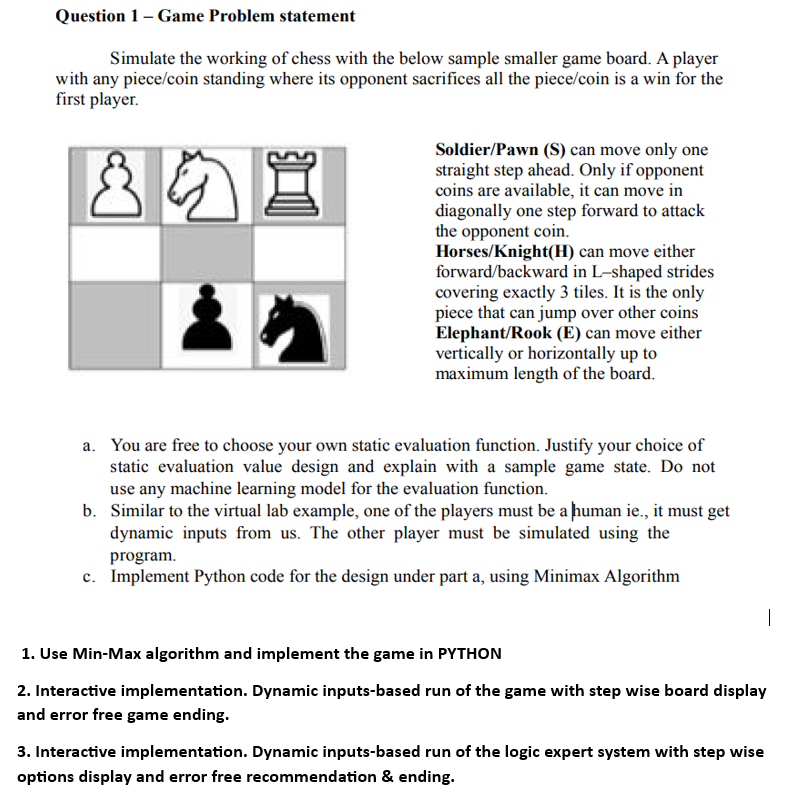
Question 1-Game Problem statement Simulate the working of chess with the below sample smaller game board. A player with any piece/coin standing where its opponent sacrifices all the piece/coin is a win for the first player. Soldier/Pawn (S) can move only one straight step ahead. Only if opponent coins are available, it can move in diagonally one step forward to attack the opponent coin. Horses/Knight(H) can move either forward/backward in L-shaped strides covering exactly 3 tiles. It is the only piece that can jump over other coins Elephant/Rook (E) can move either vertically or horizontally up to maximum length of the board. a. You are free to choose your own static evaluation function. Justify your choice of static evaluation value design and explain with a sample game state. Do not use any machine learning model for the evaluation function. b. Similar to the virtual lab example, one of the players must be a human ie., it must get dynamic inputs from us. The other player must be simulated using the program. c. Implement Python code for the design under part a, using Minimax Algorithm 1. Use Min-Max algorithm and implement the game in PYTHON 2. Interactive implementation. Dynamic inputs-based run of the game with step wise board display and error free game ending. 3. Interactive implementation. Dynamic inputs-based run of the logic expert system with step wise options display and error free recommendation \& ending
Step by Step Solution
There are 3 Steps involved in it

Get step-by-step solutions from verified subject matter experts
 Study Help