Question: Question 2 (1} (2 Marks} This is an openbook exam. The interest rate raise in the US has significant impact on the global financial markets.
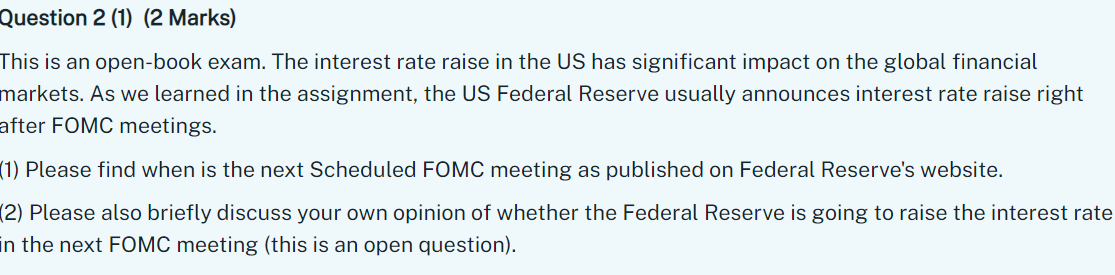
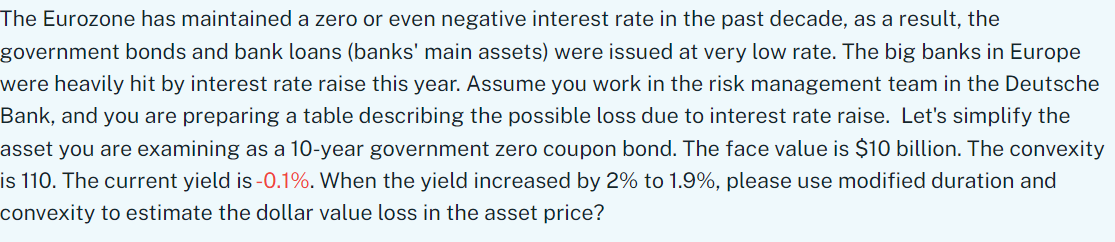
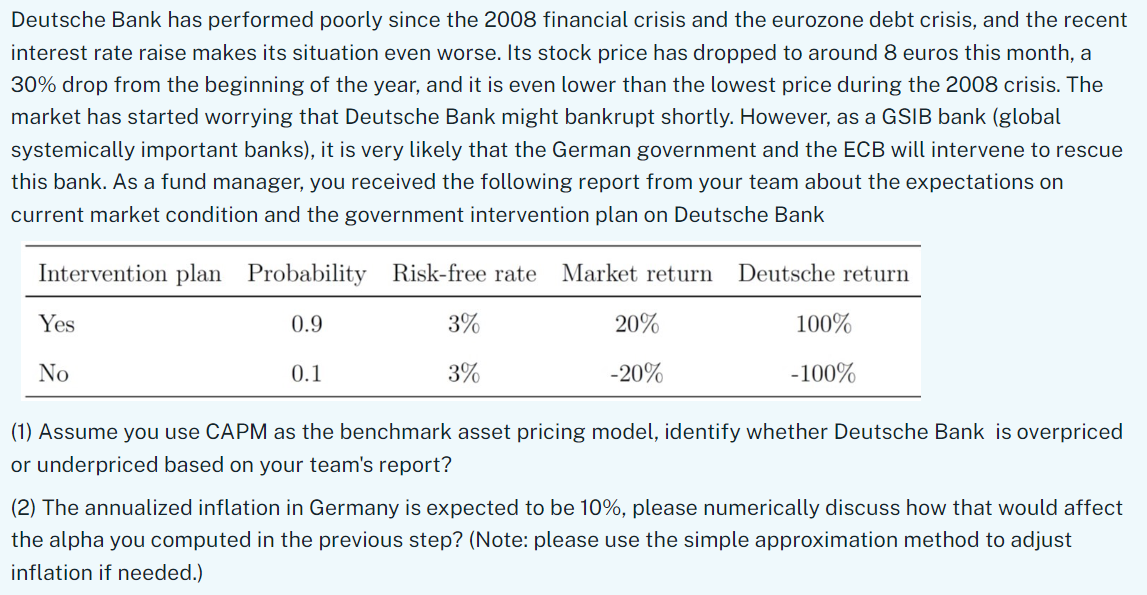
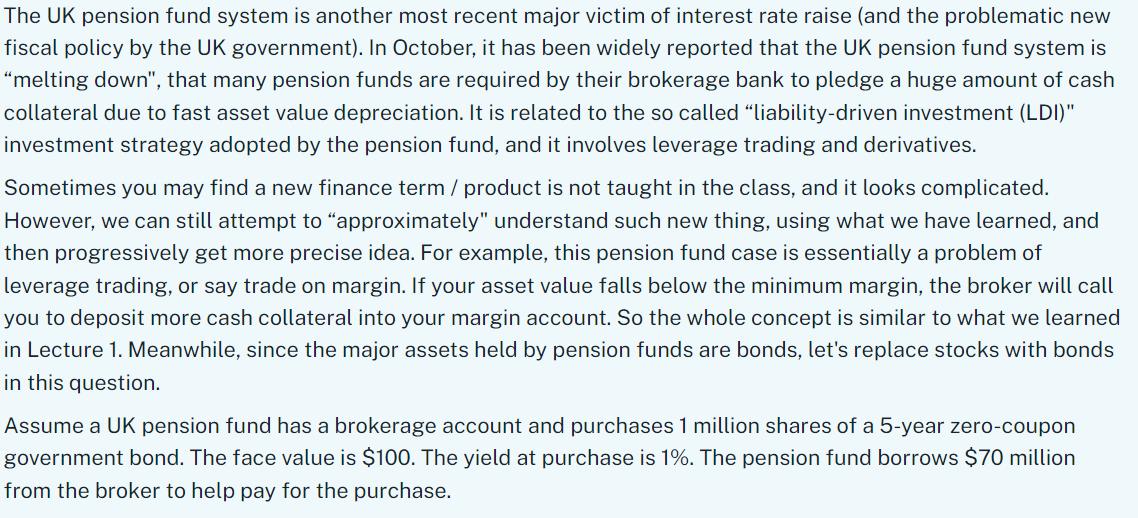
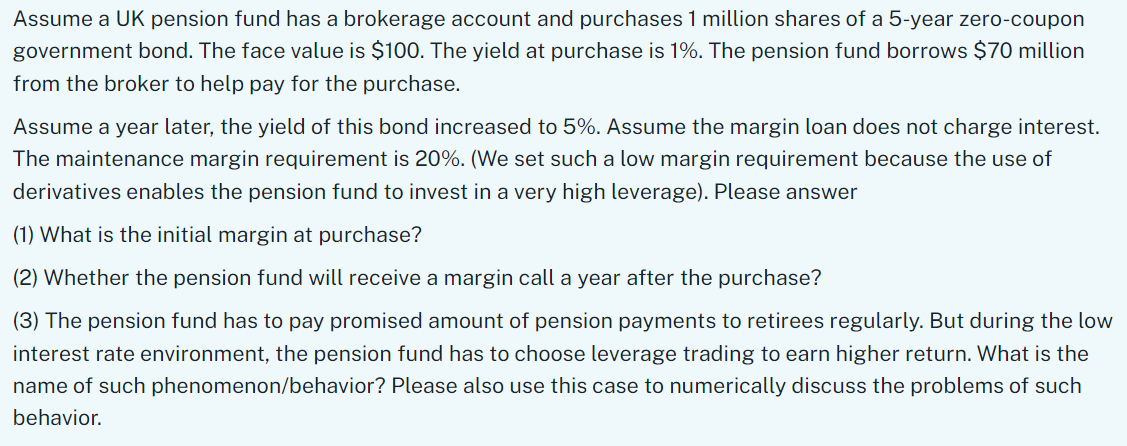
Question 2 (1} (2 Marks} This is an openbook exam. The interest rate raise in the US has significant impact on the global financial markets. As we learned in the assignment, the US Federal Reserve usually announces interest rate raise right after FOMC meetings. [1) Please find when is the next Scheduled FOMC meeting as published on Federal Reserve's website. [2) Please also briefly discuss your own opinion of whether the Federal Reserve is going to raise the interest rate in the next FOMC meeting (this is an open question). \"Yield spread" is a term often referred during the debt crisis. Yield spread is the difference in yield between bonds issued by two entities. During the crisis, the yield spread between Greek government bonds and German government bonds increased a lot, since the market considered Germany as a much \"safer" country during the crisis. Please use what we learned in Lecture 9 to economically explain what might have caused this increase in yield spread. The Eurozone has maintained a zero or even negative interest rate in the past decade, as a result, the government bonds and bank loans [banks' main assets) were issued at very low rate. The big banks in Europe were heavily hit by interest rate raise this year. Assume you work in the risk management team in the Deutsche Bank, and you are preparing a table describing the possible loss due to interest rate raise. Let's simplify the asset you are examining as a 10year government zero coupon bond. The face value is $10 billion. The convexity is 110. The current yield is 0.1%. When the yield increased by 2% to 1.9%, please use modified duration and convexity to estimate the dollar value loss in the asset price? Deutsche Bank has performed poorly since the 2008 financial crisis and the eurozone debt crisis. and the recent interest rate raise makes its situation even worse. Its stock price has dropped to around 8 euros this month, a 30% drop from the beginning of the year, and it is even lower than the lowest price during the 2008 crisis. The market has started worrying that Deutsche Bank might bankrupt shortly. However, as a GSIB bank [global systemically important banks}. it is very likely that the German government and the ECB will intervene to rescue this bank. As a fund manager. you received the following report from your team about the expectations on current market condition and the government intervention plan on Deutsche Bank Intcl'vclltionplan Probability Risk-frccmtc Market return Dcutschcrcturn Yes 0.9 3% 20% 100% No 0.1 3% 20% 400% (1) Assume you use CAPM as the benchmark asset pricing model, identify whether Deutsche Bank is overpriced or underpriced based on your team's report? (2) The annualized inflation in Germany is expected to be 10%, please numerically discuss how that would affect the alpha you computed in the previous step? (Note: please use the simple approximation method to adjust inflation if needed.) The UK pension fund system is another most recent major victim of interest rate raise [and the problematic new fiscal policy by the UK government). In October, it has been widely reported that the UK pension fund system is \"melting down". that many pension funds are required by their brokerage bank to pledge a huge amount of cash collateral due to fast asset value depreciation. It is related to the so called \"liabilitydriven investment [LD|) investment strategy adopted by the pension fund. and it involves leverage trading and derivatives. Sometimes you may find a new finance term 1' product is not taught in the class, and it looks complicated. However, we can still attempt to \"approximately" understand such new thing, using what we have learned, and then progressively get more precise idea. For example. this pension fund case is essentially a problem of leverage trading, or say trade on margin. If your asset value falls below the minimum margin. the broker will call you to deposit more cash collateral into your margin account. 80 the whole concept is similar to what we learned in Lecture 1. Meanwhile, since the major assets held by pension funds are bonds, let's replace stocks with bonds in this question. Assume a UK pension fund has a brokerage account and purchases 1 million shares of a 5year zerocoupon government bond. The face value is $100. The yield at purchase is 1%. The pension fund borrows $70 million from the broker to help pay for the purchase. Assume a UK pension fund has a brokerage account and purchases 1 million shares of a 5year zerocoupon government bond. The face value is $100. The yield at purchase is 1%. The pension fund borrows $70 million from the broker to help pay for the purchase. Assume a year later. the yield of this bond increased to 5%. Assume the margin loan does not charge interest. The maintenance margin requirement is 20%. (We set such a low margin requirement because the use of derivatives enables the pension fund to invest in a very high leverage). Please answer (1) What is the initial margin at purchase? (2) Whether the pension fund will receive a margin call a year after the purchase? (3) The pension fund has to pay promised amount of pension payments to retirees regularly. But during the low interest rate environment, the pension fund has to choose leverage trading to earn higher return. What is the name of such phenomenonfbehavior? Please also use this case to numerically discuss the problems of such behavior
Step by Step Solution
There are 3 Steps involved in it
1 Expert Approved Answer
Step: 1 Unlock
Question Has Been Solved by an Expert!
Get step-by-step solutions from verified subject matter experts
Step: 2 Unlock
Step: 3 Unlock
Students Have Also Explored These Related Finance Questions!










 Study Help