







Question: Question 2 1 A mass m hanging on a spring with a spring constant k executes simple harmonic motion with a period T. If the
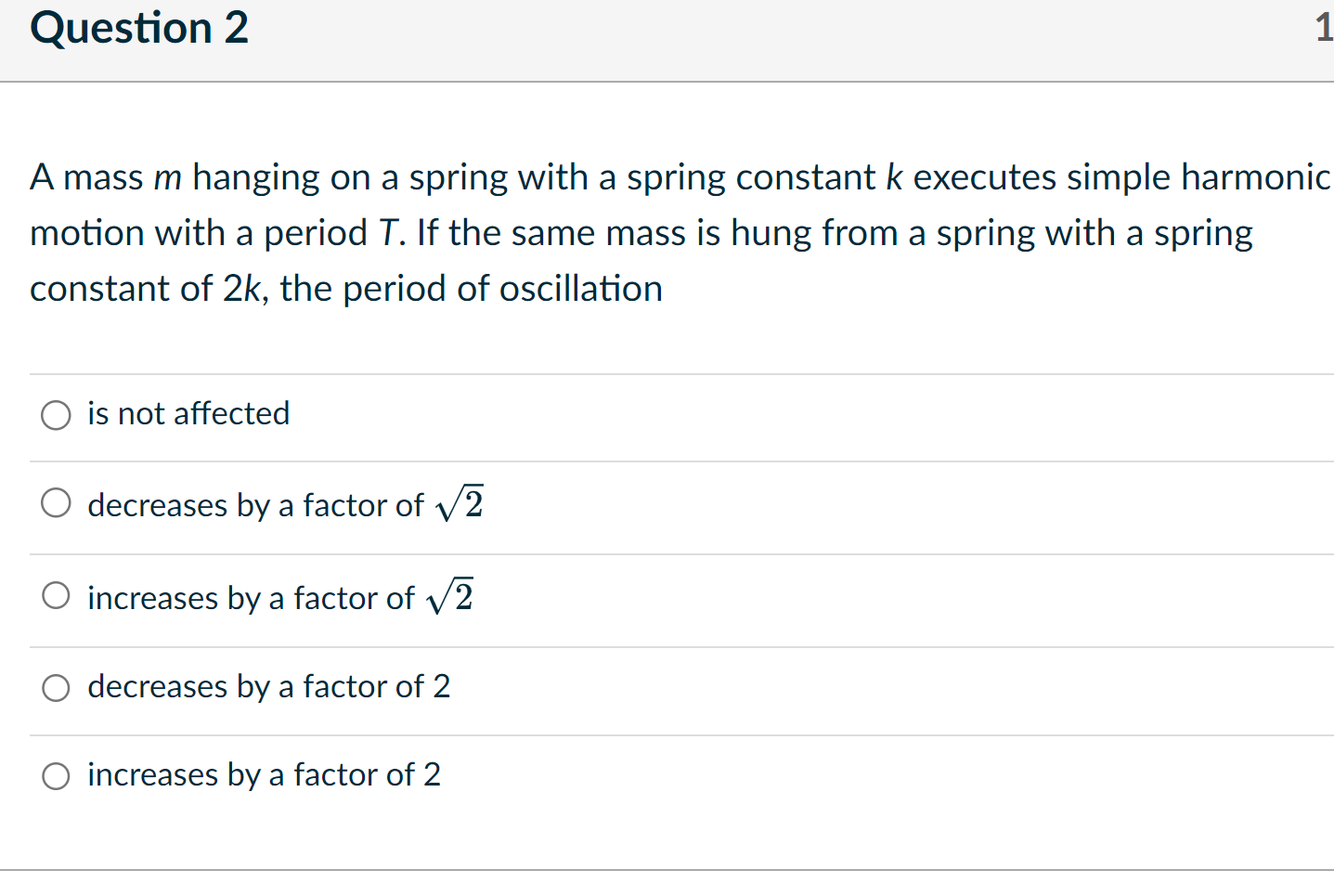
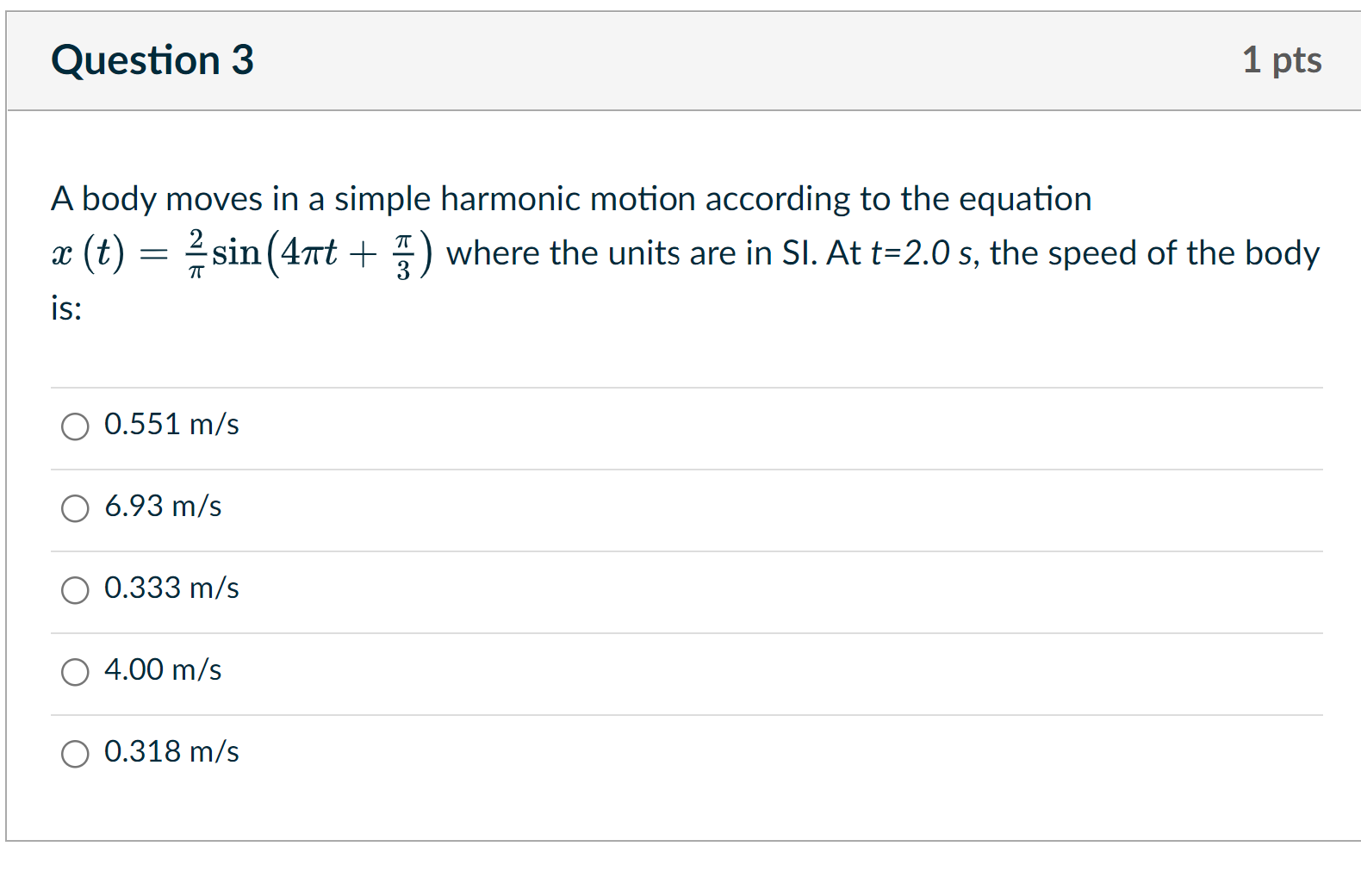
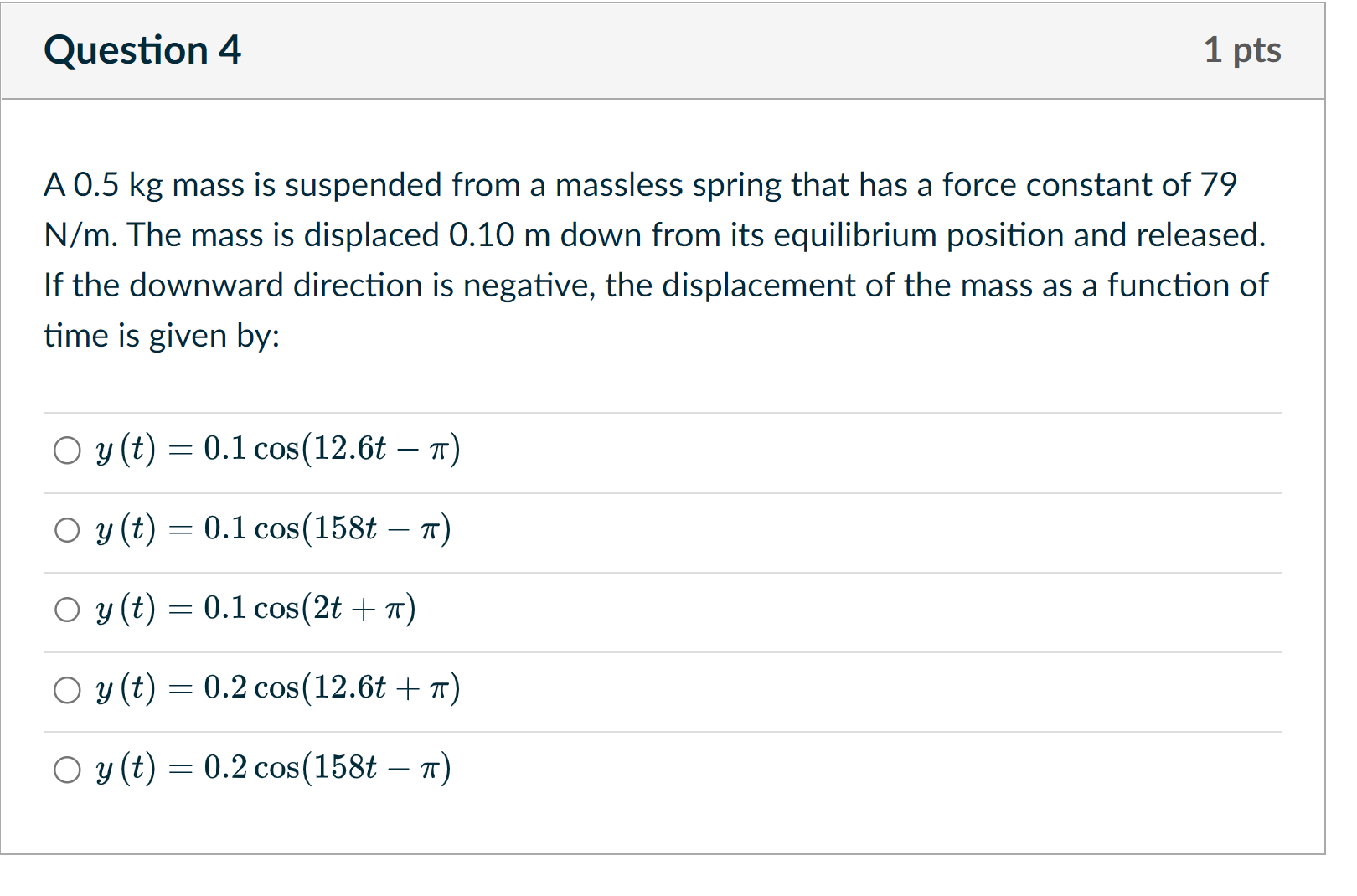
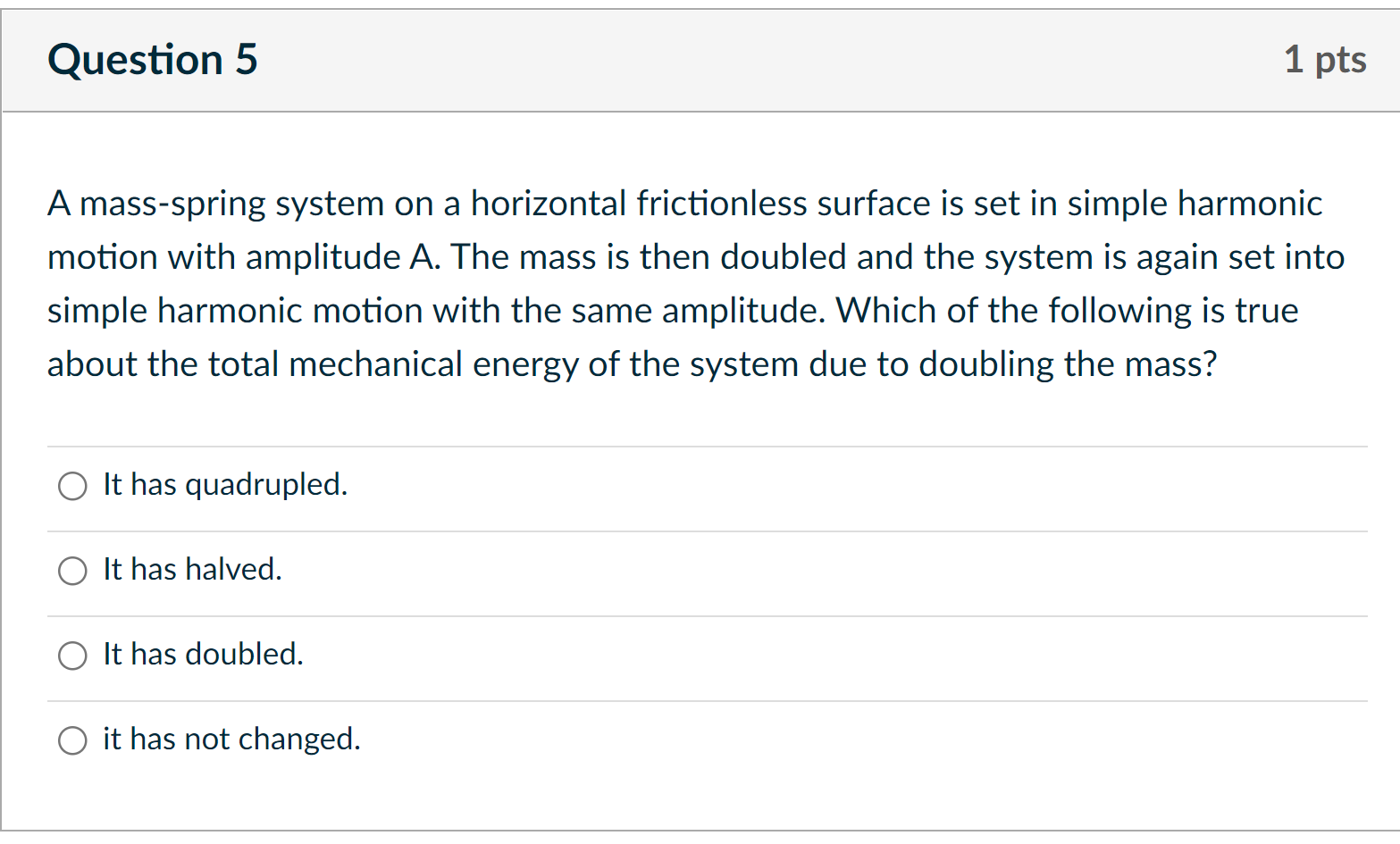
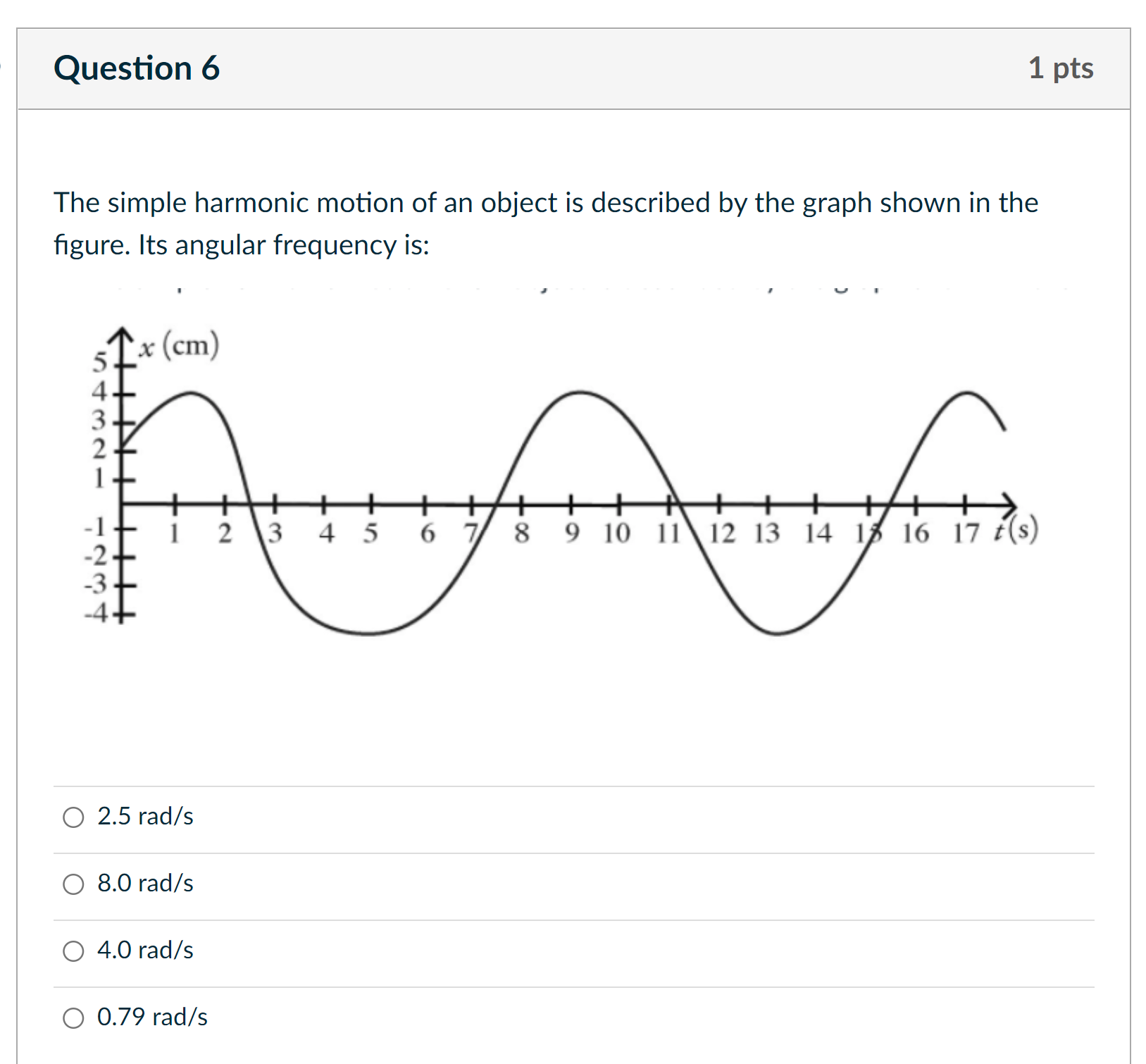
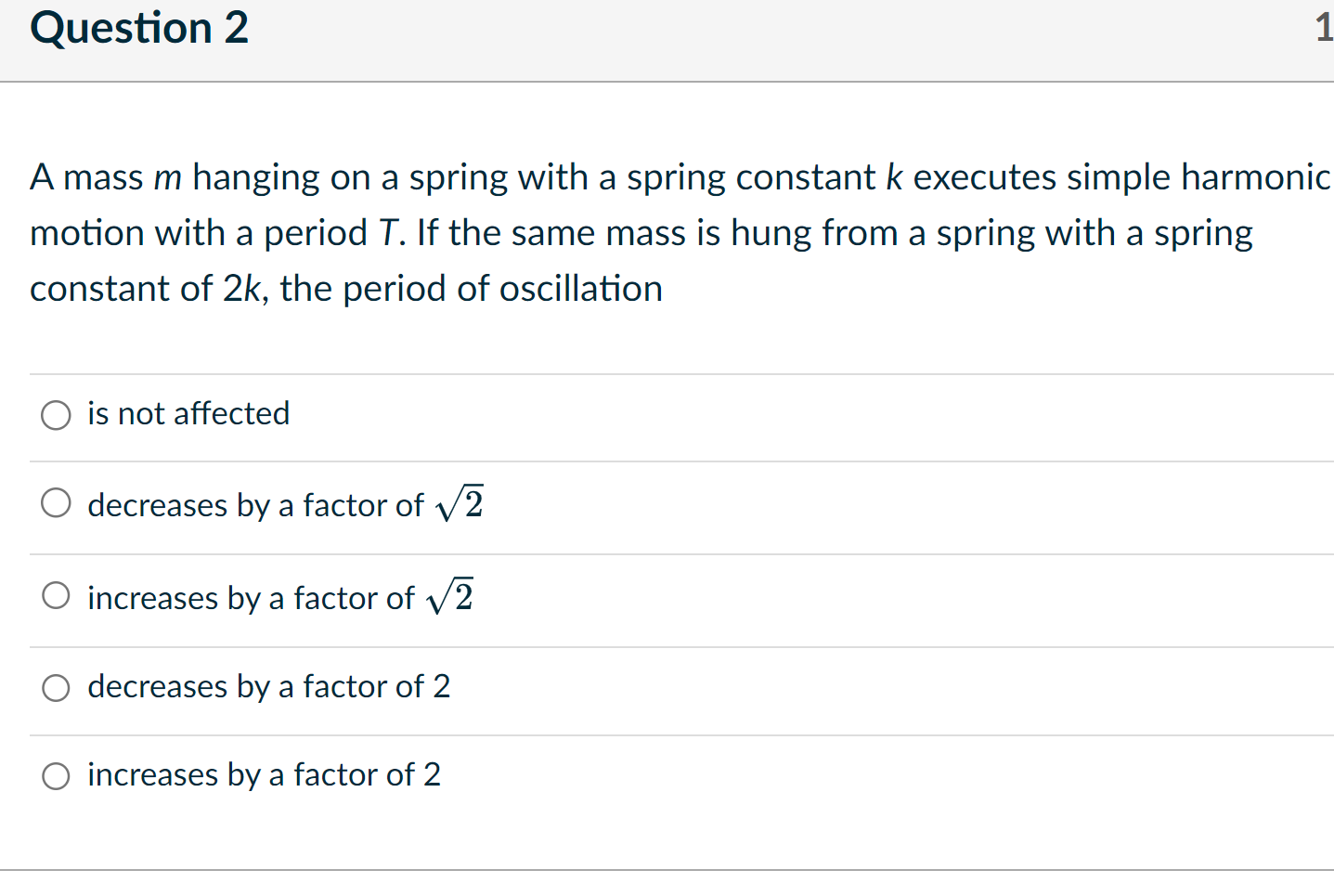
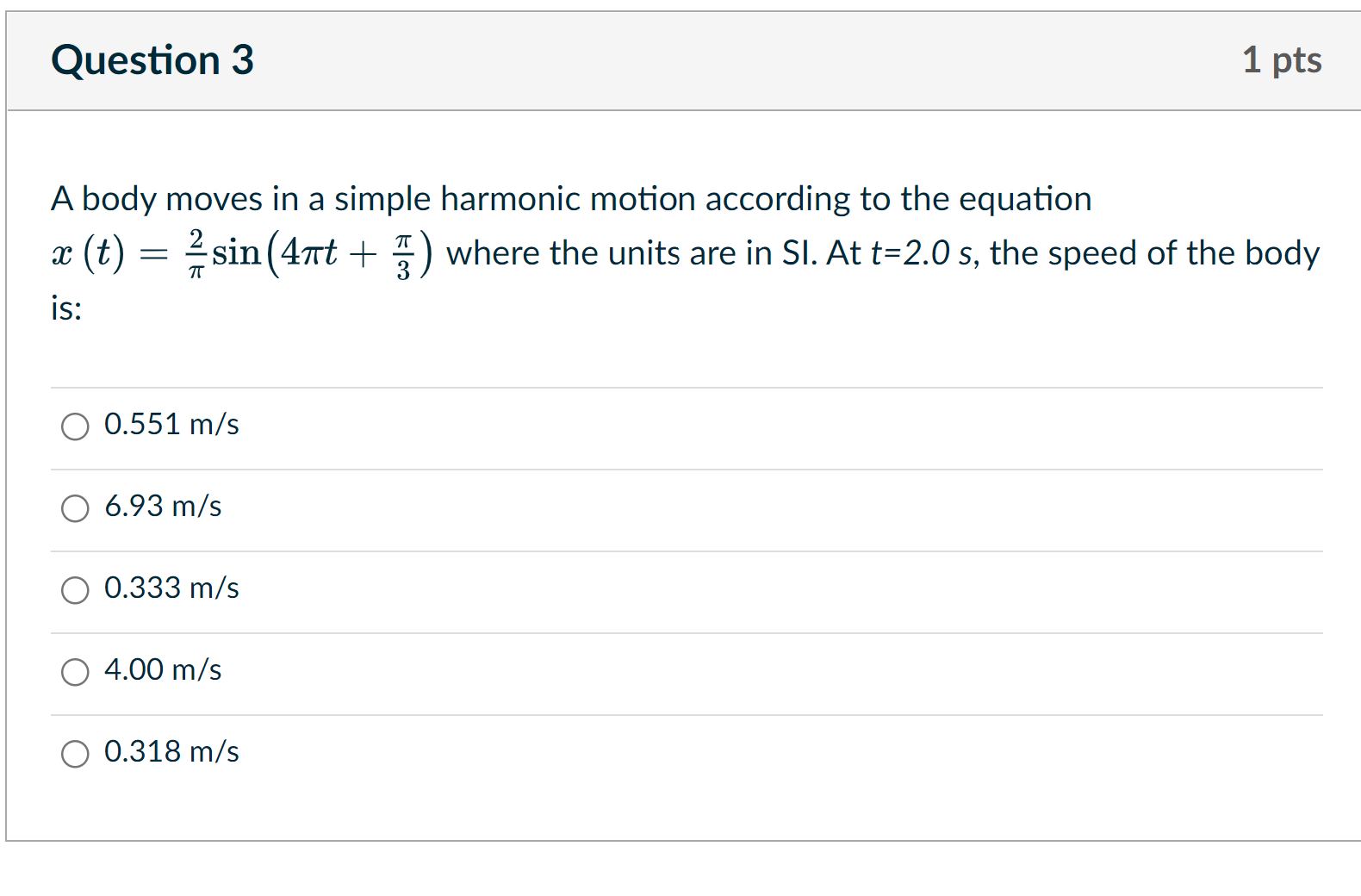
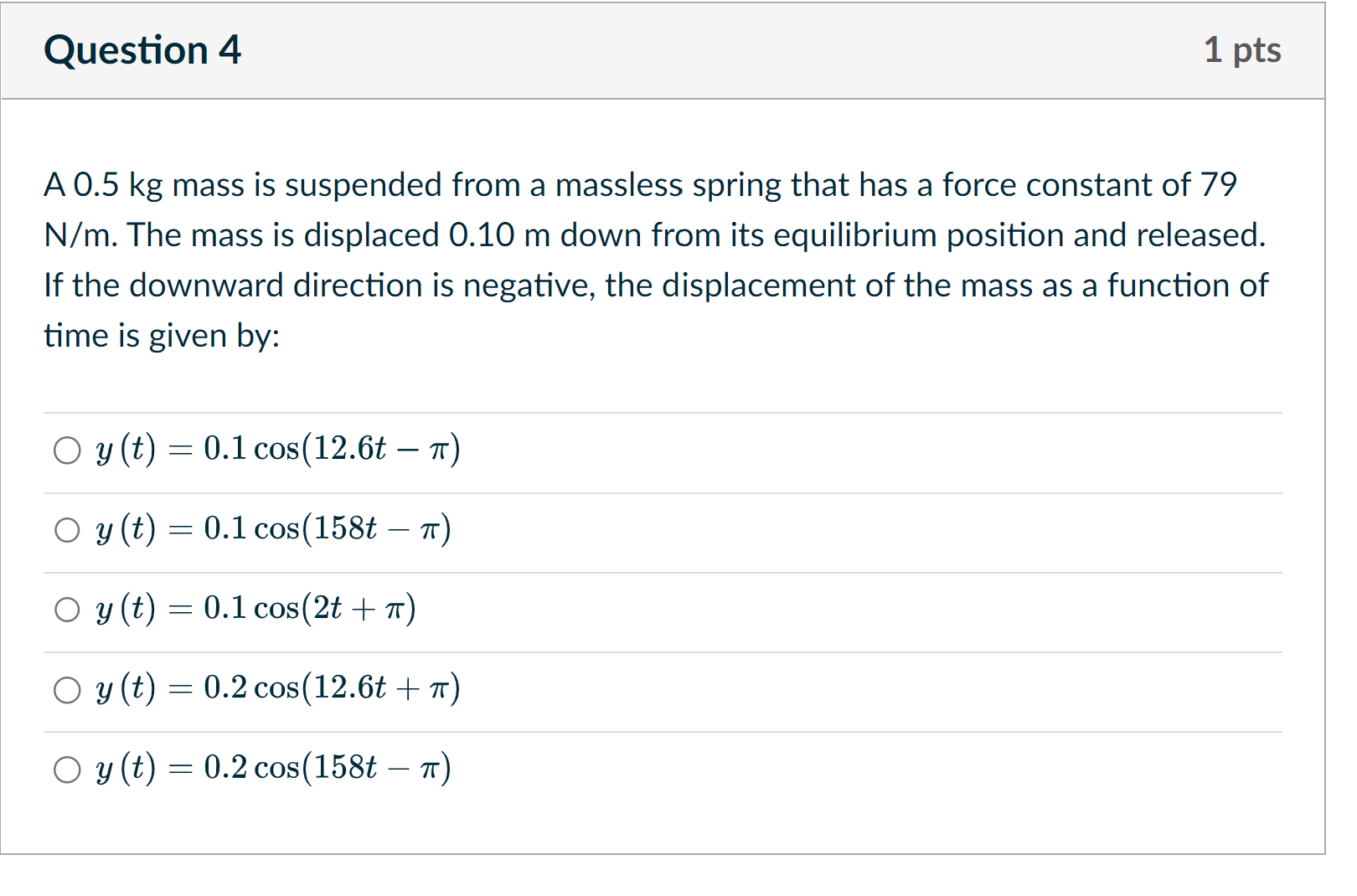
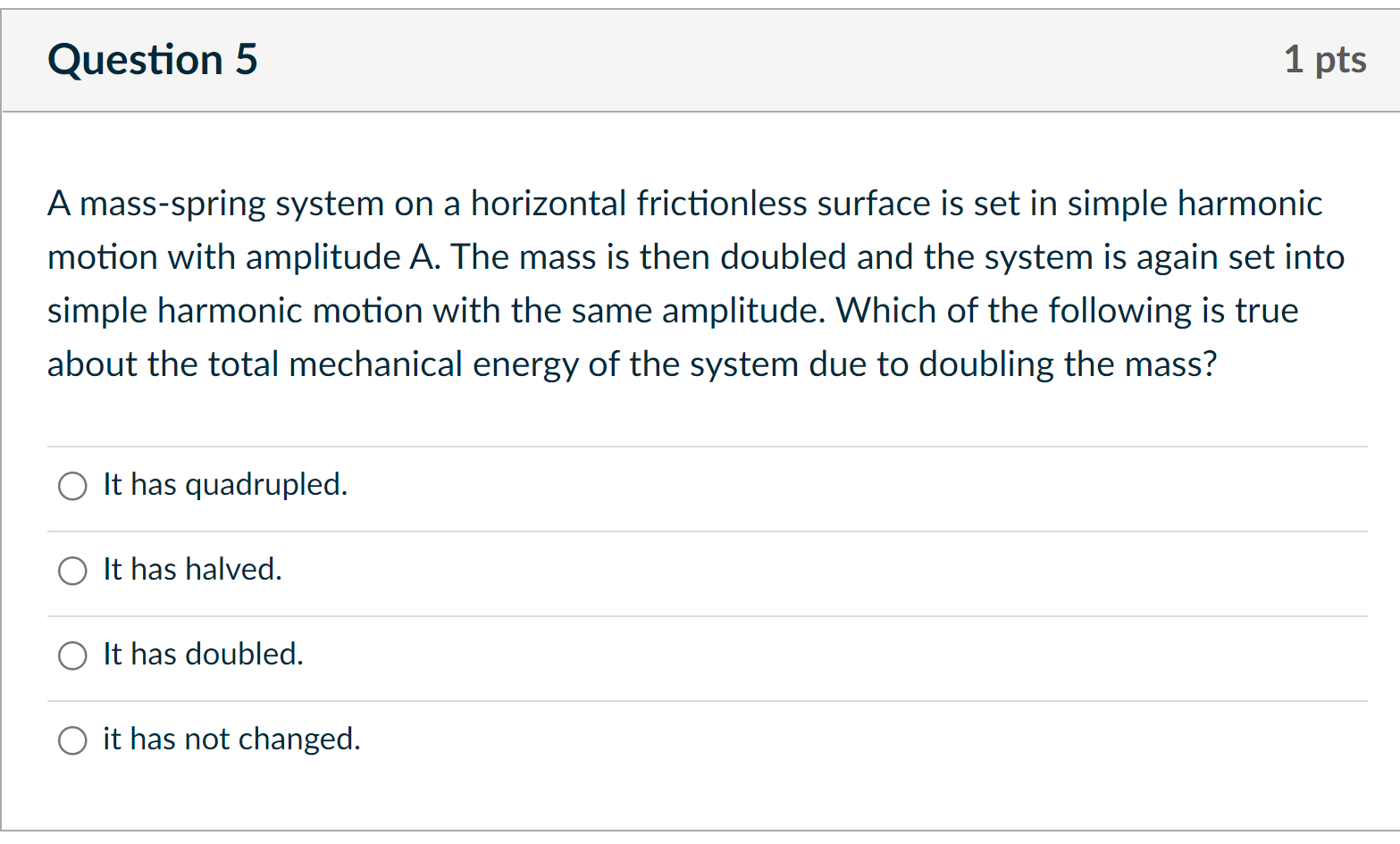
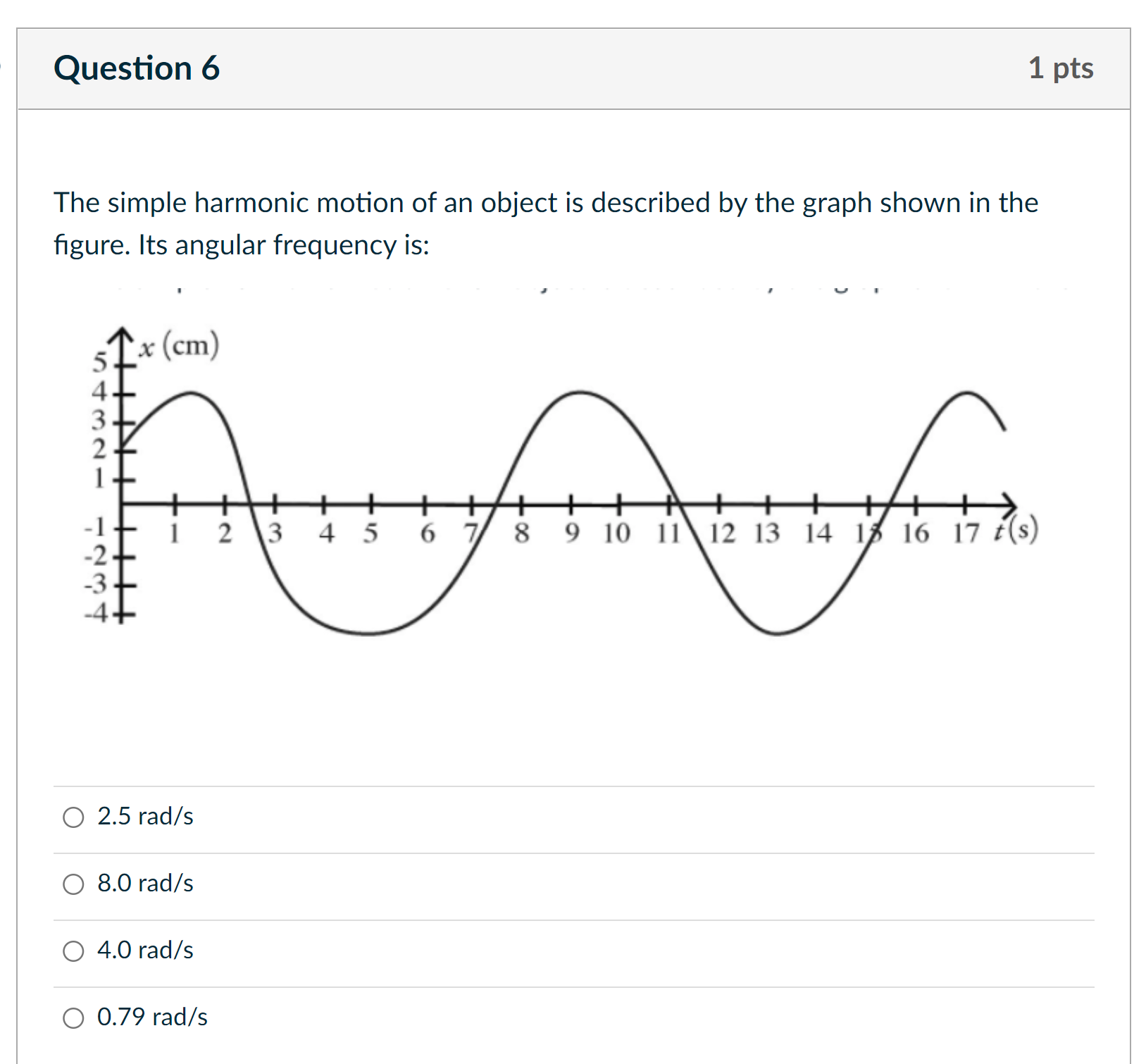
Question 2 1 A mass m hanging on a spring with a spring constant k executes simple harmonic motion with a period T. If the same mass is hung from a spring with a spring constant of 2k, the period of oscillation O is not affected 0 decreases by a factor of x/i 0 increases by a factor of x/i 0 decreases by a factor of 2 0 increases by a factor of 2 Question 3 1 pts A body moves in a simple harmonic motion according to the equation :13 (t) = %sin (4711 + %) where the units are in SI. At t=2.0 s, the speed of the body is: O 0.551 m/s 0 6.93 m/s 0 0.333 m/s 0 4.00 m/s O 0318 m/s Question 4 1 pts A 0.5 kg mass is suspended from a massless spring that has a force constant of 79 N/m. The mass is displaced 0.10 m down from its equilibrium position and released. If the downward direction is negative, the displacement of the mass as a function of time is given by: O y (t) : 0.1 cos(12.6t 11') O 391(13): 0.1 cos(158t 71') O y (t) : 0.1 cos(2t l 71') O y (t) = 0.2cos(12.6t + W) O y (75) = 0.2 cos(158t 71') Question 5 1 pts A mass-spring system on a horizontal frictionless surface is set in simple harmonic motion with amplitude A. The mass is then doubled and the system is again set into simple harmonic motion with the same amplitude. Which of the following is true about the total mechanical energy of the system due to doubling the mass? 0 It has quadrupled. Q It has halved. Q It has doubled. 0 it has not changed. Question 6 1 pts The simple harmonic motion of an object is described by the graph shown in the figure. Its angular frequency is: x (cm) AWNL - NWAUI 2 3 4 8 9 10 11 12 13 14 18 16 17 (s) O 2.5 rad/s O 8.0 rad/s O 4.0 rad/s O 0.79 rad/s
Step by Step Solution
There are 3 Steps involved in it

Get step-by-step solutions from verified subject matter experts
 Study Help