







Question: Question 2 [1 marks] A researcher is testing a new design of running shoe. To test if the shoe is better designed, they had 23
![Question 2 [1 marks] A researcher is testing a new design](https://dsd5zvtm8ll6.cloudfront.net/si.experts.images/questions/2024/09/66eeb581956fe_06566eeb58172ed6.jpg)
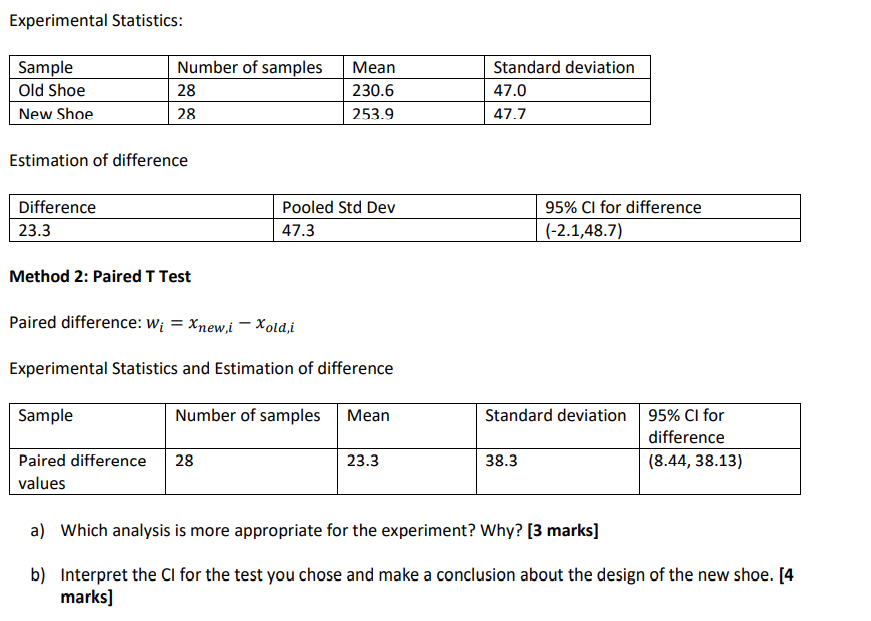
Question 2 [1 marks] A researcher is testing a new design of running shoe. To test if the shoe is better designed, they had 23 test athletes of varying skill levels. The athletes had to complete one run of a fixed track using the old model of shoe, and one run of the same track using the new model of shoe. The order of which shoes were used rst were randomly assigned. For each run the performance {a magic unitless number) of each athlete was tracked (no pun intended}. The researcher, who is not confident in their analysis skills, asked you to look at the two analyses they had completed. They knew they had to build a oondence interval for Hum - yum , but weren't sure whether to use a 2-sample t or paired t test. The output for both are given below. Method 1: Two-Sample T-Test Methodology: Hum: mean of the performance of the new shoe [unitlessl pom: mean of the performance of the old shoe (unitlessl Difference: #113\Experimental Statistics: Sample Number of samples Mean Standard deviation Old Shoe 28 230.6 47.0 New Shoe 28 253.9 47.7 Estimation of difference Difference Pooled Std Dev 95% Cl for difference 23.3 47.3 (-2.1,48.7) Method 2: Paired T Test Paired difference: Wi = Knew,i - Xold,i Experimental Statistics and Estimation of difference Sample Number of samples Mean Standard deviation 95% Cl for difference Paired difference 28 23.3 38.3 (8.44, 38.13) values a) Which analysis is more appropriate for the experiment? Why? [3 marks] b) Interpret the CI for the test you chose and make a conclusion about the design of the new shoe. [4 marks]
Step by Step Solution
There are 3 Steps involved in it

Get step-by-step solutions from verified subject matter experts
 Study Help