







Question: Question 2 (10 mins, 10 marks) Required: Circle the correct answer 1. An increase in the discount rate will result in an increase in the
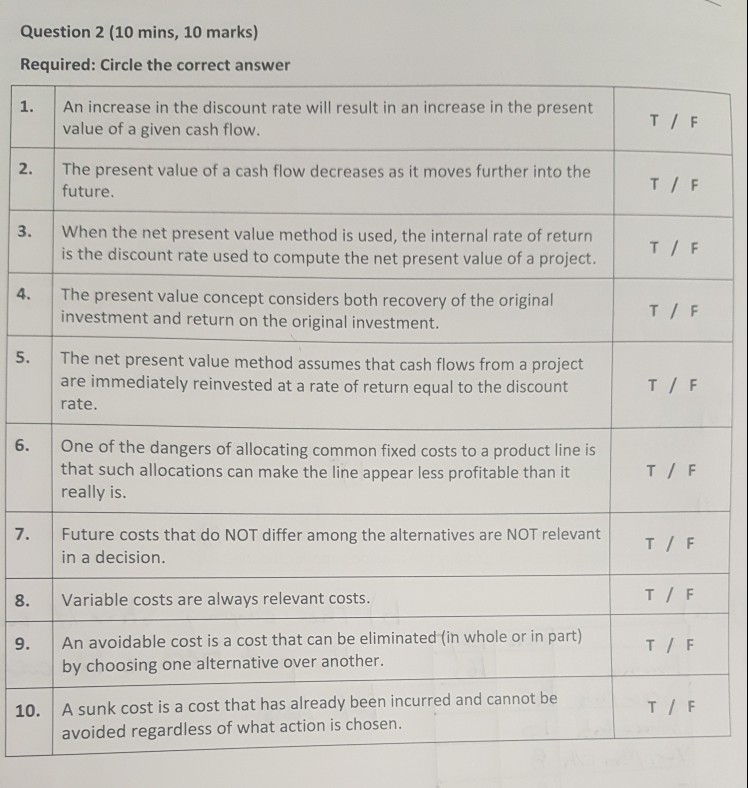
Question 2 (10 mins, 10 marks) Required: Circle the correct answer 1. An increase in the discount rate will result in an increase in the present T/F value of a given cash flow. 2. The present value of a cash flow decreases as it moves further into the 3. When the net present value method is used, the internal rate of return 4. The present value concept considers both recovery of the original future. T/F is the discount rate used to compute the net present value of a project. TIF investment and return on the original investment. 5. The net present value method assumes that cash flows from a project are immediately reinvested at a rate of return equal to the discount rate T/F 6. One of the dangers of allocating common fixed costs to a product line is that such allocations can make the line appear less profitable than it really is. T/F 7. Future costs that do NOT differ among the alternatives are NOT relevant T/F T/F T/F in a decision. 8. Variable costs are always relevant costs. 9. An avoidable cost is a cost that can be eliminated (in whole or in part) 10. A sunk cost is a cost that has already been incurred and cannot be by choosing one alternative over another avoided regardless of what action is chosen
Step by Step Solution
There are 3 Steps involved in it

Get step-by-step solutions from verified subject matter experts
 Study Help