





Question: Question 2 (18 points) Modeling Public Transit Use in a Metropolitan Area Consider a major metropolitan area which has extensive metro and bus networks. The
Question 2 (18 points) Modeling Public Transit

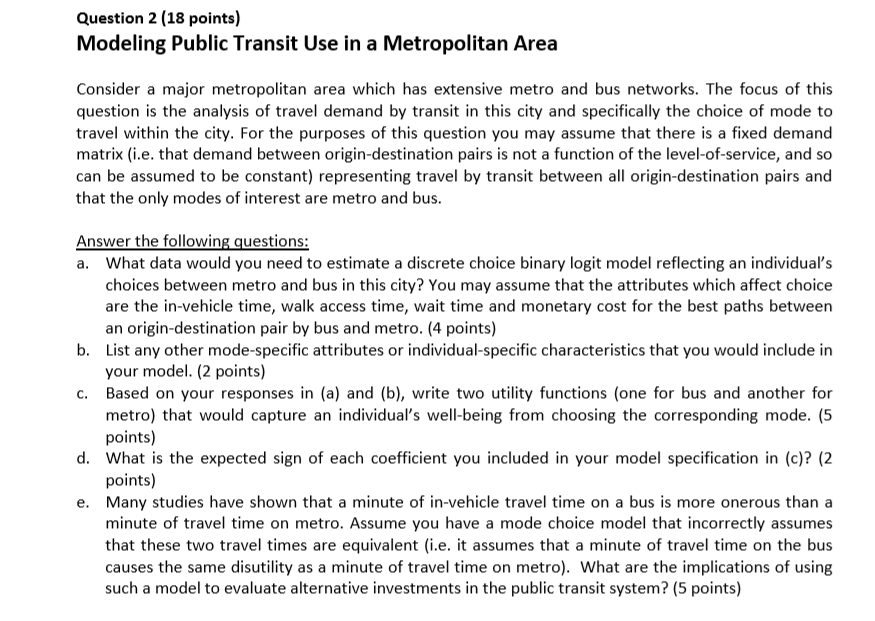
Question 2 (18 points) Modeling Public Transit Use in a Metropolitan Area Consider a major metropolitan area which has extensive metro and bus networks. The focus of this question is the analysis of travel demand by transit in this city and specifically the choice of mode to travel within the city. For the purposes of this question you may assume that there is a fixed demand matrix (i.e. that demand between origin-destination pairs is not a function of the level-of-service, and so can be assumed to be constant) representing travel by transit between all origin-destination pairs and that the only modes of interest are metro and bus. Answer the following questions: a. What data would you need to estimate a discrete choice binary logit model reflecting an individual's choices between metro and bus in this city? You may assume that the attributes which affect choice are the in-vehicle time, walk access time, wait time and monetary cost for the best paths between an origin-destination pair by bus and metro. (4 points) b. List any other mode-specific attributes or individual-specific characteristics that you would include in your model. (2 points) C. Based on your responses in (a) and (b), write two utility functions (one for bus and another for metro) that would capture an individual's well-being from choosing the corresponding mode. (5 points) d. What is the expected sign of each coefficient you included in your model specification in (c)? (2 points) e. Many studies have shown that a minute of in-vehicle travel time on a bus is more onerous than a minute of travel time on metro. Assume you have a mode choice model that incorrectly assumes that these two travel times are equivalent (i.e. it assumes that a minute of travel time on the bus causes the same disutility as a minute of travel time on metro). What are the implications of using such a model to evaluate alternative investments in the public transit system? (5 points) Question 2 (18 points) Modeling Public Transit Use in a Metropolitan Area Consider a major metropolitan area which has extensive metro and bus networks. The focus of this question is the analysis of travel demand by transit in this city and specifically the choice of mode to travel within the city. For the purposes of this question you may assume that there is a fixed demand matrix (i.e. that demand between origin-destination pairs is not a function of the level-of-service, and so can be assumed to be constant) representing travel by transit between all origin-destination pairs and that the only modes of interest are metro and bus. Answer the following questions: a. What data would you need to estimate a discrete choice binary logit model reflecting an individual's choices between metro and bus in this city? You may assume that the attributes which affect choice are the in-vehicle time, walk access time, wait time and monetary cost for the best paths between an origin-destination pair by bus and metro. (4 points) b. List any other mode-specific attributes or individual-specific characteristics that you would include in your model. (2 points) C. Based on your responses in (a) and (b), write two utility functions (one for bus and another for metro) that would capture an individual's well-being from choosing the corresponding mode. (5 points) d. What is the expected sign of each coefficient you included in your model specification in (c)? (2 points) e. Many studies have shown that a minute of in-vehicle travel time on a bus is more onerous than a minute of travel time on metro. Assume you have a mode choice model that incorrectly assumes that these two travel times are equivalent (i.e. it assumes that a minute of travel time on the bus causes the same disutility as a minute of travel time on metro). What are the implications of using such a model to evaluate alternative investments in the public transit system? (5 points)

Step by Step Solution

There are 3 Steps involved in it

1 Expert Approved Answer
Step: 1 Unlock blur-text-image

Question Has Been Solved by an Expert!

Get step-by-step solutions from verified subject matter experts

Step: 2 Unlock
Step: 3 Unlock

Students Have Also Explored These Related General Management Questions!