







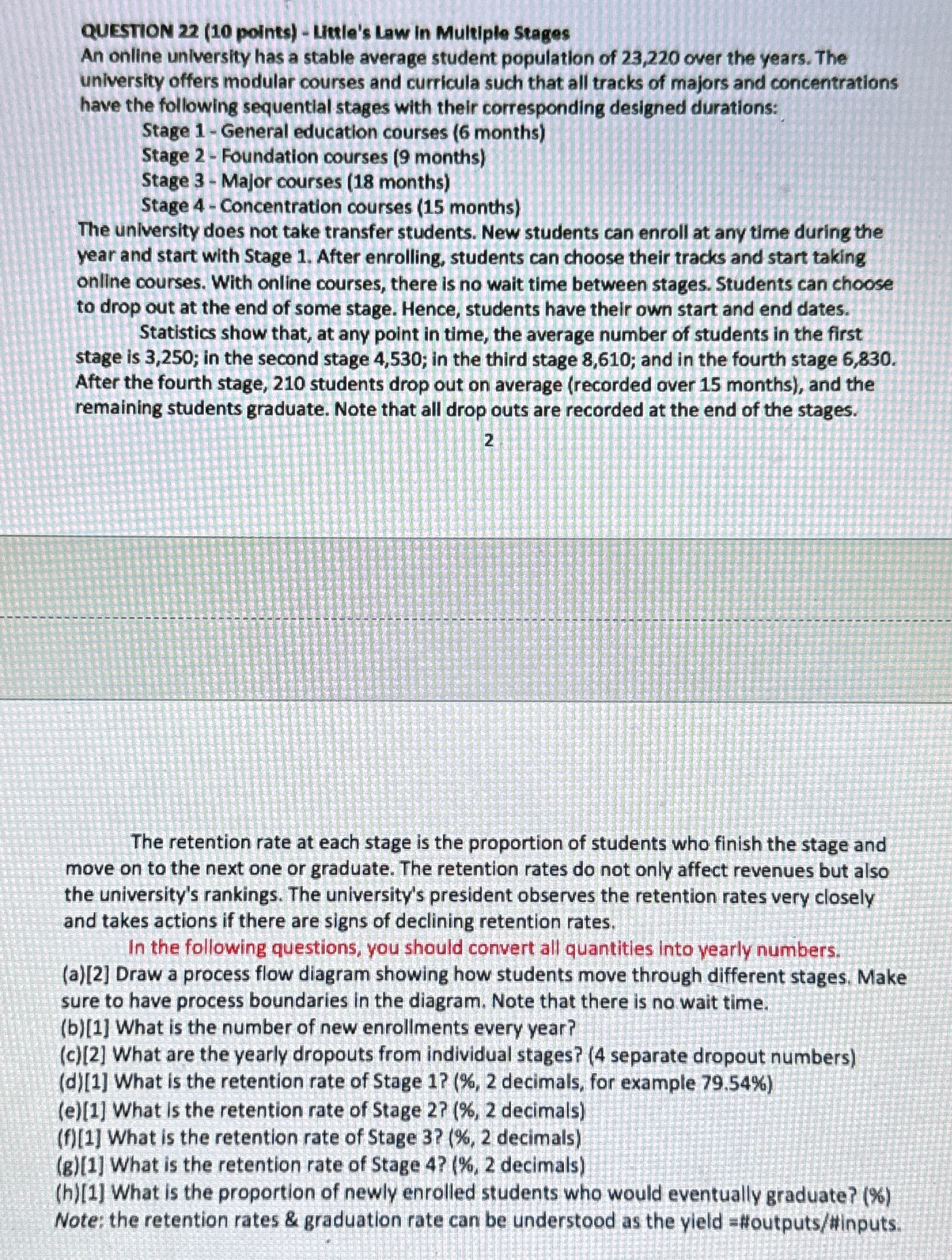
Question: QUESTION 2 2 ( 1 0 points ) - Little's Law in Multiple Stages An online university has a stable average student population of 2
QUESTION points Little's Law in Multiple Stages
An online university has a stable average student population of over the years. The
university offers modular courses and curricula such that all tracks of majors and concentrations
have the following sequential stages with their corresponding designed durations:
Stage General education courses months
Stage Foundation courses months
Stage Major courses months
Stage Concentration courses months
The university does not take transfer students. New students can enroll at any time during the
year and start with Stage After enrolling, students can choose their tracks and start taking
online courses. With online courses, there is no wait time between stages. Students can choose
to drop out at the end of some stage. Hence, students have their own start and end dates.
Statistics show that, at any point in time, the average number of students in the first
stage is ; in the second stage ; in the third stage ; and in the fourth stage
After the fourth stage, students drop out on average recorded over months and the
remaining students graduate. Note that all drop outs are recorded at the end of the stages.
The retention rate at each stage is the proportion of students who finish the stage and
move on to the next one or graduate. The retention rates do not only affect revenues but also
the university's rankings. The university's president observes the retention rates very closely
and takes actions if there are signs of declining retention rates.
In the following questions, you should convert all quantities into yearly numbers.
a Draw a process flow diagram showing how students move through different stages. Make
sure to have process boundaries in the diagram. Note that there is no wait time.
b What is the number of new enrollments every year?
c What are the yearly dropouts from individual stages? separate dropout numbers
d What is the retention rate of Stage decimals, for example
e What is the retention rate of Stage decimals
f What is the retention rate of Stage decimals
g What is the retention rate of Stage decimals
h What is the proportion of newly enrolled students who would eventually graduate?
Note: the retention rates & graduation rate can be understood as the yleld #outputs#inputs.
Step by Step Solution
There are 3 Steps involved in it
1 Expert Approved Answer
Step: 1 Unlock

Question Has Been Solved by an Expert!
Get step-by-step solutions from verified subject matter experts
Step: 2 Unlock
Step: 3 Unlock
 Study Help