







Question: Question 2 ( 2 4 marks ) LABORATORY 1 SAMPLING THEOREM 1 . 0 Objective To verify the Sampling Theorem 2 . 0 Theory Sampling
Question marks
LABORATORY SAMPLING THEOREM
Objective
To verify the Sampling Theorem
Theory
Sampling is defined as measuring the value of an information signal at predetermined
time interval. The rate at which the signal is sampled is known as the sampling rate or
sampling frequency. The types of sampling are natural sampling and flat top sampling.
A continuous time signal can be processed by processing its samples through a
discrete time system. For reconstructing the continuous time signal from its discrete
time samples without any error, the signal should be sampled at a sufficient rate that
is determined by the sampling theorem.
Sampling theorem
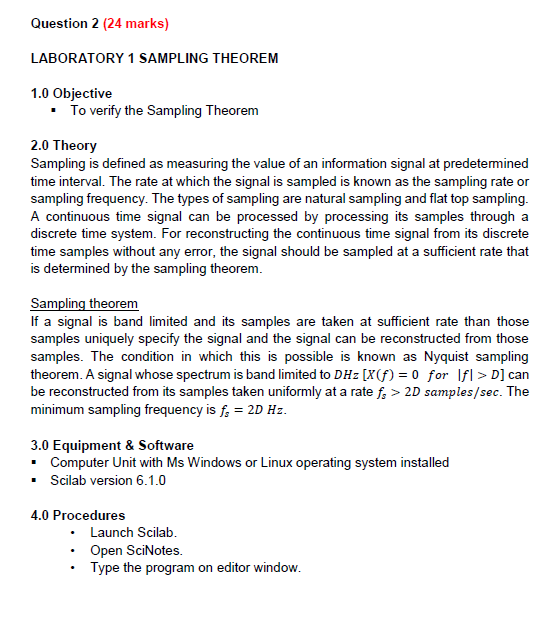
If a signal is band limited and its samples are taken at sufficient rate than those
samples uniquely specify the signal and the signal can be reconstructed from those
samples. The condition in which this is possible is known as Nyquist sampling
theorem. A signal whose spectrum is band limited to for can
be reconstructed from its samples taken uniformly at a rate samples The
minimum sampling frequency is
Equipment & Software
Computer Unit with Ms Windows or Linux operating system installed
Scilab version
Procedures
Launch Scilab.
Open SciNotes.
Type the program on editor window. Source Code:close;
clear;
fminputEnter the input signal frequency:;
kinoutEnter the number of Cycles of input signal:;
AinoutEnter the amplitude of input signal:;
tm:fmfm:kfm;
xmp@subsuptextrmAmp@subsupmathrm pitextrmfm
figure;
a gca;
axlocation "origin";
aylocation "origin";
plottmx;
titleORIGINAL SIGNAL';
xlabelTime;
ylabelAmplitude;
Xgrid
Sampling RateNyquist Ratefm
fnyqfm;
UNDER SAMPLING fs
a gca;
axlocation "origin"; aylocation "origin"; plotdgnnnxn; plotnxnr; titleUnder
Sampling'; xlabelTime; ylabelAmplitude;
legendSampled Signal', 'Reconstructed Signal'; xgrid
NYQUIST SAMPLING fsfnyq; n:fs kfm; xnAoperatornamecospin; figure;
a gca;
axlocation "origin"; aylocation "origin"; plotdgnnnxn; plotnxnr; titleNyquist
Sampling'; xlabelTime; ylabelAmplitude;
leqendSampled Signal', 'Reconstructed Signal'; xgrid
OVER SAMPLING fsfnyqoperatornamecospin; figure;
a gca;
axlocation "origin"; aylocation "origin"; plotdgnnnxn; plotnxnr;titleOver
Sampling'; xlabelTime; ylabelAmplitude;
legendSampled Signal', 'Reconstructed Signal'; xgridSample inputs:
Enter the input signal frequency:
Enter the number of Cycles of input signal:
Enter the amplitude of input signal:
Save the program with filename sce extension.
Execute the program and observe the output or waveforms.
Step by Step Solution
There are 3 Steps involved in it
1 Expert Approved Answer
Step: 1 Unlock

Question Has Been Solved by an Expert!
Get step-by-step solutions from verified subject matter experts
Step: 2 Unlock
Step: 3 Unlock
 Study Help