



Question: Question 2 (20 marks): A government is contemplating an increase from $1 to $1.1 in the toll on a highway that is - at present
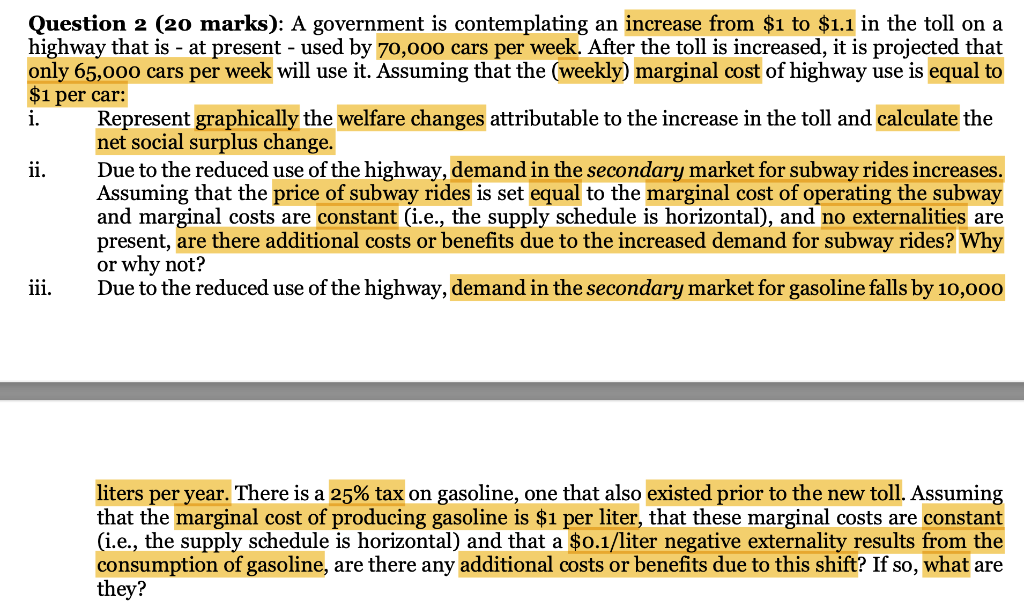
Question 2 (20 marks): A government is contemplating an increase from $1 to $1.1 in the toll on a highway that is - at present - used by 70,000 cars per week. After the toll is increased, it is projected that only 65,000 cars per week will use it. Assuming that the (weekly) marginal cost of highway use is equal to $1 per car: i. Represent graphically the welfare changes attributable to the increase in the toll and calculate the net social surplus change. ii. Due to the reduced use of the highway, demand in the secondary market for subway rides increases. Assuming that the price of subway rides is set equal to the marginal cost of operating the subway and marginal costs are constant (i.e., the supply schedule is horizontal), and no externalities are present, are there additional costs or benefits due to the increased demand for subway rides? Why or why not? iii. Due to the reduced use of the highway, demand in the secondary market for gasoline falls by 10,000 liters per year. There is a 25% tax on gasoline, one that also existed prior to the new toll. Assuming that the marginal cost of producing gasoline is $1 per liter, that these marginal costs are constant (i.e., the supply schedule is horizontal) and that a $0.1/liter negative externality results from the consumption of gasoline, are there any additional costs or benefits due to this shift? If so, what are they
Step by Step Solution
There are 3 Steps involved in it

Get step-by-step solutions from verified subject matter experts