





Question: QUESTION 2 20 points Question 2. Match each term with the correct description A measure of process potential used to describe the portion of the
QUESTION 2 20 points Question 2. Match each term
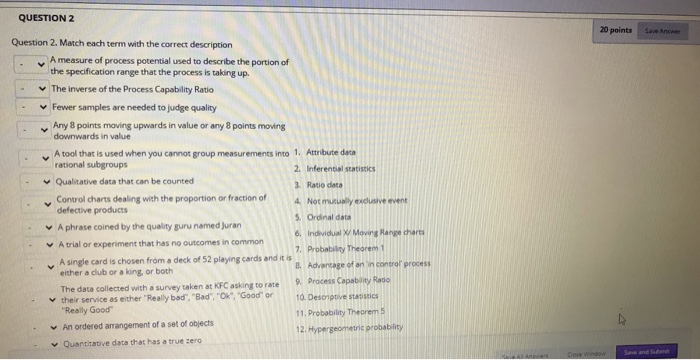
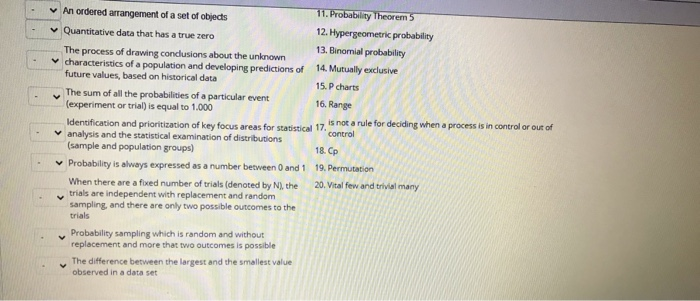
QUESTION 2 20 points Question 2. Match each term with the correct description A measure of process potential used to describe the portion of the specification range that the process is taking up. The inverse of the Process Capability Ratio Fewer samples are needed to judge quality Any 8 points moving upwards in value or any 8 points moving downwards in value A tool that is used when you cannot group measurements into 1. Attribute data rational subgroups 2. Inferential statistics Qualitative data that can be counted 3. Ratio data Control charts dealing with the proportion or fraction of 4. Not muually exclusive event defective products 5. Ordinal data A phrase coined by the quality guru named Juran 6. Individual X Moving Range charts A trial or experiment that has no outcomes in common 7. Probability Theorem 1 A single card is chosen from a deck of 52 playing cards and it is either a club or a king, or both 8. Advantage of an in control process 9. Process Capability Radio The data collected with a survey taken at KFC asking to rate their service as either 'Really bad","Bad", "OK", "Good' or 10. Descriptive statistics "Really Good 11. Probability Theorem 5 An ordered arrangement of a set of objects 12. Hypergeometric probability Quantitative data that has a true zero v Con Wind Save and An ordered arrangement of a set of objects 11. Probability Theorem Quantitative data that has a true zero 12. Hypergeometric probability 13. Binomial probability The process of drawing conclusions about the unknown characteristics of a population and developing predictions of 14. Mutually exclusive future values, based on historical data 15. P charts The sum of all the probabilities of a particular event 16. Range (experiment or trial) is equal to 1.000 Identification and prioritization of key focus areas for statistical 17. is not a rule for deciding when a process is in control or out of control analysis and the statistical examination of distributions (sample and population groups) 18. Cp Probability is always expressed as a number between 0 and 1 19. Permutation When there are a fixed number of trials (denoted by N), the 20. Vital few and trivial many trials are independent with replacement and random sampling, and there are only two possible outcomes to the trials Probability sampling which is random and without replacement and more that two outcomes is possible The difference between the largest and the smallest value observed in a data set V v QUESTION 2 20 points Question 2. Match each term with the correct description A measure of process potential used to describe the portion of the specification range that the process is taking up. The inverse of the Process Capability Ratio Fewer samples are needed to judge quality Any 8 points moving upwards in value or any 8 points moving downwards in value A tool that is used when you cannot group measurements into 1. Attribute data rational subgroups 2. Inferential statistics Qualitative data that can be counted 3. Ratio data Control charts dealing with the proportion or fraction of 4. Not muually exclusive event defective products 5. Ordinal data A phrase coined by the quality guru named Juran 6. Individual X Moving Range charts A trial or experiment that has no outcomes in common 7. Probability Theorem 1 A single card is chosen from a deck of 52 playing cards and it is either a club or a king, or both 8. Advantage of an in control process 9. Process Capability Radio The data collected with a survey taken at KFC asking to rate their service as either 'Really bad","Bad", "OK", "Good' or 10. Descriptive statistics "Really Good 11. Probability Theorem 5 An ordered arrangement of a set of objects 12. Hypergeometric probability Quantitative data that has a true zero v Con Wind Save and An ordered arrangement of a set of objects 11. Probability Theorem Quantitative data that has a true zero 12. Hypergeometric probability 13. Binomial probability The process of drawing conclusions about the unknown characteristics of a population and developing predictions of 14. Mutually exclusive future values, based on historical data 15. P charts The sum of all the probabilities of a particular event 16. Range (experiment or trial) is equal to 1.000 Identification and prioritization of key focus areas for statistical 17. is not a rule for deciding when a process is in control or out of control analysis and the statistical examination of distributions (sample and population groups) 18. Cp Probability is always expressed as a number between 0 and 1 19. Permutation When there are a fixed number of trials (denoted by N), the 20. Vital few and trivial many trials are independent with replacement and random sampling, and there are only two possible outcomes to the trials Probability sampling which is random and without replacement and more that two outcomes is possible The difference between the largest and the smallest value observed in a data set V v

Step by Step Solution

There are 3 Steps involved in it

1 Expert Approved Answer
Step: 1 Unlock blur-text-image

Question Has Been Solved by an Expert!

Get step-by-step solutions from verified subject matter experts

Step: 2 Unlock
Step: 3 Unlock

Students Have Also Explored These Related General Management Questions!