







Question: Question 2. (20 points) Suppose the input to the intersection-enumeration algorithm we covered in class are the segments on slide 22 of the computational geometry
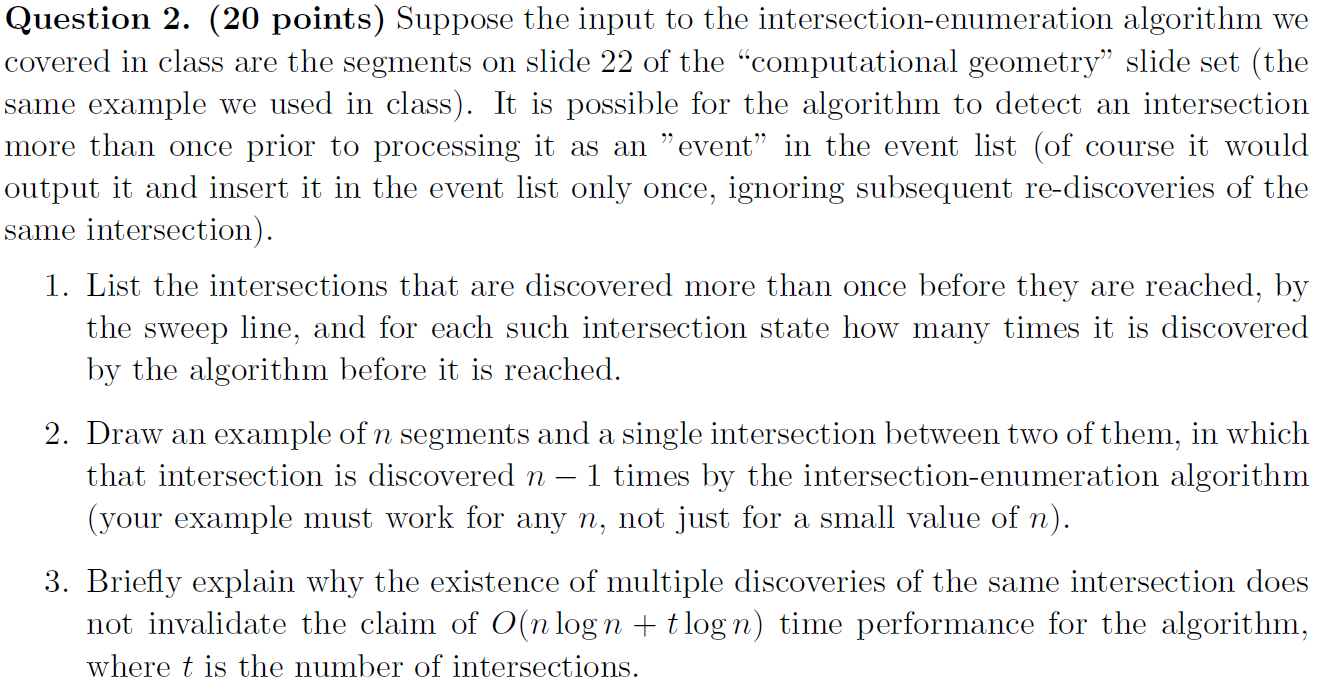
Question 2. (20 points) Suppose the input to the intersection-enumeration algorithm we covered in class are the segments on slide 22 of the computational geometry" slide set (the same example we used in class). It is possible for the algorithm to detect an intersection more than once prior to processing it as an "event" in the event list (of course it would output it and insert it in the event list only once, ignoring subsequent re-discoveries of the same intersection). 1. List the intersections that are discovered more than once before they are reached, by the sweep line, and for each such intersection state how many times it is discovered by the algorithm before it is reached. 2. Draw an example of n segments and a single intersection between two of them, in which that intersection is discovered n - 1 times by the intersection-enumeration algorithm (your example must work for any n, not just for a small value of n). 3. Briefly explain why the existence of multiple discoveries of the same intersection does not invalidate the claim of ((n log n + tlog n) time performance for the algorithm, where t is the number of intersections. Question 2. (20 points) Suppose the input to the intersection-enumeration algorithm we covered in class are the segments on slide 22 of the computational geometry" slide set (the same example we used in class). It is possible for the algorithm to detect an intersection more than once prior to processing it as an "event" in the event list (of course it would output it and insert it in the event list only once, ignoring subsequent re-discoveries of the same intersection). 1. List the intersections that are discovered more than once before they are reached, by the sweep line, and for each such intersection state how many times it is discovered by the algorithm before it is reached. 2. Draw an example of n segments and a single intersection between two of them, in which that intersection is discovered n - 1 times by the intersection-enumeration algorithm (your example must work for any n, not just for a small value of n). 3. Briefly explain why the existence of multiple discoveries of the same intersection does not invalidate the claim of ((n log n + tlog n) time performance for the algorithm, where t is the number of intersections
Step by Step Solution
There are 3 Steps involved in it

Get step-by-step solutions from verified subject matter experts
 Study Help